Your Lawn Has a Brown Stripe and It's Not the Dog: Diagnosing Broken Sprinkler Heads
There's a specific stripe of dead grass that only looks like one thing. Not a dog run, not a fungus, not a shade problem — a clean, rectangular strip of brown running across an otherwise green zone. Sometimes it's a circle. Sometimes it's a triangle. Whatever the shape, it matches the coverage footprint of a sprinkler head that isn't working correctly.
Most homeowners do the wrong thing at this point: they set the controller to run more.
That's not how this works.
Why "Water More" Is the Wrong Answer
Before getting into the diagnosis, let's address this upfront because it's the most expensive mistake people make.
If a zone has 8 heads and one of them is producing a fraction of its rated coverage, running that zone longer does very little for the dry spot. The heads that are working fine will over-saturate their coverage areas — encouraging fungal conditions and wasting water — while the failed head still doesn't cover its footprint.
You can't compensate for a mechanical failure with extra runtime. You fix the mechanical failure.
The pattern we see repeatedly: homeowner notices dry spot in late June, increases controller runtime through July, dry spot persists, August arrives and the brown area is twice as large (now including root stress from under-watering combined with heat), and the call comes in as an emergency.
Fix the coverage problem first. Then adjust the schedule if needed.
The Five Most Common Causes of Dry Spots in a Running System
1. Broken or Cracked Sprinkler Head
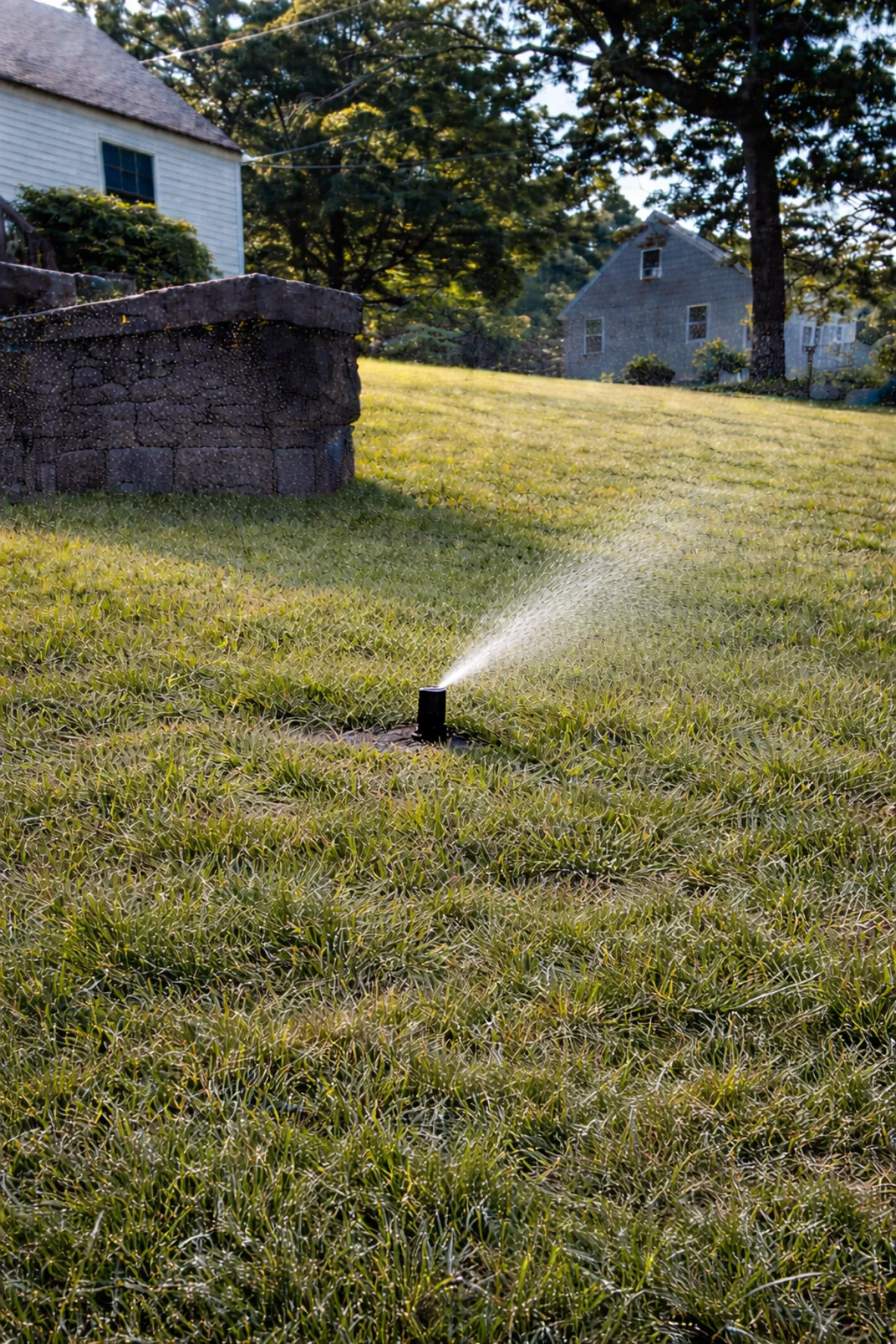
The most common cause, and the easiest to diagnose visually. Walk your zones while they're running and look for:
- A head that isn't popping up fully (spring weak, casing cracked, or stuck with debris)
- A head that sprays in a geiser pattern straight up instead of the designed arc
- A head that's visibly broken, tilted, or flush with the turf
- A head that runs and produces a small trickle at ground level
Heads crack from a few things: foot traffic, lawn mower strikes, a ground-frost shift over winter, or simply age. Hunter and Rain Bird rotors are built to last 10–15 years, but fixed spray heads can start degrading in 7–8 years in a system that's maintained and pressure-tested each spring.
The fix: Replace the head. Most residential rotor heads run $8–$25 in parts. Labor to dig, pull, replace, and adjust is typically $75–$150 per head for a single-head service call, or significantly less per head if we're doing multiple in a visit.
2. Clogged or Worn Nozzle
The head pops up normally, the rotor turns, but the spray pattern is uneven, weaker than normal, or misting rather than streaming. The nozzle — the removable piece that defines the arc and precipitation rate — is clogged with mineral scale, debris, or is simply worn past its service life.
In towns with harder water (Chelmsford, Billerica, and parts of Bedford have moderately hard municipal water), mineral scale on nozzles builds up faster. You'll see a classic arc that's fine on three-quarters of the rotation and then falls off toward the end, leaving a consistent wedge-shaped dry spot.
The fix: Pull the nozzle, rinse or replace it. Nozzles run $2–$8 each. Cleaning takes 5 minutes if you have the tool to pull the rotor stem. It's a reasonable DIY task if you know your system — we'll often clean them during a service visit and flag any that need full replacement.
3. Head Misalignment
The head is intact, the nozzle is clean, but the arc is pointing the wrong direction or the radius trim is set too short. This is common after:
- Winter frost heave that shifted the head position
- A spring startup that wasn't followed by a full head-by-head adjustment
- Sod or regrading work that changed the soil level around heads
- Lawn mower contact that rotated the head in the sleeve
A misaligned rotor throwing toward the driveway instead of the center of the zone is watering asphalt perfectly. Your grass is not impressed.
The fix: Adjustment. On a rotor, arc and radius trim are set with a small key or flathead screwdriver. This is a 2-minute fix per head once you know what to do, and a reasonable DIY task if your system has standard rotors. Pop-up spray heads are less adjustable — many have fixed arc nozzles, so misalignment means a nozzle swap.
We do full head-by-head adjustments as part of spring startups and can do mid-season audits if you find misalignment showing up in July.
4. Low or Inconsistent Zone Pressure
All the heads in a zone pop up, they run, but the coverage is shorter-radius than it should be. The precipitation rate drops, and the outer edges of the zone's coverage pattern go dry while the inner areas near the heads stay fine.
This pattern usually means a pressure problem at the zone level — either a partially closed valve, sediment in the valve diaphragm, or a pressure drop from a main line issue. It can also mean the zone has too many heads for the GPM available — a design problem from the original install that shows up more as the system ages and flow rates slowly decline.
Low zone pressure is harder to diagnose by walking the yard. It requires checking static pressure at the backflow preventer, comparing zone flow rates, and inspecting valves. This one usually needs a service call.
The fix: Valve cleaning or rebuild ($75–$150 parts + labor), zone redesign if heads per zone are too many for available flow (varies by scope), or pressure regulation adjustment at the mainline.
5. Tree Root Intrusion on Lateral Lines
Less common, but worth knowing about in older landscapes: tree roots — especially from mature maples and oaks — can grow into PVC lateral lines over time, partially or completely blocking flow. This typically shows up as a zone where some heads run fine and one or two downstream heads have noticeably reduced pressure.
In established neighborhoods in the Bedford–Concord corridor where irrigation systems are 20+ years old, we find this more often than people expect. The fix is identifying where the root intrusion is (sometimes via camera scope, sometimes by elimination) and replacing the affected section of lateral.
How to Walk Your Zones: A Simple Diagnostic
You don't need tools for this. Just 20 minutes and a willingness to get misted.
Run each zone manually from the controller. Start each zone and walk it while it's running. You're looking for the specific failures listed above — visually checking every head.
Map what you find. Which zone, which head location, what the failure mode looks like. Even rough notes like "Zone 3, back corner head near fence — pops up but doesn't rotate" are useful.
Cross-reference with dry spots. The location of the dry spot should approximately match the coverage gap you found. If they don't match, you may have an underground issue (lateral line problem) rather than a head problem.
Check timing. If all heads seem to be running normally but coverage still looks thin, the issue might be runtime — either the schedule was cut during watering restrictions without compensating on allowed days, or the system was never calibrated for your soil and turf type.
Note anything unusual about pressure. Heads that sputter at the start of a zone, zones that take longer to come to full pressure than others, or heads at the end of a zone that don't reach full arc — these all point to pressure or flow issues worth investigating.
The DIY Line: What's Worth Attempting
Honest answer, because we've seen both the "never call anyone" homeowner and the "I just called you to flip a switch" homeowner:
Reasonable DIY:
- Cleaning a clogged nozzle on a standard pop-up head
- Adjusting arc and radius on a rotor using the manufacturer's tool (usually comes with the head)
- Replacing a standard pop-up spray head if the stem and body are the same manufacturer and spec
- Resetting a tripped zone circuit breaker if your controller has one
Call a professional:
- Anything involving the valve box — valve rebuilds, solenoid replacements, wiring issues
- Broken lateral pipe (requires excavation, gluing PVC, pressure test)
- Pressure-related diagnosis (requires gauges and flow testing)
- Rain sensor replacement or smart controller installation
- Any situation where the failure isn't immediately obvious after a zone walk
The cost of a service call to diagnose and fix a valve issue is almost always less than the cost of a homeowner making it worse with the wrong parts or the wrong approach.
What Repairs Actually Cost
We try to be straightforward about this because vague estimates help no one:
- Broken rotor head (parts + labor): $85–$150 for a single head replacement; lower per-head cost on multi-head visits
- Nozzle cleaning or replacement: often done at no additional charge during a service visit
- Valve rebuild: $100–$175 in most cases; valve replacement is $125–$200 depending on valve size and access
- Lateral pipe repair: $150–$350 depending on depth and length of affected section
- Smart controller installation: $250–$500 depending on zone count, controller model, and any sensor work
- Full zone audit + head adjustment: included in our spring startup service; available as a standalone mid-season service call
For EMI members, parts and repairs come with 10% off, and the first hour of a service call is included.
When You Don't Need to Figure It Out Yourself
If you've walked the system and can't identify the source of the dry spot — or if you've found problems in multiple zones and the scope is beyond what you want to tackle — a service call gets it diagnosed and fixed in one visit the vast majority of the time.
We serve Bedford, Billerica, Burlington, Lexington, Concord, Carlisle, and surrounding communities. Same-week scheduling is usually available.
Ready to get your system handled? Call EMI Irrigation at 781-983-3739 or book online.
Frequently Asked Questions
Q: Can I replace a broken sprinkler head myself? A: For standard pop-up spray heads, yes — as long as you replace it with an identical spec head (same brand, same body height, same nozzle arc). Rotors are a bit more involved but still DIY-able if you're comfortable with a small amount of digging and working with PVC fittings. The risk is mismatching specs, which creates pressure and precipitation rate problems.
Q: How do I know if the problem is a broken head versus a line break? A: A broken head usually produces a visible symptom — it doesn't pop up, sprays erratically, or sits crooked. A line break often shows up as a head with almost no pressure at the end of a zone, combined with unusual wet spots or soft ground in an area that isn't near any head. Line breaks can also cause the zone to never reach full pressure across any head.
Q: How long does a sprinkler head last? A: Quality rotors (Hunter PGP, Rain Bird 5000 series) typically last 10–15 years. Fixed spray heads vary more — some last 15 years, some fail at 7. Annual spring startup inspection is the best way to catch heads that are starting to degrade before they become a mid-July problem.
Q: Is a mid-season irrigation audit worth it? A: If you've noticed coverage issues and you're not sure whether they're head problems, schedule problems, or something else — yes. A zone-by-zone walkthrough takes under an hour for most residential systems and usually identifies everything that needs attention before the second half of the season. It's a much cheaper conversation to have in June than in September.
Ready to get your system handled?
EMI Irrigation — family-owned, serving the greater Billerica area and Southern NH.