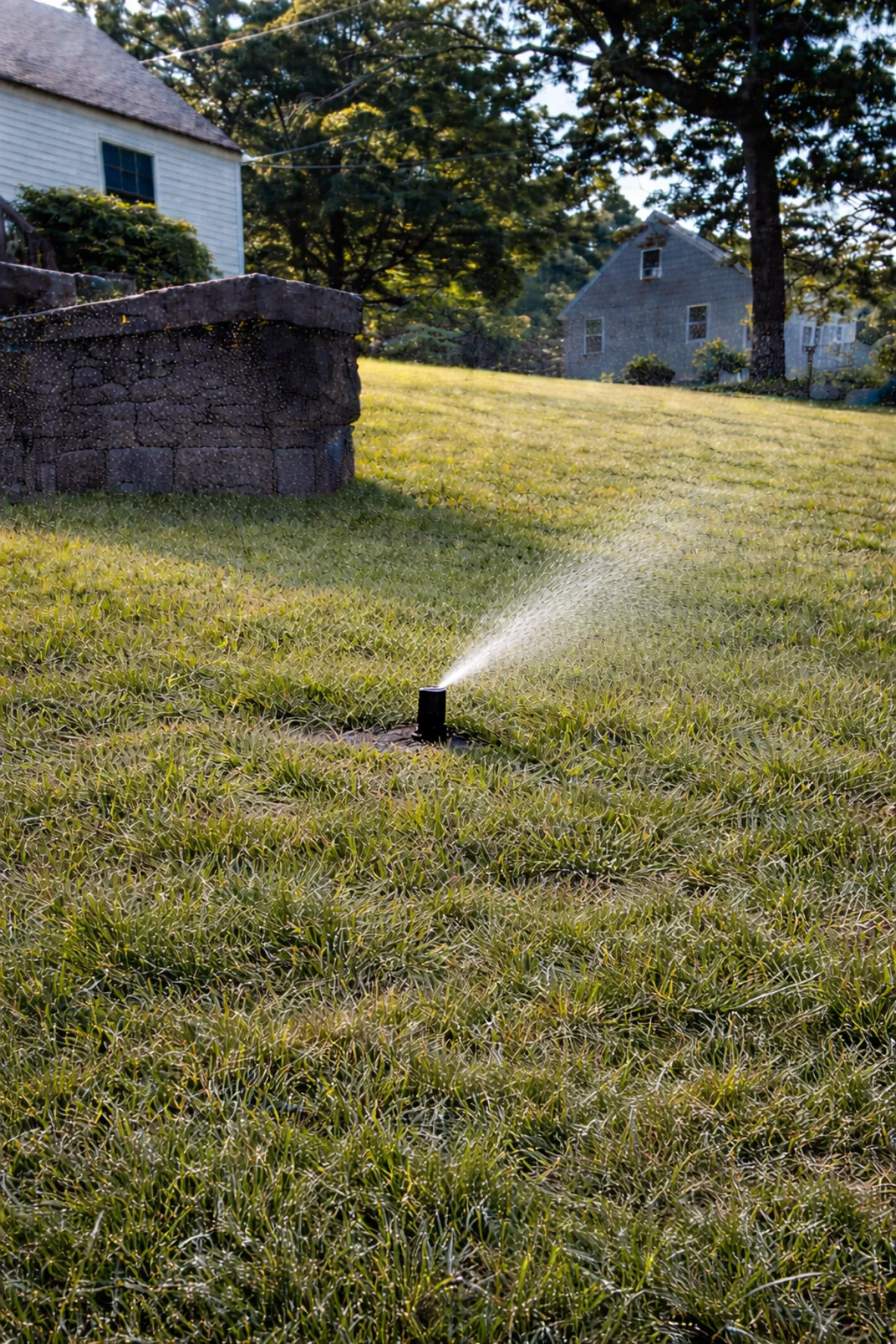
Brown Spots in Burlington? What's Actually Wrong With Your Sprinkler System (And How to Tell)
Burlington has a specific irrigation problem that doesn't get talked about enough: a lot of the residential systems out there were installed during the construction boom of the 2000s and early 2010s, when there was significant new development along the Route 62 corridor and off Winn Street. Those systems are now 15–20 years old. They were installed by builders chasing schedules, not by irrigation specialists designing for longevity. And they're starting to show it.
The symptom is almost always the same: brown patches in an otherwise-irrigated lawn. The assumption is almost always wrong: the system is broken, therefore water more. That assumption costs Burlington homeowners real money every summer.
Burlington's Irrigation Reality: What You're Working With
Before diagnosing, it helps to understand what these systems were built with. Residential irrigation systems installed during tract and development builds in Burlington during the 2000s typically featured:
- Standard 4-inch and 6-inch pop-up rotors and spray heads — often Rain Bird or Hunter mid-grade — that are now at or past their design service life
- Builder-grade valve manifolds located in basement utility rooms or in-ground boxes that haven't been serviced since install
- Backflow preventers that were installed, tested at permit, and then never touched again
- Controller timers (typically the original Rainbird ESP or Hunter ICC) set to a schedule that hasn't been meaningfully updated in a decade
None of that is catastrophically bad design, but 15–20 years of freeze-thaw cycles, root intrusion, foot traffic, and lawn mower contact adds up. The heads that were hitting their coverage arcs perfectly in 2009 are now cracked, misaligned, or running at reduced pressure.
Burlington also has its own municipal water system (not MWRA), which means local aquifer conditions determine restriction levels. Summers that hit dry spells can trigger Burlington DPW restrictions independently of what's happening in neighboring MWRA-supplied towns. If you haven't checked Burlington's current restriction status this season, do it before your next watering cycle.
What's Actually Causing the Brown Spots
In a Burlington mid-2000s development system, the most likely culprits — in rough order of frequency:
Heads Shifted by Frost Heave
Burlington sits on mixed soils — parts of town have fairly sandy fill in newer development areas, others have the clay-heavy glacial till typical of eastern Massachusetts. Clay soils move. They freeze, they swell, they settle. In a system that's been through 15+ winters without inspection, it's common to find heads that are:
- Tilted 10–20 degrees off vertical, throwing their arc sideways
- Heaved up to grade or above, so the mower clips them twice a season
- Sunk below grade, so the popup barely clears the turf and can't complete the arc
A tilted rotor that should be covering 30 feet of lawn in a specific arc is now throwing 40% of its precipitation toward the fence. The turf inside that arc goes brown.
Worn Rotor Nozzles at End of Service Life
The rotors in 15-year-old systems have nozzles that are simply past their service life. The plastic wears, the tolerances widen, and precipitation rate drops. You'll see a pattern where coverage is adequate in the zones near the valve but falls short at the heads farthest from the manifold — those are working hardest against residual pressure drop.
This is a straightforward nozzle replacement job, but it requires someone walking the system with zones running and noting which heads are underperforming, not just swapping parts blindly.
Valve Diaphragm Degradation
The valve diaphragm is a rubber component inside each zone valve that opens and closes with solenoid activation. After 15 years, rubber hardens, develops micro-tears, or accumulates mineral scale from Burlington's water. A partially failing diaphragm doesn't close completely — which wastes water continuously — or doesn't open fully, reducing zone pressure below what the heads need to hit their rated arc.
Signs: a zone that seems to run at 70% of its previous coverage, or one that runs sluggishly and takes longer than usual to pressurize. A valve rebuild (cleaning + new diaphragm kit, $10–$15 in parts) versus a full valve replacement ($40–$80 for the valve body) is the usual call after inspection.
Root Intrusion in Lateral Lines
Burlington has mature landscaping in its older established neighborhoods — plenty of Norway maples, pin oaks, and the occasional silver maple that was planted in the 80s and is now 50 feet tall with a root system that extends well beyond the drip line. In systems that have been in the ground since the early 2000s, it's not unusual to find lateral lines where root intrusion has partially blocked flow.
The diagnostic sign: one or two heads at the far end of a zone with notably weaker output than the heads near the valve, even after cleaning and nozzle checks. If a zone flow test shows significantly lower GPM than the installed heads should require, root intrusion or a buried line compromise is worth investigating.
The One Thing That Makes Brown Spots Worse Every Time
Here's the thing about Burlington summer brown spots that's consistent year after year: homeowners who water more are the ones whose problems compound the fastest.
When a system has coverage gaps from a broken head, increasing runtime saturates the areas that are already getting full coverage while doing almost nothing for the dry spot — the head that's failed or misaligned still doesn't cover its zone. But now the well-covered areas are wet enough to encourage fungal conditions (dollar spot, brown patch), which looks like drought stress but is actually overwatering damage. It's a convincing mimicry, and it sends homeowners further in the wrong direction.
The correct sequence: diagnose the mechanical failure → fix it → re-evaluate whether the schedule needs adjustment. In that order.
A Practical Walk-Through for Burlington Homeowners
If you've got brown spots and want to understand what you're dealing with before calling:
During zone operation (run each zone manually):
- Is every head in the zone popping up fully? Partially risen heads are failing.
- Is every head completing its full arc, or does any rotor stop or reverse prematurely?
- Are there any heads producing a geyser pattern (cracked casing letting water out at the base)?
- Does the zone pressure seem consistent across all heads, or do the last 2–3 heads in the sequence show weaker output?
After each zone:
- Note which zone number corresponds to which coverage area
- Mark any heads with observable problems (use a flag or just a phone photo with location)
Cross-referencing:
- The dry spot should correspond to the coverage gap you found. If it doesn't — if the dry spot is in an area where heads look fine but the lawn is still brown — look for signs of wet ground in unexpected places (soft spots, unusually green grass in a strip adjacent to the dry area), which may indicate a broken lateral.
What Repairs Cost in Burlington
For systems in the 15–20 year age range, here are realistic numbers:
Single rotor head replacement: $85–$150 (parts + labor for one head, one trip) Multi-head replacement visit: lower per-head cost when multiple heads are done together — it makes sense to do a full zone at once if several are failing Valve rebuild: $100–$175 — reasonable fix for a sluggish zone Valve replacement: $150–$225 depending on valve size and access Lateral line repair (6–12 inch section): $150–$300 Full system audit and head adjustment: typically 1.5–2.5 hours labor for a standard 6–10 zone Burlington residential system Smart controller upgrade: $250–$500 installed — particularly relevant for systems still running original 2000s-era timers
EMI members get 10% off all parts and repairs, plus priority scheduling when the phone lines are backed up in July.
Burlington Service Area
We've worked on systems throughout Burlington — off Winn Street, Cambridge Street, Francis Wyman Road, and the neighborhoods west toward the Landlocked Forest. We know the builder-grade systems that went into a lot of the post-2000 construction, and we know what they need at this stage of their service life.
If you're looking at dry spots that didn't respond to schedule changes, or if your system is pushing into its second decade without a thorough inspection, a service visit is the right call before the peak of summer.
Ready to get your system handled? Call EMI Irrigation at 781-983-3739 or book online.
Frequently Asked Questions
Q: My Burlington home was built around 2005. Is the irrigation system still worth repairing or should I replace it? A: Most systems from that era have solid bones — the mainline PVC and valve manifold can last 30+ years. What typically needs attention at 15–20 years is the heads, nozzles, and valve diaphragms. A full system replacement is rarely necessary unless there's significant lateral line damage or the original zone layout was poorly designed. A service visit will tell you whether targeted repairs make sense or whether specific zones need redesign.
Q: Does Burlington have outdoor watering restrictions this summer? A: Burlington runs its own municipal water system (not MWRA), so restrictions are issued by Burlington DPW based on local conditions. Check Burlington's DPW website or call them directly for current status — restrictions can change within a season depending on rainfall and usage levels.
Q: How often should a 15-year-old system be serviced? A: Annually at minimum — spring startup every year to pressurize, check heads, and adjust coverage, plus winterization in October or November. At 15 years, a full head-by-head inspection each spring becomes more important because age-related failures start happening more frequently. An EMI membership covers both seasonal services plus a service call, which is the most cost-effective structure for older systems.
Q: One zone in my Burlington system makes a loud humming noise when it runs. Is that a problem? A: Yes. A humming solenoid or valve body is typically a sign of debris in the valve diaphragm or a solenoid that's starting to fail electrically. It's not an emergency, but it's the kind of thing that turns into a failed zone mid-July if ignored. Get it looked at during a service visit.
Ready to get your system handled?
EMI Irrigation — family-owned, serving the greater Billerica area and Southern NH.