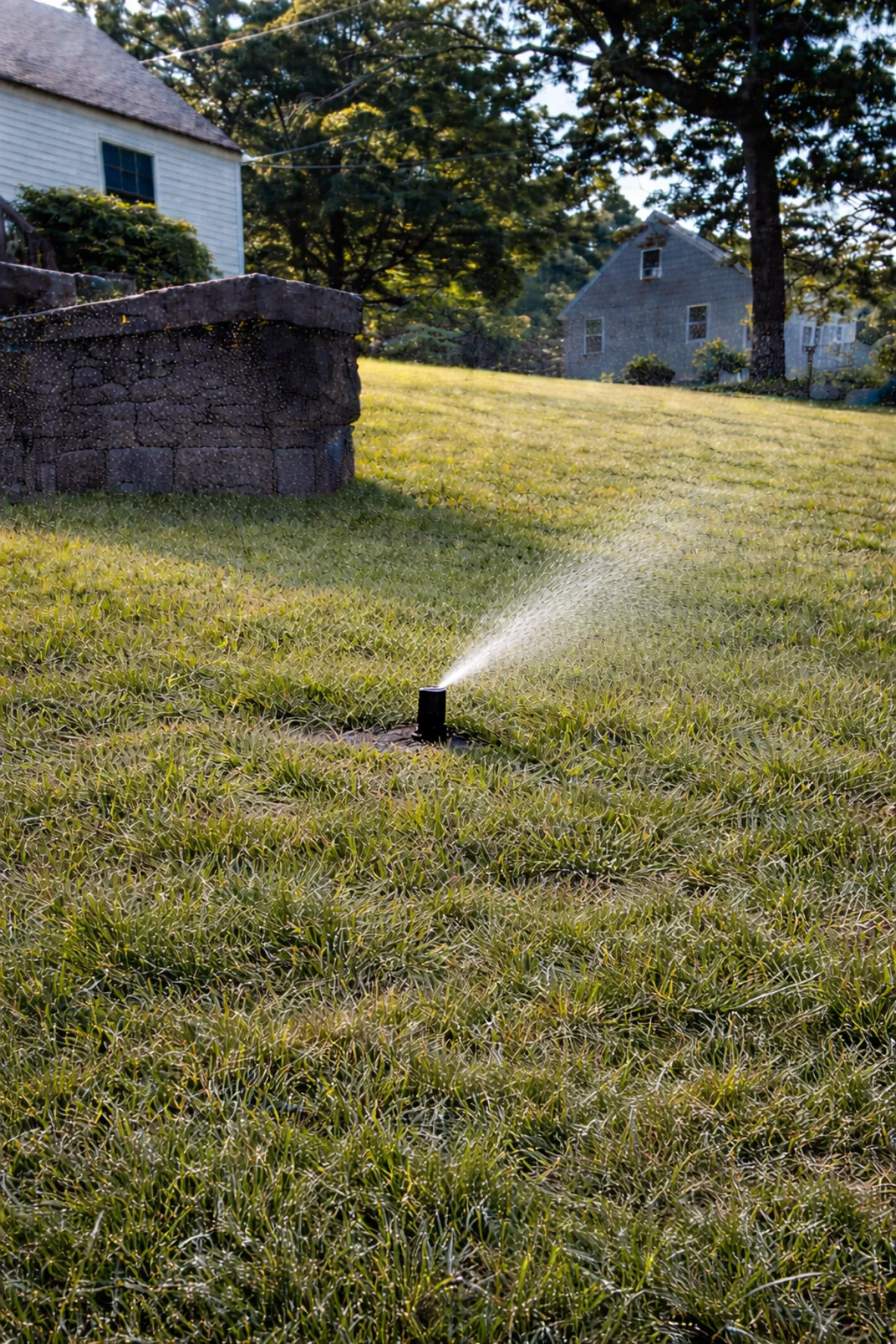
Fall Irrigation Prep in MA — The Homeowner Checklist Before the First Freeze
Every fall I get the same call. "Hey Nick, my neighbor already blew out his sprinklers and it's still September. Am I behind?" No. Your neighbor is early. And if he used a shop vac instead of a compressor, he's also wrong.
(I once watched a guy in Tewksbury hook up a leaf blower to his blowout port. The heads spat leaves for ten minutes. He called it a success. His backflow preventer called it a disaster.)
TL;DR: Fall irrigation prep in Massachusetts starts in mid-September and wraps up before the first hard freeze — usually mid-November in Middlesex County. There are things you can do yourself (shut off the water, drain the backflow, adjust the controller) and one thing you should not do yourself (the compressed-air blowout). A professional winterization runs $100–$150 for a standard residential system. Skipping it risks $400–$800 in freeze damage.
When to start fall irrigation prep in Massachusetts
The calendar matters more than the thermometer. In Middlesex County — hardiness zone 6a — the average first frost hits mid-October. But a light frost will not crack your pipes. What cracks pipes is a hard freeze: below 28°F for multiple consecutive nights. That usually arrives in early to mid-November.
Here is the timeline I follow for my own customers:
Mid-September to early October: Walk the system. Run each zone for two minutes. Note heads that are tilted, clogged, or not popping up. Fix the mechanical problems now, while the ground is soft and scheduling is easy. Waiting until November means competing with every other homeowner in Billerica who suddenly remembered they have sprinklers.
October: Shut off the irrigation water supply. Close the isolation valve. Drain the backflow preventer — open both test cocks and the two ball valves to let water gravity-drain. If you have a smart controller, switch it to "off" or "winter" mode. If you have an old-school timer, unplug it.
Late October to mid-November: Professional compressed-air blowout. This is the step that actually prevents freeze damage. Everything else is preparation for this.
The fall irrigation prep checklist
Here is what I walk through on every fall prep visit. You can handle the first four items yourself. Item five is where a compressor and some experience come in.
1. Run each zone and inspect
Turn on each zone for two minutes. Walk it. You are looking for:
- Heads that do not pop up. Debris, a cracked cap, or a stuck wiper seal. Most are a $10 fix if you catch them before winter.
- Heads tilted by frost heave. In sandy soil — Tewksbury, parts of Billerica, Dracut — heads settle and tilt every winter. A head that sat flush in May might be half an inch low by October. That half inch means the spray hits the grass in front of the head instead of arcing over it. You get brown patches next summer and blame the system. The head just needs raising — $75–$120.
- Geysering at the base. A cracked fitting or a loose riser. Water shooting straight up instead of spraying out. Fix it now or dig it up frozen in April.
- Rotors stuck mid-arc. Usually a worn gear assembly. The rotor hits one spot and stops. That spot gets flooded. The rest of the zone gets nothing.
Write down what you find. If you call us for winterization, we will check all of this too — but if you spot problems early, we can fix them in the same visit instead of scheduling a second trip in November.
2. Shut off the irrigation water supply
Find the isolation valve — it is usually near your water meter, before the backflow preventer. Turn it off. This stops fresh water from entering the system. If you skip this and the blowout misses a line, that line fills back up overnight and freezes.
Some homes in Middlesex County have a dedicated irrigation meter. If yours does, the shutoff is at that meter. If you share the main house meter, the irrigation shutoff might be a ball valve on the line that branches off toward the backflow.
Rule of thumb: if you do not know where this valve is, find it before October. Do not wait until the morning of the blowout to discover it is buried under mulch.
3. Drain the backflow preventer
Your backflow preventer is that brass assembly near the water meter with two test cocks and two handle valves. To drain it:
- Close both handles (turn perpendicular to the pipe).
- Open both test cocks (the small screws on the side — quarter turn).
- Open the two ball valves to 45 degrees.
- Let it drain.
Water will drip out. That is normal. If water gushes, you forgot step one. The backflow is the most freeze-vulnerable part of the system because it sits above ground, exposed to wind and cold. A freeze-cracked backflow costs $400–$800 to replace. Draining it takes three minutes.
4. Adjust or shut down the controller
If you have a smart controller — Hunter Hydrawise, Rachio, Rain Bird ESP-TM2 — switch it to "off" or "winter" mode. It will stop running schedules but keep your settings saved for spring. If you unplug a smart controller, you lose the programming and have to set it up again in April.
If you have an old-school timer — the kind with the dial and the plastic tabs — unplug it. There is no "winter mode." It will try to run zones that have no water in them, which is harmless but annoying when you hear the solenoids clicking at 6 AM in December.
5. Professional compressed-air blowout
This is the step that actually protects your system. We hook a commercial compressor — 50 to 80 PSI, 25 to 40 CFM — to the blowout port and run through each zone, one at a time, until the heads spit air instead of water. The whole job takes 20 to 45 minutes depending on how many zones you have.
Why you should not do this with a home compressor: A typical shop compressor puts out 3 to 5 CFM. That is not enough volume to push water out of 200 feet of buried PVC pipe. You will see air coming out of the heads and think you are done. You are not. There is still water sitting in the low spots, the tee fittings, and the ends of each lateral line. That water freezes, expands, and cracks the pipe. You discover the damage in April when you turn the system on and your lawn turns into a swamp.
Why you should not skip this step: Massachusetts winters push pipes and fittings apart. The frost line is 36 to 40 inches here, but most irrigation lines are buried at 8 to 12 inches. Every winter, the ground freezes, expands, and shifts. By the third or fourth winter without a proper blowout, the PVC glue joints start to separate. A blowout removes the water before it can freeze and expand.
The blowout window in Middlesex County is early October through mid-November. We start booking in August. By late October, we are running six to eight jobs a day. If you wait until the first frost warning, you are competing with 300 other homeowners for the same three-day window.
What fall prep costs
For a standard residential system in Middlesex County:
| Service | Cost | What is included |
|---|---|---|
| Professional winterization (blowout) | $100–$150 | Compressed-air blowout of all zones, backflow drain-down, controller set to winter mode |
| Winterization + mid-season check (bundled) | $195–$275 | Winterization plus a spring start-up visit |
| EMI 1-Year Membership | $410 | Winterization + spring start-up + mid-season check-in + service call (first hour free) + 10% off parts |
| Backflow replacement (if freeze-damaged) | $400–$800 | New backflow preventer, installed |
The membership math works out for systems older than 10 years. If your system is under 5 years old, paying per service is usually cheaper. If your system is 12-plus years old, the membership pays for itself by the second seasonal service because failures cluster around seasonal transitions — spring start-up and fall winterization are when the old hardware shows its age.
When not to call us
If your system is brand new — installed this year or last year — and you have a smart controller with a freeze sensor, you can probably handle the fall prep yourself. The controller will shut down automatically when temperatures drop. The backflow drain is a three-minute job. And the pipes are new enough that a single missed blowout will not crack them.
If you have a drip irrigation system (the black tubing with emitters) instead of pop-up heads, the blowout is simpler. Drip lines are flexible and more forgiving of residual water. You still need to drain the backflow and shut off the supply, but the compressed-air step is faster and less critical.
And if you are selling the house this winter and do not care what happens in April, skip it. I mean that sincerely. Just do not blame the next owner's contractor when the backflow is cracked.
Signs your system needs attention before winter
Some problems are easier to fix in October than in April:
- A zone that will not turn off. Stuck valve. Running water in December means an ice rink by morning. Shut off the main supply and call us.
- Low pressure on one zone but not others. Partially closed valve, clogged filter, or a lateral line leak. Left over winter, the leak gets worse as freeze-thaw cycles shift the pipe.
- A backflow preventer that drips constantly. Worn check valve. Not an emergency, but it will get worse over winter and you will have a puddle by the meter in spring.
- Controller showing an error code. Wiring fault, communication error, or a dead backup battery. The controller is the brain — if it is confused in October, it will be useless in April.
FAQ
Q: When should I winterize my sprinkler system in Massachusetts?
A: Mid-October through mid-November in Middlesex County. The target is before the first hard freeze — below 28°F for multiple nights. The average first hard freeze in Eastern Massachusetts is early to mid-November. Book in September or early October to guarantee your preferred date.
Q: Can I winterize my sprinkler system myself?
A: The water shutoff, backflow drain, and controller shutdown — yes, those are straightforward. The compressed-air blowout requires a commercial compressor (50–80 PSI, 25–40 CFM). A home shop compressor does not have enough volume to clear the lines properly. Residual water in the low spots freezes and cracks pipes. A professional blowout costs $100–$150 and takes 20 to 45 minutes.
Q: What happens if I skip winterization?
A: Water left in the pipes freezes, expands, and cracks PVC fittings, valve bodies, and the backflow preventer. Repairs range from $150 for a single cracked fitting to $800 for a freeze-damaged backflow. The damage is not always visible until spring start-up, when you turn the system on and discover leaks underground.
Q: Is a sprinkler blowout the same as winterization?
A: Yes, in practical terms. Winterization is the full process: water shutoff, backflow drain, controller shutdown, and compressed-air blowout. The blowout is the most important step — it removes water from the buried pipes. Some contractors use the terms interchangeably.
Q: How much does sprinkler winterization cost in Middlesex County?
A: $100 to $150 for a standard residential system (4 to 10 zones). Larger systems over 10 zones may add $15 per additional zone. EMI offers a 1-Year Membership at $410 that includes winterization, spring start-up, mid-season check-in, and a service call.
Q: Should I drain my backflow preventer before the blowout?
A: Yes. Drain the backflow first — close both handles, open both test cocks, and let it gravity-drain. This protects the most freeze-vulnerable part of the system before the technician arrives. If you forget, we will drain it during the blowout visit, but having it done ahead of time means less water sitting in the assembly overnight.
Q: Can I use a leaf blower or shop vac to blow out my sprinkler lines?
A: No. A leaf blower produces high volume at very low pressure — maybe 1 to 2 PSI. You need 50 to 80 PSI at 25 to 40 CFM to push water out of buried PVC pipe. A shop vac pulls air out, which is the wrong direction. Both will leave water in the lines. Both will give you a false sense of security. Both will result in freeze damage.
Q: Do smart controllers handle winterization automatically?
A: No. Smart controllers adjust watering schedules based on weather — they reduce run times in cool, wet weather and increase them in hot, dry weather. They do not drain water out of pipes. The controller and the freeze protection are two different problems. Your smart phone is also smart. It still will not survive a swimming pool.
Ready to schedule? Text or call EMI at 781-983-3739. We winterize systems across 50-plus towns in Middlesex County and into the Lakes Region in New Hampshire. Book in September or October to get your preferred date — November slots fill fast.
Nearby: Sprinkler Winterization Cost in Massachusetts · Sprinkler Blowout Cost Near Me · Spring Irrigation Startup Cost · Lawn Aeration in Massachusetts · How Many Sprinkler Zones Do I Need
External resources: Hunter Industries Winterization Guide · Irrigation Association — Winterization Best Practices
Ready to get your system handled?
EMI Irrigation — family-owned, serving the greater Billerica area and Southern NH.