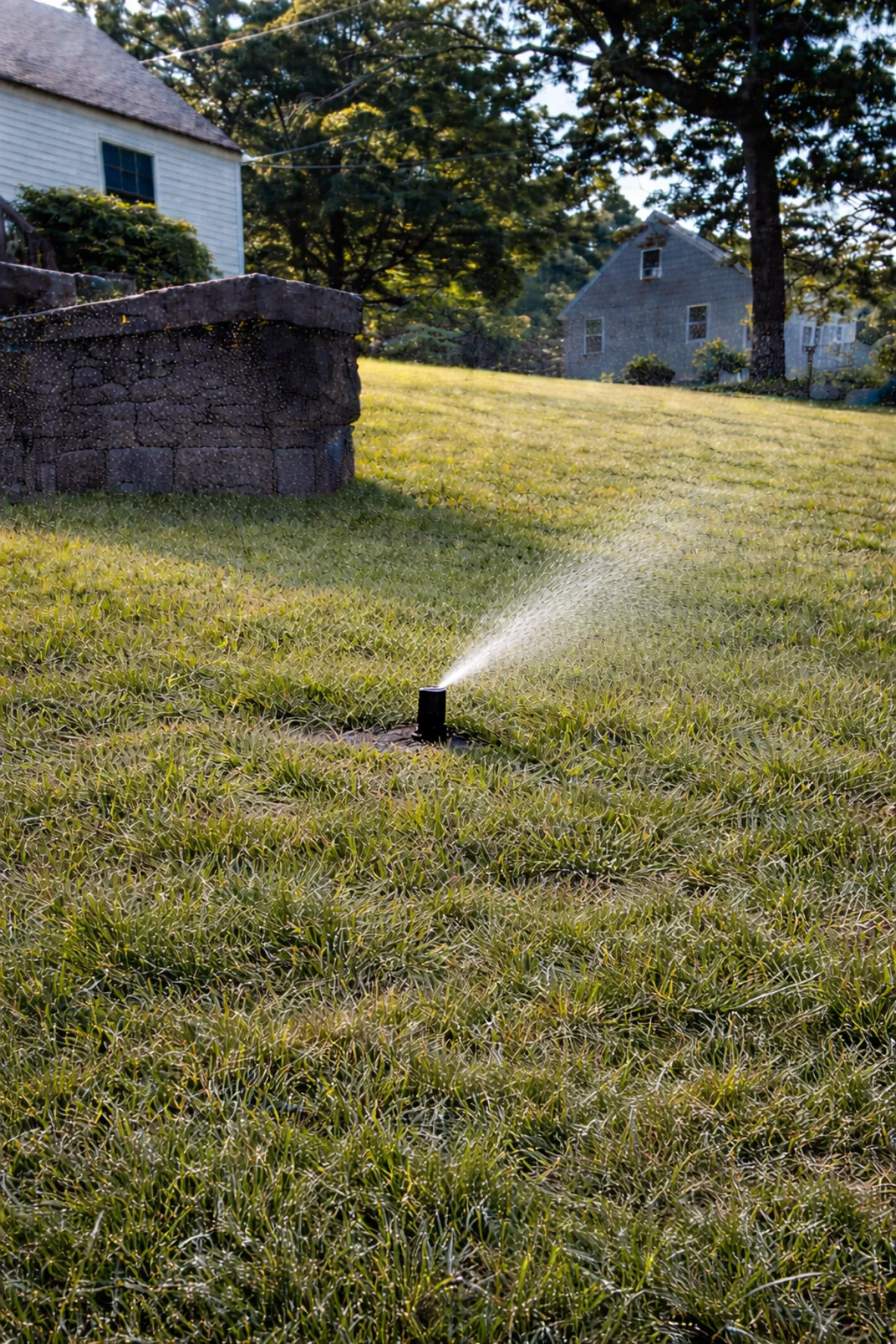
How Many Sprinkler Zones Do I Need? Middlesex County Answer
How many sprinkler zones you need is not a question about your lawn. It's a question about your plumbing. Specifically: how much water can your house push through a pipe at one time, and how many sprinkler heads can that water feed before the pressure drops and the last head on the line starts misting instead of spraying. (If your sprinklers are misting, they're not watering. They're just making the lawn feel vaguely damp and confused.) I've been designing zone layouts across Middlesex County since 2000, and the most common mistake I see is someone counting square footage when they should be measuring flow rate.
Think of it like a restaurant. The kitchen can cook 10 meals at once. You have 40 guests. You need at least 4 seatings, not because the dining room is too small, but because the kitchen has limits. Your water supply is the kitchen. The sprinkler heads are the guests. The zones are the seatings.
TL;DR
Most Middlesex County residential lots (quarter-acre to half-acre) need 5 to 8 zones. The number depends on your water flow rate (GPM), water pressure (PSI), lot shape, and plant types, not just lot size. Each zone runs 3 to 5 heads and uses $400–$700 in materials and labor. A 6-zone system typically costs $4,500–$6,500 installed. For the full pricing breakdown, see our sprinkler installation cost guide.
If you're planning a DIY installation, zone design is the step most people get wrong. The pipe layout and trenching are the easy parts. Matching zone capacity to your water supply is where things go sideways.
The four things that determine zone count
1. Flow rate (the one that actually matters)
Your flow rate is how many gallons per minute (GPM) your water supply delivers. This is the hard limit on how many heads each zone can run.
How to measure it: Run a hose bib at full blast into a 5-gallon bucket. Time how long it takes to fill. Divide 5 by the minutes. That's your GPM. A typical Middlesex County home on municipal water delivers 8–14 GPM. Well-fed properties in Groton, Carlisle, and parts of Westford might see 5–8 GPM depending on the pump.
Why it matters: A pop-up spray head uses 2–4 GPM. A rotary head uses 3–6 GPM. If your supply delivers 10 GPM, you can run 3 spray heads or 2 rotary heads per zone before pressure drops. Exceed the flow rate and the heads at the far end of the zone mist instead of spraying. The lawn looks watered. It isn't.
2. Pressure (PSI)
Pressure determines how far each head throws water. A head rated for a 15-foot radius at 45 PSI only reaches 12 feet at 30 PSI. Lower pressure means more heads per zone to cover the same area, which means more zones total.
Most Middlesex County homes have 40–60 PSI at the hose bib. That's fine for standard pop-up and rotary heads. Below 40 PSI, you need pressure-compensating nozzles or a booster pump. Above 65 PSI, you need a pressure regulator to avoid blowing fittings.
3. Lot shape and size
A perfect square lot is the easiest to zone. Four heads in a square pattern, one zone, done. Real lots aren't squares. They're L-shaped, pie-shaped, narrow strips along a fence, wide open in front, cramped in back. Every odd corner needs its own head. Every narrow strip might need a dedicated zone with strip-spray nozzles.
Rough sizing guide for Middlesex County:
| Lot size | Typical zones | Why |
|---|---|---|
| Quarter-acre (10,000 sqft) | 4–5 | Small, compact, fewer heads needed |
| Third-acre (14,000 sqft) | 5–6 | Standard colonial lot |
| Half-acre (20,000 sqft) | 6–8 | More area, more corners, often side yards |
| Three-quarter-acre+ | 8–12 | Large lots, multiple garden zones, mixed terrain |
These assume municipal water at 8–12 GPM. Well-fed properties often need more zones because the flow rate is lower.
4. Plant types
Lawn, garden beds, and trees need different amounts of water. A zone that waters the lawn at 1 inch per week will drown a garden bed. A zone sized for garden beds won't reach the far edge of the lawn.
This is why most designs separate:
- Turf zones (lawn): pop-up spray or rotary heads, full coverage
- Garden bed zones: drip irrigation or low-volume spray heads
- Tree/shrub zones: drip or bubbler heads, deep watering
Mixing plant types in one zone is the design equivalent of putting a cactus and a fern in the same pot. Technically possible. Practically a disaster.
The Burlington lesson (why zone design matters)
Burlington had a residential construction boom in the 2000s. Those systems were installed by framers chasing schedules, not irrigation designers calculating flow rates. Standard approach: 4 zones, cover the front and back lawn, move on. The problem is that a 4-zone system on a half-acre lot means each zone runs 6–8 heads. On a 10 GPM supply, that's double what the water can actually feed.
Fifteen years later, those systems show the same pattern: the heads closest to the valve throw a full arc, the heads at the far end mist. The homeowner sees green near the valve box and brown at the property line. They assume the system isn't running long enough. They extend the run time. The green parts get greener. The brown parts stay brown. The water bill climbs.
The fix isn't running longer. It's splitting oversized zones into properly sized ones. Two zones where there was one. Each running 3–4 heads instead of 7–8. Same water supply, same lawn, different design. The difference shows up in about two weeks.
How to estimate your zone count
Here's the math, simplified:
Step 1: Measure your flow rate. Run a hose bib into a 5-gallon bucket. Time it. Divide 5 by the minutes = GPM.
Step 2: Check the GPM rating of the heads you want. Standard pop-up spray: 2–4 GPM each. Rotary (Hunter PGP, Rain Bird 5000): 3–6 GPM each.
Step 3: Divide flow rate by head GPM. That's your max heads per zone. Example: 10 GPM supply ÷ 3 GPM per rotary head = 3 heads per zone (round down, always).
Step 4: Count the heads you need. Walk the property. Every corner, every strip, every area that needs coverage gets a head. A half-acre rectangular lot might need 20–25 heads.
Step 5: Divide total heads by heads per zone. 24 heads ÷ 3 per zone = 8 zones.
This is the simplified version. A real design also accounts for precipitation rate matching (every head in a zone should deliver the same inches per hour), pressure loss through pipe runs, and elevation changes. But for estimating purposes, the flow-rate math gets you in the ballpark.
The honest answer for common Middlesex County lots
I've designed systems on every type of lot in this county. Here's what I typically see:
Billerica colonial, quarter-acre, municipal water: 4–5 zones. Compact lot, standard shape, 10–12 GPM supply. Front lawn, back lawn, two side strips, maybe a garden bed zone.
Tewksbury ranch, third-acre, municipal water: 5–6 zones. Longer lot, sandy soil that needs shorter cycles (more zones with less run time per zone). The iron in Tewksbury water clogs nozzles faster, so we size zones conservatively.
Chelmsford colonial, half-acre, mixed soil: 6–8 zones. The clay side holds water (longer cycle, fewer zones). The sandy side drains fast (shorter cycle, more zones). Same lot, different zone strategies on each half.
Bedford hilltop, half-acre, well water: 7–9 zones. Well flow rate is usually 5–8 GPM, lower than municipal. More zones, fewer heads per zone. We always do a flow test before designing.
Lexington colonial, third-acre, MWRA water: 5–6 zones. MWRA pressure is consistent (good) but watering restrictions mean the controller programming matters as much as the zone count. A smart controller handles the odd/even scheduling automatically.
When more zones is actually better
There's an instinct to want fewer zones. Fewer valves, less pipe, lower cost. But more zones with fewer heads each delivers better coverage. Here's why.
Each head in a zone throws a fixed amount of water per minute. Three heads at 3 GPM each use 9 GPM, a comfortable margin on a 10 GPM supply. Six heads at 3 GPM each use 18 GPM, way over the supply capacity. The first three heads get full pressure. The last three get whatever's left. Coverage is uneven by design.
Smaller zones also let you tailor watering schedules. The south-facing lawn zone bakes in July and needs 30 minutes. The north-facing side stays cool and needs 15. The garden bed zone needs 10 minutes of drip. One controller, three different schedules, each zone getting exactly what it needs.
This is the opinion I'll defend with numbers: the cheapest installation is rarely the cheapest five-year outcome. A $2,800 system with 4 oversized zones uses 25–35% more water than a $4,500 system with 7 properly sized zones. On a Middlesex County water bill, that gap pays for the difference in two to three seasons. By year five, the cheaper system has cost you more.
When you probably don't need a new zone
If you're adding a small garden bed (under 200 square feet), you can sometimes tap into an existing zone with a pressure-compensating drip line instead of building a whole new zone. If your controller has unused stations and the mainline passes near the new area, adding a zone is straightforward. If neither of those is true, a new zone means trenching a new pipe run from the manifold. Doable, but it's a real project, not a weekend add-on.
And if your system is under 5 years old and working well, zone count isn't something to worry about. The number was set during installation based on your water supply, and that hasn't changed.
The honest pricing band
| Zones | Typical lot | EMI price range |
|---|---|---|
| 4 zones | Small quarter-acre | $3,000–$4,500 |
| 6 zones | Average third-acre | $4,500–$6,500 |
| 8 zones | Larger half-acre | $5,500–$8,000 |
| 10–12 zones | Large three-quarter-acre+ | $7,000–$10,000+ |
Each additional zone adds roughly $400–$700 (valve, wiring, pipe, heads, labor). The mainline, backflow preventer, and controller are shared costs that don't scale linearly, which is why per-zone cost drops slightly on larger systems.
For a detailed breakdown of what affects installation cost, see our cost for sprinkler system installation guide. If you want to understand what a mid-season system check includes, our sprinkler system inspection post covers that.
Straight answers
Q: How many sprinkler zones do I need for a half-acre lot?
A: For a typical half-acre lot in Middlesex County with municipal water (around 10–12 GPM flow and 50–60 PSI pressure), expect 6 to 8 zones. Each zone runs 3 to 5 heads depending on the nozzle type and throw distance. A corner lot with irregular shape might need 9 or 10. A simple rectangular lot might get by with 6. The number isn't about square footage alone. It's about how much water your supply can deliver per zone and how the lot is shaped.
Q: How many sprinkler heads can I put on one zone?
A: That depends on your water flow rate, not your lot size. If your house delivers 10 GPM at the hose bib, each zone can run heads that total 10 GPM or less. A standard pop-up spray head uses about 2–4 GPM. A rotary head uses 3–6 GPM. So a 10 GPM supply handles 3 spray heads or 2 rotary heads per zone. Exceed the flow rate and pressure drops, heads at the far end mist instead of spraying, and coverage goes uneven.
Q: What determines how many zones my sprinkler system needs?
A: Four things: water flow rate (GPM from your supply), water pressure (PSI), lot shape and size, and plant types. Flow rate sets the maximum heads per zone. Pressure determines throw distance. Lot shape affects how many heads it takes to cover without overlap. And different plant types (lawn vs garden beds vs trees) need different watering rates, which means separate zones.
Q: Can I add more zones to my existing sprinkler system?
A: Usually yes, if your controller has unused stations and your mainline has capacity. Most residential controllers support 8 to 12 stations. If you're on a 6-station controller and want to add 3 zones, you'll need a controller upgrade ($200–$500 installed for a smart controller). The mainline pipe also needs to handle the additional flow. We check both before quoting.
Q: Why does my neighbor have fewer zones than me for a similar lot?
A: Different water supply. Your neighbor might have higher flow rate (larger meter, newer pipes, higher municipal pressure), which means each zone can run more heads. Or their lot is simpler in shape. A rectangle needs fewer zones than an L-shaped property with a side yard. Also, older systems from the 2000s were often designed with fewer, oversized zones that technically 'work' but deliver uneven coverage. More zones with fewer heads each is actually better.
Q: How much does it cost per zone for sprinkler installation?
A: In Middlesex County, each zone adds roughly $400–$700 to the total installation cost. That includes the valve, wiring, pipe runs, heads, and labor. A 4-zone system runs $3,000–$4,500. An 8-zone system runs $4,500–$6,500. A 12-zone system runs $5,500–$8,000. The per-zone cost drops slightly on larger systems because the mainline, backflow preventer, and controller are shared across all zones.
Zone count is one of those things that seems simple until you're standing in a driveway with a flow-test bucket and a lot that looks like a puzzle piece. If you want an honest answer for your specific property, call 781-983-3739 and we'll measure your flow rate, walk the lot, and tell you how many zones you actually need. No upsell. Just math.
Ready to get your system handled?
EMI Irrigation — family-owned, serving the greater Billerica area and Southern NH.