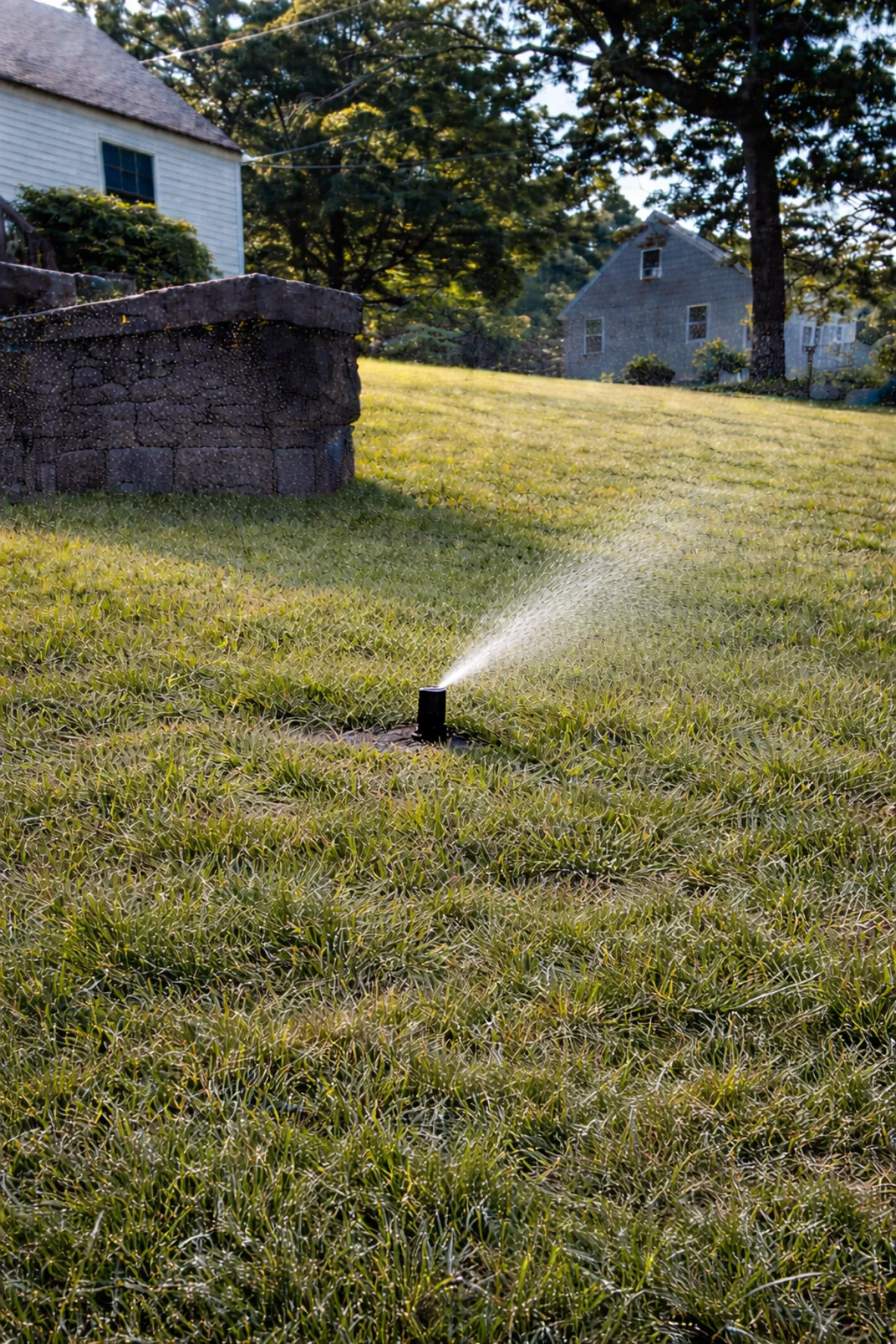
Lawn Aeration in MA: When, Cost & Why It Helps Your Lawn
Your lawn is compacted. I know this because every lawn in Massachusetts is compacted. It's not a personal failing. It's glacial till, clay soil, freeze-thaw cycles, and the fact that your kids have been playing soccer on the same patch since 2019. The ground gets hard. The grass gets sad. And you keep watering it like more water is the answer, which it isn't.
(If your lawn could talk, it would say "I can't breathe." Which is dramatic, but technically accurate.)
TL;DR: Lawn aeration in Massachusetts costs $95–$265 for a standard quarter-acre yard. The best time to aerate is early fall, mid-August through mid-October. If you have an irrigation system, aeration actually makes it work better. And if you don't have one, aeration is the cheapest way to get more out of whatever watering you're doing.
What lawn aeration actually does
Aeration pulls small plugs of soil out of your lawn, usually 2 to 3 inches deep, about the width of a pencil. Those plugs get left on the surface and break down in a week or two. The holes they leave behind do three things:
- Relieve compaction. Your soil is packed down from foot traffic, mowing, and winter frost. The holes let roots spread into looser soil underneath.
- Improve water infiltration. Instead of running off the surface or sitting in puddles, water goes straight down to the root zone. This is where your irrigation system gets involved, more on that in a minute.
- Reduce thatch. Thatch is the layer of dead grass and roots between the green stuff and the soil. When it gets thicker than half an inch, it blocks water, air, and nutrients. Aeration helps break it down.
Think of it like this: your lawn is a sponge that someone stepped on. Aeration is un-stepping on it. (I've been doing this 25 years and I still can't make "aeration" sound exciting. My wife says that's because it isn't. She's not wrong.)
When to aerate in Massachusetts
This is the question I get every September. The answer depends on your grass type, and in Middlesex County, you're almost certainly growing cool-season grasses: Kentucky bluegrass, perennial ryegrass, or tall fescue.
Fall is prime time. Early September through mid-October. The grass is still growing, the soil is warm, and there's usually enough moisture to help the plugs break down. Aeration in fall gives the roots the entire winter to expand into the loosened soil before spring growth kicks in.
Spring is second best. Late April through May works, but fall is better. Spring aeration competes with crabgrass germination. Those holes are perfect little nurseries for weed seeds. If you're going to aerate in spring, pair it with a pre-emergent or overseeding.
Summer is a waste. The grass is stressed, the soil is baked, and you're just poking holes in a lawn that's already having a bad time. Don't.
Winter is impossible. The ground is frozen. I mention this because someone asks every year. (Usually the same person who asks if we can install sprinklers in January. The answer is also no.)
Rule of thumb: if you're putting the patio furniture away and the leaves are turning, it's time. If you're still mowing weekly and the nights are above 50°F, you're in the window.
What it actually costs
Here's the honest breakdown for Middlesex County:
| Yard Size | Typical Cost | Time to Complete |
|---|---|---|
| Small (under 5,000 sq ft) | $95–$145 | 30–45 minutes |
| Average (5,000–10,000 sq ft) | $145–$190 | 45–75 minutes |
| Large (10,000–15,000 sq ft) | $190–$265 | 1–2 hours |
Those prices are for core aeration, the kind that pulls actual plugs. Liquid aeration (a spray that's supposed to loosen soil) is cheaper but, honestly, about as effective as wishing really hard. The plugs do the work. The spray is mostly marketing.
Some companies bundle aeration with overseeding. That's a good deal if your lawn is thin. The seeds fall into the holes and have direct soil contact, which is exactly what they need. Overseeding alone on compacted soil is like throwing seeds on a parking lot. (Slight exaggeration. Slight.)
Why your irrigation system cares
Here's where this connects to what we actually do at EMI.
A compacted lawn doesn't absorb water well. You can run your sprinkler system for 30 minutes a zone, and half that water runs off the surface into the storm drain. The grass roots stay shallow because the water isn't getting deep enough. So you water more, which makes the shallow roots even shallower, and now you're in a cycle where your water bill goes up and your lawn gets worse.
Aeration breaks that cycle. The holes let water from your irrigation system go straight down to 2–3 inches, where the roots actually are. One study from the University of Massachusetts Extension found that aerated lawns absorb 30–50% more water than compacted lawns from the same irrigation run time. That means your existing system, same heads, same zones, same schedule, waters more effectively after aeration.
If you have a smart controller (Hunter Hydrawise, Rachio, Rain Bird ESP-TM2), the combination is even better. The controller adjusts run times based on weather. The aeration improves infiltration. Together, you're using less water and getting a greener lawn. It's one of those rare situations where two things actually compound instead of just adding up.
We've seen this play out in Burlington, Tewksbury, and Billerica, the towns with the 2000s-era builder-installed systems. Those systems were designed for a lawn that wasn't compacted yet. Fifteen years of freeze-thaw and foot traffic later, the same zones that worked fine in 2009 are under-delivering because the soil can't absorb what the heads are putting out. Aeration fixes the soil side. We handle the system side.
The Chelmsford problem (and why one-size doesn't work)
I've told this story before, but it bears repeating because it's exactly why aeration timing and method matter in our area.
You can dig a trench off Billerica Road in Chelmsford and hit dense clay within eight inches. Drive a mile west toward the Westford line and it's sandy glacial outwash, drains so fast the water's at root level for about 90 seconds before it's gone. Two Chelmsford homeowners can have the same lawn, same grass type, and one needs aeration every year while the other can go three years between passes.
Clay soils compact faster. They hold water longer. They need aeration more often. Sandy soils drain fast and compact slower, but when they do compact, the roots can't find moisture at all.
If you're in Chelmsford, Billerica, Tewksbury, or any of the towns where the soil varies street by street, the generic "aerate every year" advice doesn't apply. Some lawns need it annually. Some can wait. The test is simple: stick a screwdriver into the lawn. If it goes in easily, your soil is fine. If you're pushing hard and it barely penetrates two inches, you need aeration.
(If you don't own a screwdriver, I can't help you. That's a different kind of problem.)
DIY vs. calling a pro
You can rent a core aerator from Home Depot or a local equipment rental shop for $60–$100 per day. People do it. Some of them do it fine.
But here's what goes wrong with DIY aeration:
The machine is heavy and hard to maneuver. A core aerator weighs 200–300 pounds. It doesn't steer like a mower. On slopes, around trees, along fences, it's a workout. We've had customers who rented one, did the front yard, and called us to finish the back because their arms gave out.
Timing matters more than you think. The soil needs to be moist, not wet, not dry. If it's too dry, the tines pull out shallow plugs or just poke holes without removing soil. If it's too wet, the holes collapse and you've accomplished nothing. We check soil moisture before we start. Most rental places don't mention this.
You might hit irrigation lines. This is the one that costs money. If you don't know exactly where your sprinkler lines are buried, the aerator tines can crack a lateral line or puncture a mainline. We've repaired plenty of DIY aeration casualties, $150–$350 per break. If you're going to do it yourself, at least know where your valve boxes are and trace the lines from there.
If you're handy and you've done it before, rent the machine. If you're watching YouTube at midnight because you just realized your lawn is hard as a rock, call someone. Call us, call someone else, just call someone.
When you probably don't need us
Here's the part where I talk you out of hiring us:
- Your lawn is less than 3 years old. New construction lawns are usually fine for the first few years. The soil hasn't compacted yet. Wait.
- You just had aeration done in the last 12 months. Annual aeration is for clay soils and high-traffic areas. If your lawn is in good shape and you're on sandy soil, every 2–3 years is fine.
- You're planning a full lawn renovation. If you're killing the whole lawn and starting over, aeration is part of the prep, but your landscaper will handle it as part of the project.
- You have a screwdriver test that says your soil is fine. If the screwdriver goes in easily, the soil isn't compacted. Save your money.
For everyone else, especially if you've noticed water pooling on the surface after your sprinklers run, or brown spots that don't respond to more watering, aeration might be the missing piece.
What it costs (the honest version)
- Core aeration, standard residential lawn: $95–$265 depending on yard size
- Aeration + overseeding bundle: $200–$450 depending on yard size and seed type
- DIY rental: $60–$100 per day, plus your Saturday and possibly your lower back
- What happens if you skip it: Your irrigation system keeps running, the water keeps running off, your bill keeps going up, and your lawn keeps looking like it needs more water. It doesn't. It needs less water, delivered better.
If you have an irrigation system, aeration is the cheapest upgrade you can make to improve its performance. No new heads. No new controller. No new zones. Just holes in the ground that let the water you're already paying for actually reach the roots.
Straight answers
Q: When should I aerate my lawn in Massachusetts?
A: Early fall, mid-August through mid-October. The grass is still growing, the soil is warm, and there's usually enough moisture. Spring (late April through May) works too, but fall is better because the roots have all winter to expand.
Q: How much does lawn aeration cost in Middlesex County?
A: $95–$265 for a standard residential lawn. Small yards under 5,000 square feet run $95–$145. Average yards (5,000–10,000 square feet) run $145–$190. Larger properties run $190–$265. These are honest numbers, no "starting at $49" with a surprise invoice.
Q: How often should I aerate my lawn?
A: Depends on your soil. Clay soils (common in Billerica, Chelmsford, and Tewksbury) benefit from annual aeration. Sandy soils can go 2–3 years between passes. The screwdriver test tells you: if it goes in easily, you're fine. If it doesn't, you need aeration.
Q: Does aeration help my sprinkler system?
A: Yes. Compacted soil doesn't absorb water well. It runs off the surface. Aeration creates channels that let water from your irrigation system reach the root zone. Aerated lawns absorb 30–50% more water from the same irrigation run time. Same system, better results.
Q: Can I aerate and overseed at the same time?
A: Yes, and it's the best time to overseed. The seeds fall into the holes and have direct soil contact, which is exactly what they need to germinate. Overseeding on compacted soil without aeration is mostly wasted seed.
Q: Should I aerate before or after fertilizing?
A: Aerate first, then fertilize. The fertilizer goes straight into the holes and reaches the roots. If you fertilize first and then aerate, you're pulling plugs of fertilizer out of the ground. (Which is wasteful, and also kind of funny if you think about it.)
Q: Will aeration damage my sprinkler system?
A: It can, if you don't know where the lines are buried. The aerator tines go 2–3 inches deep, and most irrigation lines are buried 6–12 inches. But shallow lines, lines near valve boxes, or lines that have shifted over time can be hit. If you're doing it yourself, trace your valve boxes and know the line paths. If we're doing it, we know where to avoid.
Q: Is liquid aeration as good as core aeration?
A: No. Liquid aeration is a spray that's supposed to loosen soil chemically. It doesn't pull plugs, doesn't relieve compaction mechanically, and doesn't create channels for water infiltration. Core aeration, the kind that pulls actual plugs, is the only method that works. The spray is mostly marketing.
Aeration is one of those things that costs $150 and makes everything else work better: your irrigation system, your fertilizer, your overseeding, your water bill. It's not glamorous. It's not exciting. But neither is flossing, and your dentist keeps telling you to do that too.
We're at 781-983-3739, Monday through Friday 7 AM to 6 PM, Saturday 8 AM to 2 PM. If you call and I answer, that's just the owner picking up the phone. Old habit. We service 50+ towns across Middlesex County and into the Lakes Region in New Hampshire. If your lawn is compacted and your sprinkler system is working harder than it should, let's talk. I'll bring the aerator. You can bring the coffee. (I'll probably bring my own anyway.)
Ready to get your system handled?
EMI Irrigation — family-owned, serving the greater Billerica area and Southern NH.