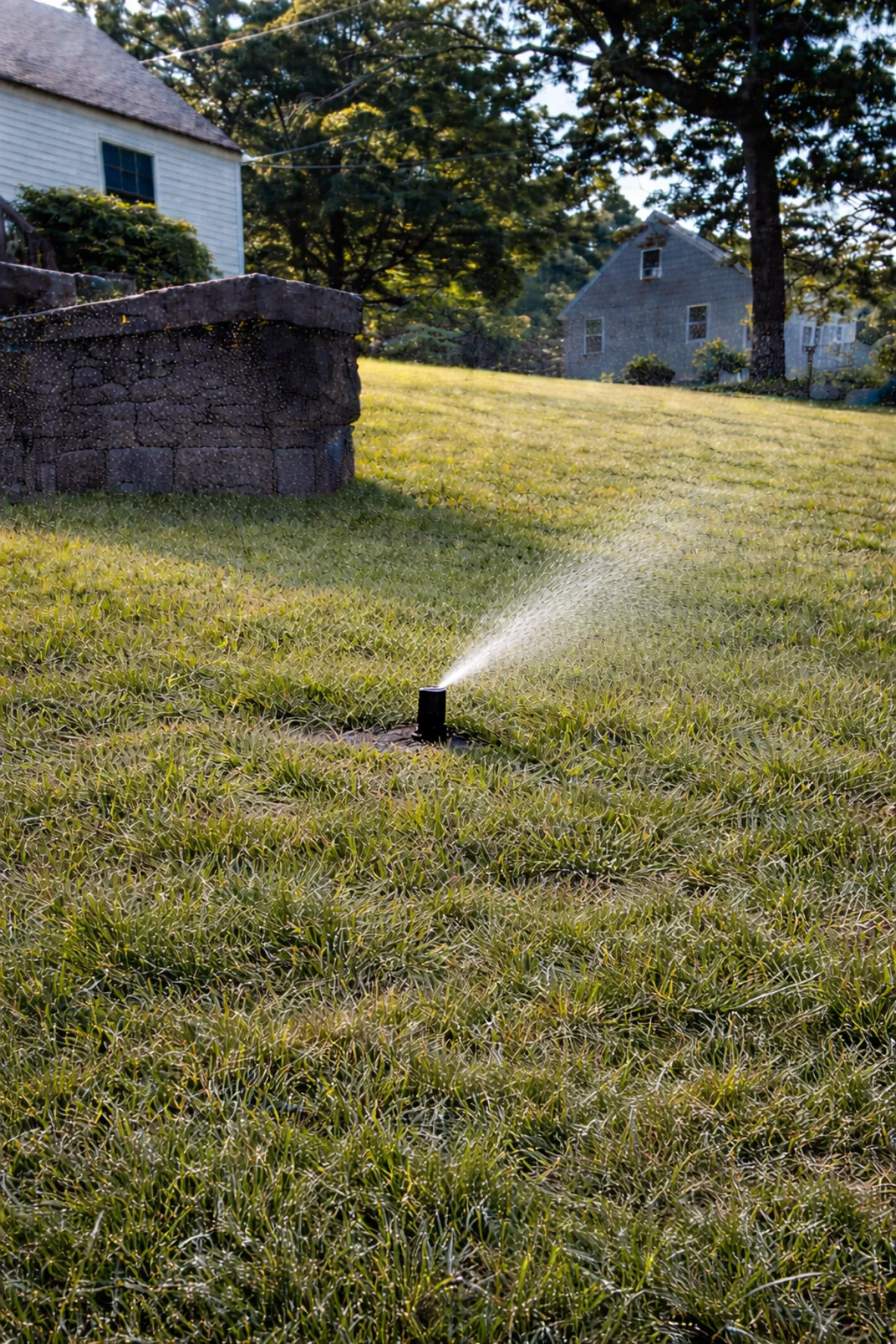
Massachusetts Watering Restrictions Are Back. Here's How Not to Kill Your Lawn While Staying Legal
Every summer, sometime between Memorial Day and the Fourth of July, a notice goes up on your town's website. Odd-house-number days on Tuesday, Thursday, Saturday. Even-number days on Monday, Wednesday, Friday. No watering between 9 AM and 5 PM. During drought declarations: two days a week, period.
And then the calls start coming in. "My lawn is turning brown and I'm not doing anything wrong."
Actually, most of the time, you are — just not in the way you'd guess.
What Massachusetts Watering Restrictions Actually Say (and Why They Vary by Town)
There's a common misconception that Massachusetts has one statewide watering rule everyone follows. That's not quite how it works.
The Massachusetts Department of Environmental Protection sets the framework through the Water Management Act, and organizations like the MWRA issue guidance during drought conditions — but the actual enforcement lands at the local level. Your town's DPW or water department issues restrictions based on their supply situation, reservoir levels, or aquifer readings. Two neighboring towns can have completely different rules on the same day.
Here's what most Bedford-area towns enforce during a declared drought or elevated water demand period:
- No outdoor irrigation between 9 AM and 5 PM (peak evaporation hours)
- Odd/even day watering based on house number — odd numbers on odd calendar days, even numbers on even days
- During Stage 1 drought: voluntary reduction, typically 25% below normal
- During Stage 2 or Stage 3 drought: mandatory restrictions, often down to twice per week or less
- No watering during or within 24–48 hours of measurable rainfall
- Hand-watering of new plants and vegetable gardens typically exempted
Some towns — especially those sourcing from MWRA supply (which includes towns running off the Cosgrove Tunnel or Wachusett Reservoir system) — can face more aggressive restrictions based on MWRA-wide drawdown levels. If your town is on municipal well water, restrictions get triggered locally based on well levels, which can fluctuate faster than you'd expect in a dry June.
The bottom line: restrictions are real, enforced, and vary. Violations can result in fines, and water departments do drive through neighborhoods during restriction periods.
Why Following the Rules Is Making Some Lawns Worse
Here's the problem nobody talks about: following the letter of the restrictions while watering incorrectly can actually accelerate lawn damage.
Most homeowners with a traditional timer-based controller do one of two things when restrictions hit:
Cut the runtime in half. So instead of running zone 3 for 12 minutes, it runs for 6. The soil gets wet to about half an inch — shallow enough for the grass roots to stay in the top layer where it dries out fastest.
Skip days randomly to stay within the allowed days, without adjusting how long each zone runs on the days they do water.
What your lawn actually needs during a dry New England summer is deep, infrequent watering — soaking the soil 4 to 6 inches down so roots chase water downward. This is especially true in eastern Massachusetts, where clay-heavy soils hold water longer than sandy soils but also compact and run off quickly when watered too fast.
The result of shallow, frequent watering is a lawn with shallow roots — which means it burns out faster during the heat stress days we get every July and August, and which shows up as dry patches even if the system is technically running fine.
The honest take here: your instinct to water more is making the problem worse. The correct response to restrictions is usually to water longer on fewer days with better coverage — not to panic and cut runtime.
The Problem with Your Timer-Based Controller Right Now
The standard irrigation timer — the box in your garage or mechanical room that's been quietly doing its thing for 10 years — has one setting it doesn't know about: what's happening outside.
It doesn't know it rained Tuesday night. It doesn't know your town just declared a Stage 2 restriction. It doesn't know the forecast calls for three days of thunderstorms. It just runs the program you set in April and does it on autopilot.
That creates two simultaneous problems:
Problem 1: It waters when it shouldn't. Watering during a rain event wastes water, risks a violation fine, and can actually over-saturate certain soil types. A timer-based controller doesn't care.
Problem 2: It under-waters when it should. When the system cuts itself off on restricted days without increasing runtime on allowed days, coverage gets patchy. Zones that were already borderline on a full schedule become visibly dry in a 90°F week.
We've been out to enough July service calls to know the pattern: homeowner set it in May, forgot about it, got fined for watering during a restriction, then called us in August because the back lawn looks like a dirt lot.
How Smart Controllers Actually Solve This
WiFi-enabled smart controllers — Hunter's Hydrawise, Rachio, Orbit B-Hyve — pull real-time weather data and calculate watering schedules based on what's actually happening, not what you programmed four months ago.
The key features that matter in a Massachusetts summer:
ET-based scheduling (evapotranspiration). The controller knows how much water the grass actually lost yesterday based on temperature, humidity, wind speed, and sun exposure. It only runs to replace what was lost — not to hit a fixed runtime. On a 95°F day, it runs more. On a 60°F overcast day, it might skip entirely.
Rain sensor integration or weather-based rain skip. Modern smart controllers either pair with a wired rain sensor (required by Massachusetts law for new irrigation systems installed after 2009) or pull weather data and skip when measurable precipitation falls. No more running after thunderstorms.
Restriction scheduling built in. You can program your specific restriction rules — odd/even, days-of-week, blackout hours — and the controller works within that framework automatically. When Stage 2 kicks in, you change one setting. Done.
Remote access. If you're at work and the town announces restrictions, you can update the schedule from your phone. No driving home, no digging around in the garage, no hunting for the manual.
EMI Irrigation installs Hunter Hydrawise and compatible smart controllers that we also program for your specific zone layout, water pressure, and current local restriction schedule. Most upgrades take 90 minutes and work with your existing wiring — no digging required.
The typical outcome: 20–40% reduction in water usage while maintaining the same coverage quality. Most clients notice the difference on their water bill by mid-July.
Practical Steps for Right Now
If you're reading this during peak season and you're not sure whether your system is compliant:
Step 1: Find your town's current restriction status. Check your town DPW's website. If you can't find it in under 2 minutes, call the water department. They'll tell you exactly what's in effect and what the fines are.
Step 2: Check your controller's current program. Is it running during the 9 AM–5 PM blackout window? What days is it scheduled? Cross-reference against your current house number and the restriction calendar.
Step 3: Increase runtime on allowed watering days. If you were running 10 minutes per zone on 3 days a week and now you're limited to 2 days, run 15 minutes instead. You want the same weekly water volume, delivered on fewer days.
Step 4: Verify you have a working rain sensor. Required by Massachusetts law, but plenty of older systems have sensors that are dead, clogged, or defeated. You can test yours by checking if the system stays off after rain. If it runs the day after a soaking thunderstorm, the sensor isn't working.
Step 5: Consider whether your controller is doing more harm than good. A 10+ year-old timer controller with no weather awareness is a liability during restriction season. The upgrade math usually works: a Hydrawise or Rachio controller installed is $200–$500 depending on zone count, and it pays back in water savings within one or two seasons.
When to Call Us
If you've walked your system and found broken heads, zones not firing, coverage gaps, or controller issues you can't trace — that's a service call. We diagnose and repair most systems in one visit, and same-week scheduling is typically available.
If you want to upgrade to a smart controller, we'll handle the full install and programming. We'll also do a quick zone audit while we're there — because a smart controller on a system with two broken heads and a misaligned rotor on zone 4 is still going to give you brown spots.
We serve Bedford, Billerica, Burlington, Lexington, Concord, Carlisle, Chelmsford, and the surrounding area. If your town is issuing restrictions and your system is running on autopilot from April, now is a good time to address it — before August makes the problem obvious.
Ready to get your system handled? Call EMI Irrigation at 781-983-3739 or book online.
Frequently Asked Questions
Q: Are Massachusetts watering restrictions the same in every town? A: No. The MA DEP sets the framework and MWRA issues guidance for member communities, but each town's water department sets and enforces its own restrictions. Always check your specific town's DPW website during the summer months.
Q: Does a smart controller automatically comply with town restrictions? A: A smart controller handles rain skips and ET-based scheduling automatically, but you still need to program your town's specific restriction schedule (days/hours). Most smart controllers make this straightforward — you set the rules once, and it works within them from then on.
Q: Is it legal to water new grass or just-seeded areas during restrictions? A: Most Massachusetts towns exempt new seed and sod from standard restrictions, but you typically need to register with the water department and may be limited to hand-watering or specific time windows. Confirm with your town — rules vary.
Q: My neighbor's system runs during the restriction window and nothing happens. Do they actually enforce this? A: Towns enforce restrictions inconsistently — some hire water restriction officers during drought declarations, others rely on neighbor complaints. But fines are real ($25–$200 for first offense in many towns, escalating), and a repeat during a Stage 3 declaration can trigger shutoff. Not worth it.
Ready to get your system handled?
EMI Irrigation — family-owned, serving the greater Billerica area and Southern NH.