Repair of Sprinkler System : What Breaks and What It Costs
A sprinkler system breaks the same way a car does . One part at a time, usually at the worst possible moment. The repair is almost always cheaper than replacing the whole system, and about a third of the calls we get turn out to be a five-minute fix the homeowner could have handled with a flashlight and a little patience.
TL;DR: Most sprinkler system repairs run $75 to $500 depending on the part. Heads are $75 to $150. Valves are $95 to $250. Pipe is $150 to $350. Before you call anyone, walk the system with each zone running , you will see the problem 80% of the time.
What actually breaks on a sprinkler system
I have been repairing sprinkler systems across Middlesex County since 2000. In that time, I have seen the same five failures on repeat. The brands change, the soil changes, the town changes, but the breakdowns are predictable.
1. Sprinkler heads
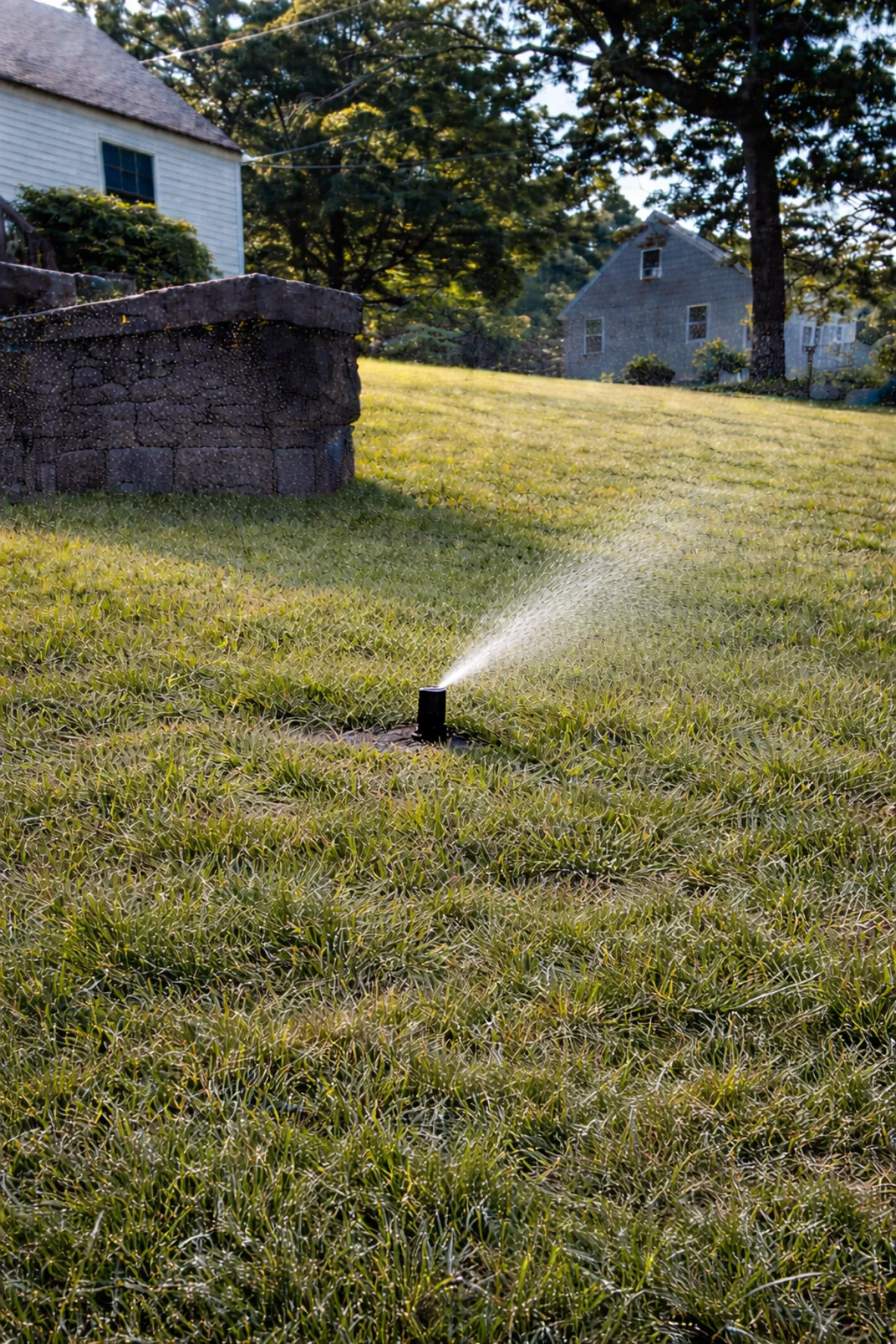
The most common repair we do. Pop-up spray heads get stepped on, hit by mowers, or buried under soil after a few winters of frost heave. Rotors strip their internal gears, especially in wind-corridor properties off Route 93 in Wilmington where the sustained gusts chew through wiper seals. A single head replacement runs $75 to $150, parts and labor, one trip.
The tell: a head that dribbles instead of spraying, a head stuck halfway up, or a geyser at the base. If you see water shooting straight up like a fountain, that is a broken head. Do not panic. Turn off that zone and call us.
2. Valves
The valve is the gatekeeper . It opens and closes to let water into each zone. The rubber diaphragm inside hardens over time, especially on the builder-grade manifolds installed during Burlington's 2000s residential boom. Those systems are 15 to 20 years old now and the diaphragms are turning into something that resembles a Triscuit more than a seal.
A valve rebuild (new diaphragm kit) is $95 to $175. A full valve replacement is $125–$250 depending on the body and how deep the box is buried. The most-overlooked failure point on any Middlesex County system , sitting in a green box, sometimes in standing water, never serviced until it stops opening.
3. Pipe
Mainline and lateral pipes crack. In Middlesex County, the most common cause is frost heave . The ground freezes, shifts, and the rigid PVC snaps at a fitting. Tewksbury's sandy glacial outwash moves more than Chelmsford's clay, so pipe repairs cluster in the sandy-soil towns. Tree roots are the second cause . They grow around pipes and eventually crush them.
A pipe repair runs $150 to $350 for a 6 to 12 inch section, depth-dependent. If the break is under a driveway or patio, add the cost of accessing it. The mainline (the big pipe from the water source to the valves) is usually Schedule 40 PVC buried at proper depth and lasts 30+ years. Don't let anyone tell you the whole mainline needs replacing when one fitting cracked.
4. Wiring
The low-voltage wire that tells each valve to open runs underground, often in the same trench as the pipe. Rodents chew it. Frost heave stretches it. A landscaper installing a fence post cuts it. The symptom: one zone stops responding to the controller while the rest work fine.
A wiring fault diagnosis and splice runs $100 to $300 depending on how far we have to trace the break. The most common fix is finding the damaged section, splicing it with waterproof wire nuts, and burying it again. Not glamorous. Always works.
5. Controllers
The timer in your garage is the brain of the system. The ones installed during the 2000s build wave like Hunter ICC and Rain Bird ESP are now 15 to 20 years old. Backup batteries dead, calendar out of date, display fading. They still "work" in the same sense that a 2003 flip phone still makes calls.
A smart controller replacement (Hunter Hydrawise, Rachio, Rain Bird ESP-TM2) runs $250 to $500 installed. This is the single highest-ROI upgrade on an aging system . The cycle-and-soak feature alone saves 20 to 35% on the water bill. If your controller is older than your oldest kid's school career, it is time.
Try this before you call anyone
About a third of "the system is broken" calls dissolve in ten minutes with no truck involved. Before you pick up the phone, walk through this:
Check the controller display. Is it showing the right time and date? Is the program active? A dead backup battery can wipe the schedule. Replace the 9V and reprogram.
Check the rain sensor. If the sensor light is blinking, the system thinks it rained recently and is skipping cycles. Massachusetts has required rain sensors on new installs since 2009 . The ones from that era are mostly dead, clogged, or defeated by UV. A $35 sensor replacement fixes this.
Walk each zone manually. Turn on zone 1 at the controller, walk outside, watch. Then zone 2, then 3. You will see the problem . A stuck head, a leaking fitting, a zone that does not turn on. Write down what you see. That information saves us diagnostic time and saves you money.
Check the backflow preventer. The two handles on the backflow device (usually near the meter) should be parallel to the pipe. If they are perpendicular, the backflow is shut and no water is getting to the system. Open them and try again.
Check the mainline shutoff. There is a valve between your water meter and the backflow preventer. If someone closed it . A plumber, a winterization tech, a curious teenager, the system gets no water.
If none of that fixes it, call us. But try the obvious things first. We would rather talk you out of a service call than drive 20 minutes to flip a handle.
When to repair vs replace
This is the question I get most often, and the honest answer depends on the age of the system.
Repair when:
- The system is under 15 years old
- The problem is isolated (one zone, one head, one valve)
- The mainline is intact
- The controller is still functional (even if it is old)
- You have had fewer than three service calls in the last two years
Replace when:
- The system is 20+ years old with multiple failures across different zones
- You are spending $400+ per year on repairs
- The valve manifold is failing in multiple locations
- The coverage was never good (common with builder-installed systems)
- You want to add zones or reconfigure the layout
The middle ground . And this is where we save people the most money is a partial rebuild. Replace the valve manifold, upgrade the controller, swap the tired heads, but keep the mainline and lateral pipes. That runs $1,500 to $3,000 on most Middlesex County systems and gives you another 15 years. A full new install is $3,000 to $8,000. The partial rebuild is the right call more often than most contractors admit.
What sprinkler system repair costs in Middlesex County
| Repair type | EMI price range | What affects the price |
|---|---|---|
| Single head replacement | $75 to $150 | Head type (pop-up spray vs rotor), accessibility |
| Sunken head raise / re-level | $75–$120 | Frost heave depth, soil type |
| Valve rebuild (diaphragm kit) | $95 to $175 | Valve box accessibility, standing water |
| Valve replacement (full body) | $125–$250 | Valve body type, depth, wiring |
| Mainline / lateral pipe repair | $150 to $350 | Depth, soil type, access (lawn vs under patio) |
| Wiring fault (locate + splice) | $100 to $300 | Length of wire run, number of breaks |
| Controller replacement (smart) | $250 to $500 | Brand, number of zones, Wi-Fi setup |
| Full diagnostic / system audit | $95 | Credited toward repair if you proceed |
We give free estimates for anything beyond a standard service call. If we get to your property and the job is more complex than the phone call suggested, we stop, quote the new number, and wait for you to say go ahead.
The Middlesex County repair patterns
Different towns, different problems. This is not generic advice . It is what we see on the trucks every week.
Tewksbury and Dracut: Iron-rich town water clogs nozzles and stains heads orange. We install a $15 to $25 inline filter at the backflow on every Tewksbury system as a standard. Without it, you are replacing nozzles every season.
Chelmsford: Variable soil . Clay near Billerica Road, sandy near the Westford line. Two neighbours can have the same system and one overwaters while the other underwaters. Repairs here often start with a soil assessment, not a parts swap.
Burlington: The 2000s build-wave systems are hitting end-of-life on a predictable schedule. Valve diaphragms, controller batteries, stripped rotor gears , all at once. We do more Burlington repair calls per capita than any other town in our service area.
Wilmington: The I-93 wind corridor chews through head seals and wiper rings. Wind-rated head bodies are a standard upgrade for Wildwood-area properties.
Bedford: Rocky glacial till near Hanscom and Page Road means pipe repairs take longer . We have broken more than one rock saw on that ridge. Budget extra time if your system runs through ledge.
Straight answers
Repair of a sprinkler system is almost always cheaper than replacement, and about a third of the time it is something you can diagnose yourself. Walk the system, check the obvious, and call us if it is beyond a handle flip or a battery swap. We have been fixing sprinkler systems across Middlesex County since 2000 and we will tell you honestly if the repair is worth it or if the system needs a bigger conversation.
Call 781-983-3739. I answer the phone myself most days. If I am on a job, I call back before the coffee gets cold.
Ready to get your system handled?
EMI Irrigation — family-owned, serving the greater Billerica area and Southern NH.