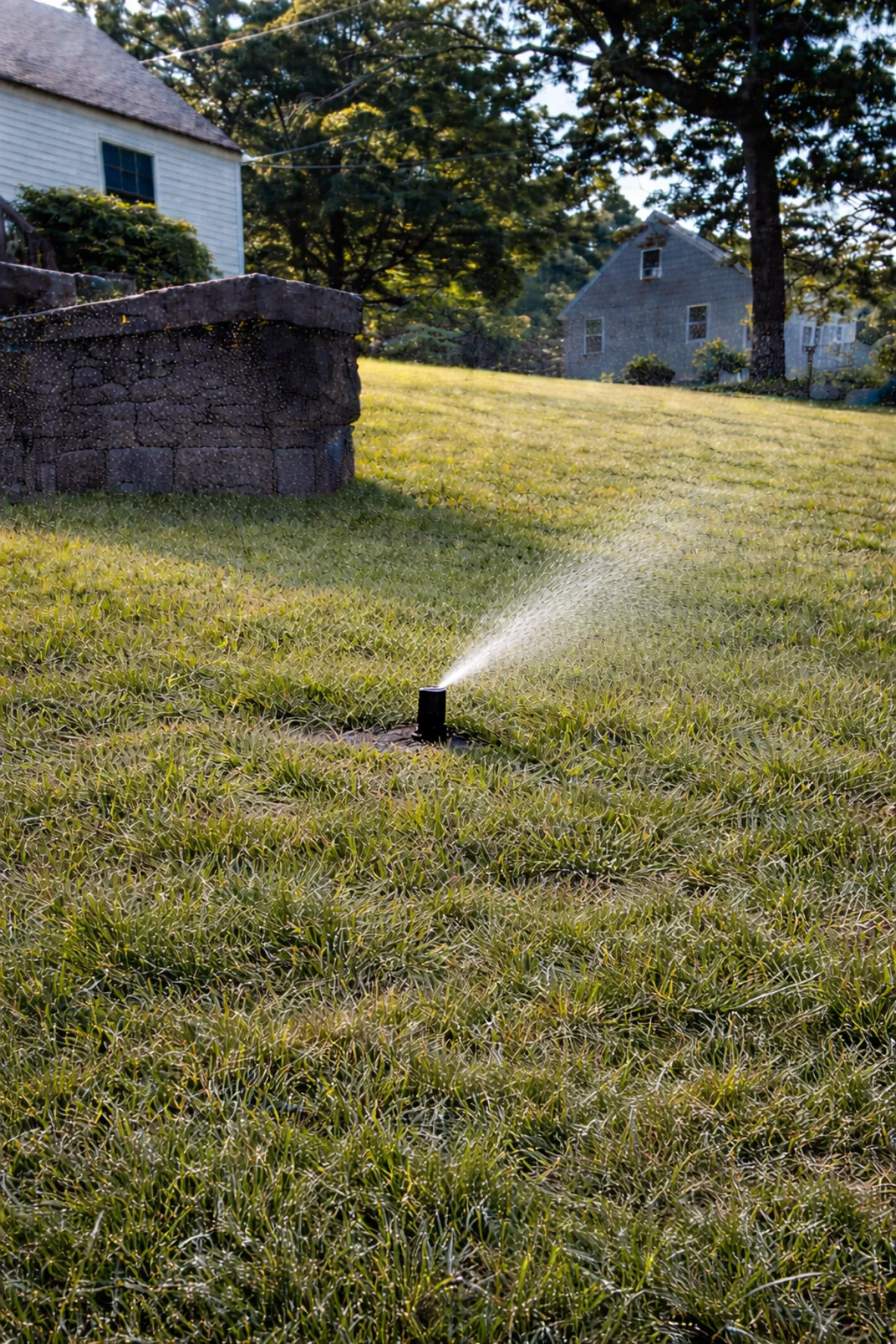
Sprinkler Head Replacement Cost in 2026: What You'll Actually Pay
Replacing a single sprinkler head runs $75–$150 in Middlesex County, parts and labor included. That's the short answer. The longer answer depends on your soil, your brand, and whether you'd rather spend Saturday digging in the yard or watching college football.
TL;DR: One head replacement: $75–$150. Multiple heads in one visit: $75–$120 each after the first. DIY parts-only: $5–$25 per head, assuming you don't crack the lateral line in the process. The national cost guides skip the Middlesex County stuff — that's what the rest of this covers.
What a sprinkler head replacement actually costs
No "starting at" pricing, no surprise add-ons when the truck shows up. Just the number.
| Service | EMI Price | National Average |
|---|---|---|
| Single head replacement (pop-up spray or rotor) | $75–$150 | $59–$150 |
| Each additional head, same visit | $75–$120 | $59–$120 |
| Sunken head raise / re-level | $75–$120 | $60–$100 |
| Nozzle swap only (no body replacement) | $45–$75 | $40–$75 |
| Wiring fault at head (locate + splice) | $100–$300 | $60–$100 |
The range on a single head depends on the type. A pop-up spray head — the small ones that water your flower beds — sits at the low end. A gear-driven rotor — the ones that sweep back and forth across the lawn — costs more because the part itself is $15–$40 versus $5–$12 for a spray body.
Labor is the bigger variable. We're onsite 15–30 minutes per head if it's a straight swap — dig around the riser, unscrew the old body, thread the new one, adjust the nozzle arc, test. If the lateral pipe below the head is cracked (which we'll get to), the timeline doubles and so does the cost.
Why Middlesex County heads fail faster than the national average
Your soil determines how often you're replacing heads. The national guides don't cover this.
In Tewksbury and parts of Billerica, the glacial outwash soil is sandy. After a frost heave cycle — which happens every winter in Massachusetts zone 6a — heads settle. They tilt. They sink below grade. A head that sat flush with the lawn in October is sitting half an inch low by April. That half inch means the spray pattern hits the grass in front of the head instead of arcing over it. You get brown patches. You think the system is broken. The head just needs to be raised.
Over in Chelmsford near Billerica Road, you've got clay. Clay holds water, expands when wet, contracts when dry. That constant movement works the threads on the riser fitting. We've pulled heads in Chelmsford that were hand-tight when installed and torqued solid by clay pressure two years later. Getting them out without cracking the lateral line underneath takes patience and a lot of muttering.
Then there's the wind corridor off I-93 in Wilmington. Properties near Route 129 get sustained summer gusts of 25–35 mph. That wind walks rotor heads off their arcs, strips wiper seals, and accelerates gear wear on the driven internals. A rotor that should last 10 years on a sheltered Bedford lot gives out in 6–7 in Wilmington.
Nationally, sprinkler heads last 10–15 years. In Middlesex County, depending on soil and microclimate, I'd plan on 7–12. The mainline pipe buried underneath? That's 30+ years. Don't replace the infrastructure when only the surface parts are tired.
Hunter vs Rain Bird vs Toro: which head is worth the money
We carry all three on the truck. Here's the honest comparison:
Hunter PGP Ultra (rotor). The workhorse. We install more of these than anything else. $18–$25 per head. The arc adjustment is a flat screwdriver — dead simple. The seal on the pop-up stem holds up better than the competition. In sandy Tewksbury soil where grit gets into everything, the Hunter lasts longest. If I had to pick one rotor for every property in Middlesex County, this is it.
Rain Bird 5000 Plus (rotor). Similar to the Hunter at $20–$28. The Rain Bird has a slightly better low-pressure performance — if your system runs below 40 PSI at the heads (common on larger lots where the zone runs far from the valve), the Rain Bird throws a more consistent pattern. Also very good. I won't argue with anyone who prefers it.
Toro (rotor). Fine. Not great. $15–$22. We install them when the existing system already uses Toro and the homeowner doesn't want to mix brands. The internals are adequate but the seal life is shorter — we see more Toro wiper seal failures at the 7-year mark than Hunter or Rain Bird.
Pop-up spray heads (any brand). These are simpler — a spring, a stem, a nozzle. Hunter 1800 series and Rain Bird 1800 series are functionally identical. $5–$12 per body. The nozzle is the important part. A clogged or worn nozzle throws an uneven pattern even if the body is fine. Sometimes a $3 nozzle swap saves you a $75 head replacement. We check that first.
Why your heads are failing (the three causes we see most)
I've been doing this since 2000 and I still get calls about the same three problems. The details change, but the pattern doesn't.
Cause 1: Mower damage. The number one killer. A riding mower passes over a head that's sitting just slightly below grade — maybe a quarter inch — and the blade catches the cap. We've seen heads decapitated clean off. Pop the cap, the spring is exposed, dirt gets in, the whole body is done. This is a $5 fix turning into a $75–$150 replacement.
Cause 2: Frost heave. Massachusetts winters push heads up, then the spring thaw lets them settle back — but not always to the same spot. Over 5–10 freeze-thaw cycles, the riser connection loosens. The head wobbles. The seal at the base starts leaking. You notice a wet spot around one head that wasn't there last year.
Cause 3: Iron and mineral buildup. This is a Tewksbury specialty. Town water in the Heath Brook area carries enough iron to stain your driveway orange and clog sprinkler nozzles within a season. The buildup narrows the nozzle orifice — a head throwing a 12-foot radius in May barely reaches 6 feet by August. Same hardware, same pressure, just sludge. A $15–$25 inline filter at the backflow cuts that maintenance load by about 70%.
DIY vs calling someone
Can you replace a sprinkler head yourself? Yes. I've talked people through it on the phone. Here's the honest version:
When DIY makes sense:
- It's a straight pop-up spray head swap (the simple ones)
- The riser threads aren't seized
- You have a replacement head that matches the brand and nozzle type
- You own a shovel and can dig a hole without hitting anything
- The lateral pipe underneath looks fine when you expose it
When to call someone:
- The head is a gear-driven rotor (more parts, more adjustment)
- The old head won't unscrew (corroded or clay-seized threads)
- You see water leaking from below the head (lateral line crack — $150–$350 to fix)
- The wiring to the head is damaged (that's a locate-and-splice job)
- You've already tried and made it worse (we've all been there, no judgment)
The biggest DIY risk isn't the head itself — it's the lateral pipe underneath. If you reef on a seized head and crack the PVC below, you've turned a $75–$150 head swap into a $150–$350 pipe repair. Use two wrenches — one to hold the riser, one to turn the head. Counter-clockwise. Gentle pressure. If it doesn't move, stop and call.
When you probably don't need us
Here's the part where I talk you out of hiring us.
A nozzle swap isn't a head replacement. If the head pops up fine, rotates (or sprays) fine, but the pattern is uneven or weak, it's probably a clogged nozzle. Unscrew the nozzle, soak it in white vinegar for 20 minutes, rinse, replace. $3 part. Try that first.
A tilted head might just need a re-level. If the body is fine but the head is leaning, you can dig around it, straighten it, and pack the soil back. Takes 10 minutes. Don't pay someone $75 for that.
Check the controller before you assume a head is broken. If a zone isn't running, it might be the controller, the valve, or the wiring — not the head. Walk each zone manually from the controller. If zone 3 doesn't run but zone 4 does, the problem is upstream of the head.
We've made the drive to a "broken head" that turned out to be a dead backup battery in the garage controller. Four-dollar part. No truck needed. I'd rather talk you out of a service call than charge you for one you didn't need. (My accountant has opinions about this. I ignore them.)
The honest pricing band
| What you need | What it costs |
|---|---|
| Single pop-up spray head, parts + labor | $75–$100 |
| Single gear-driven rotor, parts + labor | $100–$150 |
| Two heads, same visit | $150–$250 |
| Three+ heads, same visit | $75–$120 each after the first |
| Nozzle-only swap (clean or replace) | $45–$75 |
| Head raise / re-level (frost heave correction) | $75–$120 |
| Lateral pipe repair under head | $150–$350 |
| Full system diagnostic (credited toward repair) | $95 |
We don't do "starting at $49" with a surprise invoice. The price we quote on the phone is the price on the bill.
Straight answers
Q: How much does it cost to replace one sprinkler head?
A: $75–$150 in Middlesex County, MA, including parts and labor. A pop-up spray head is at the lower end. A gear-driven rotor is at the higher end. The part itself is $5–$40; the rest is labor and the service visit.
Q: Can I replace a sprinkler head myself?
A: Yes, if it's a straight pop-up spray head and the riser threads aren't seized. Use two wrenches — one to hold the riser, one to turn the head. If the old head won't budge, stop. Forcing it can crack the lateral pipe underneath, which turns a $75 fix into a $300 one.
Q: How long does a sprinkler head last?
A: Nationally, 10–15 years. In Middlesex County, plan on 7–12 depending on soil type. Sandy soil (Tewksbury, parts of Billerica) causes settling and tilt. Clay soil (Chelmsford near Billerica Road) seizes threads. Wind corridors (Wilmington near I-93) accelerate seal wear.
Q: Why do my sprinkler heads keep sinking?
A: Frost heave. Massachusetts zone 6a gets 40+ freeze-thaw cycles per winter. Each cycle pushes the head up slightly, then it settles back — but not always to the same depth. Over 5–10 years, a head that started flush with the lawn drops half an inch below grade. A sunken head raise runs $75–$120.
Q: Is it better to repair or replace a sprinkler head?
A: If the body is intact but the nozzle is clogged or worn, replace the nozzle — $3–$5 part. If the body is cracked, the seal is leaking, or the internal mechanism is worn, replace the whole head. We check the nozzle first before recommending a full replacement. (Some companies skip that step. Funny how that works.)
Q: Do I need to match the brand of my existing sprinkler heads?
A: Not strictly. Most pop-up spray heads use standard thread sizes and are cross-compatible. But if your system uses gear-driven rotors and you mix brands in the same zone, you can get uneven precipitation rates — one head throws more water than its neighbor. That leads to dry spots and wet spots. Match the brand on rotors. Spray heads are more forgiving.
Q: How much does it cost to replace multiple sprinkler heads at once?
A: After the first head at $75–$150, each additional head in the same visit runs $75–$120 because the service call and trip charge are already covered. Replacing three heads in one visit is cheaper per head than three separate visits.
Q: When is the best time to replace sprinkler heads in Massachusetts?
A: Spring start-up (mid-April through late May) or fall before winterization. During spring, we're already running each zone and can spot failing heads. During winterization prep, we can flag heads that need attention before the freeze. Avoid mid-summer if possible — we're busiest and scheduling is tighter.
A broken sprinkler head is one of those small problems that gets expensive if you ignore it. One tilted head means one dry zone, which means brown patches, which means you water more, which means the wet parts get wetter and the brown parts feel left out. (If grass had feelings, which it doesn't, but work with me here.)
We're at 781-983-3739, Monday through Friday 7 AM to 6 PM, Saturday 8 AM to 2 PM. If it's a simple nozzle swap, I'll tell you on the phone and save you the trip. If it needs a truck, we'll quote the real number before we dig.
— Nick, EMI Irrigation
Ready to get your system handled?
EMI Irrigation — family-owned, serving the greater Billerica area and Southern NH.