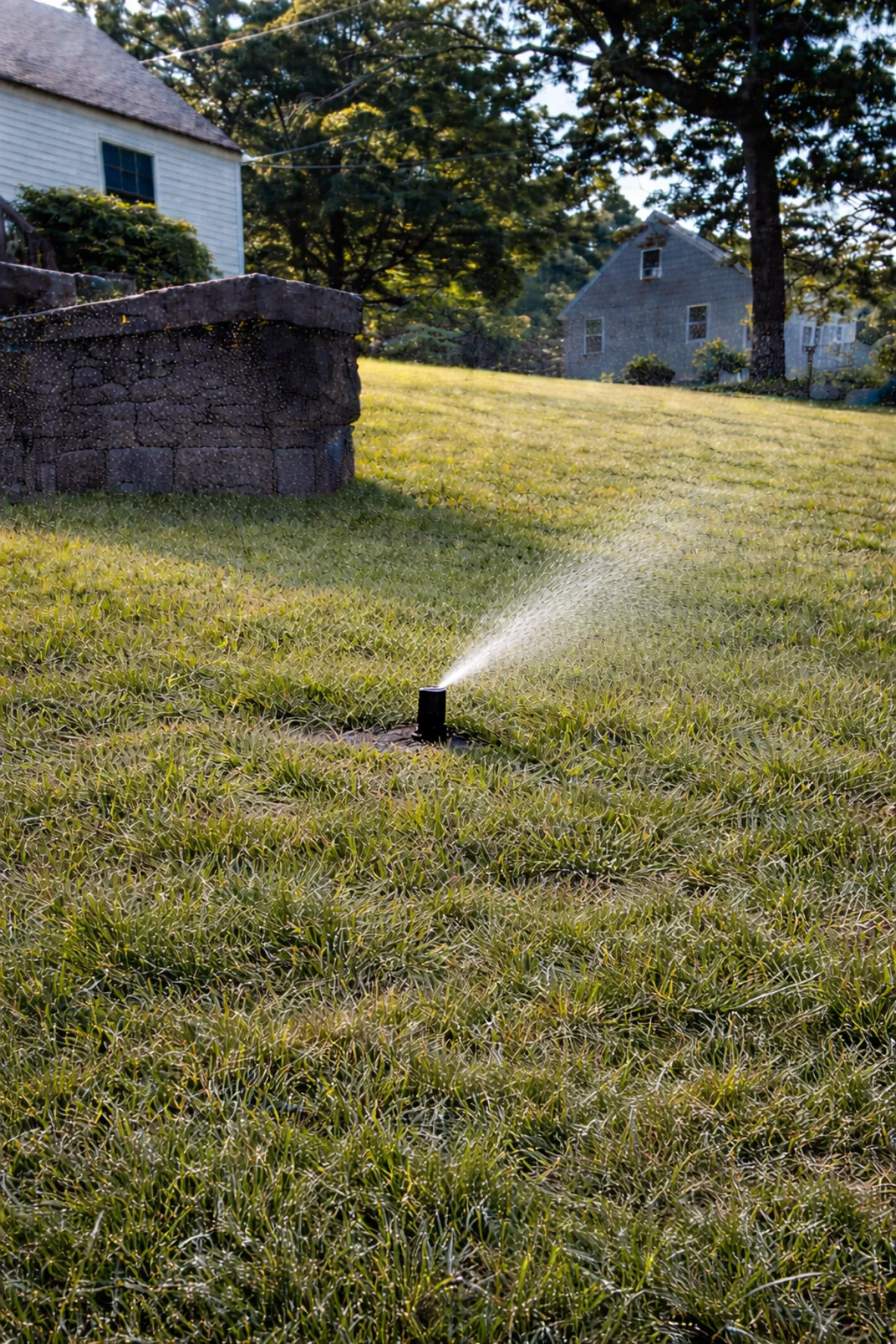
Dracut grew fast. Walk through the neighborhoods off Lakeview Avenue or over by Collinsville and you'll see the pattern. Ranches and split-levels from the 1960s and 70s near the center, then a wave of colonials and townhouses from the 1990s and 2000s pushing toward the Lowell line. Most of those houses have lawns. Most of those lawns are being watered with a garden hose and a vague sense of guilt. (The hose doesn't judge. It just leaks at the connection and costs you $40 a month in wasted water.)
I've been installing sprinkler systems in Dracut since about 2003. The soil is mostly sandy glacial outwash, which makes trenching easy but drainage fast. The town water in some neighborhoods carries enough iron to stain your driveway orange and clog your nozzles by August. And the lots are big enough that a well-designed six-zone system actually makes financial sense. You'll save more on water than the system costs within three to four years.
TL;DR: Sprinkler installation in Dracut costs $3,000–$8,000 depending on lot size and zone count. Dracut's sandy soil makes trenching straightforward but requires cycle-and-soak programming. Iron-rich water in some areas means we install inline filters as standard. Most installs take one to two days. A permit is required. We handle the paperwork.
What sprinkler installation actually costs in Dracut
National sites will tell you "$2,000 to $10,000" and leave you to figure out which end you're on. That range is technically accurate and practically useless. Here's what we charge on real Dracut properties:
| Lot type | Zones | EMI price range | Typical timeline |
|---|---|---|---|
| Small 1/4-acre / Cape Cod (~12,000 sqft) | 4 zones | $3,000–$4,500 | 1 day |
| Average 1/2-acre (~15,000–20,000 sqft) | 6–8 zones | $4,500–$6,500 | 1–2 days |
| Larger colonial / over 1/2-acre | 8–12 zones | $5,500–$8,000 | 2–3 days |
Those numbers include everything: heads, valves, mainline, lateral lines, controller, backflow preventer, wiring, trenching, cleanup, and an inline iron filter for Dracut's water. We don't do the "base price plus extras" thing where the final bill surprises you.
The national average on DripWorks and LawnLove sits around $4,600 for a half-acre system. That's actually close to our mid-range. The problem is they're averaging in states where the frost line is 6 inches and there's no backflow testing requirement. Massachusetts adds cost for frost depth, permits, and annual backflow compliance. We explain every line item before we dig.
What makes Dracut different from the next town over
Dracut's soil is mostly sandy glacial outwash. That's the good news. Trenching goes fast, the pipe goes in clean, and we're not fighting clay or ledge rock on most properties. The less-good news is that sandy soil drains fast. Water moves through the root zone in about 90 seconds on pure sand, which means a standard spray cycle dumps half its water past the roots before the grass can drink it. We design Dracut systems with shorter, more frequent run times using cycle-and-soak programming. Two or three short cycles per zone instead of one long one. It sounds like more watering. It actually uses less.
Near the Merrimack River lowlands, the soil shifts to heavier clay with a higher water table. Same town, completely different drainage profile. We pull soil samples before designing every Dracut system because the sprinkler layout that works on the sandy side of town floods the clay side.
The other Dracut-specific thing is the water. Some neighborhoods, particularly along parts of Lakeview Avenue and the older developments near the center, have iron-rich municipal water. It stains driveways orange, builds up inside sprinkler nozzles, and gradually narrows pop-up spray patterns until coverage falls off by mid-summer. We install a $15–$25 stainless mesh inline filter at the backflow on every Dracut system. It's not an upsell. It's a $20 part that saves you from replacing nozzles every season. We include it in the install price.
Why Massachusetts installation costs more than the national average
Massachusetts has three things working against cheap installation:
Frost depth. Our mainline gets buried at 10–12 inches minimum to stay below the frost line. In warmer states, 6 inches does it. Deeper trenching means more labor per foot and heavier equipment on smaller lots. The Irrigation Association publishes installation depth guidelines for frost zones. We follow them because a shallow line that freezes in January is a $500 repair come April.
Backflow preventer. Every residential irrigation system in Massachusetts needs a testable backflow preventer. That's code, not a suggestion. The hardware runs $150–$300, installation adds another $200–$400, and you'll need an annual test ($75–$125) to keep it compliant. Dracut requires it. We handle the paperwork and the test coordination.
Permits. Dracut requires a plumbing or irrigation permit for new installation. Fees range $50–$100. The permit triggers an inspection, which means the install has to meet code on the first pass. National installers who skip permits leave you with a system that works fine until you sell the house and the buyer's inspector finds it.
What's included in a professional EMI install
Every Dracut installation includes:
- Site survey and soil assessment: We walk the property, check water pressure, pull soil samples, and map the zone layout before we dig
- Design: Head placement, precipitation rate matching for sandy soil, pipe routing, valve box locations, controller placement
- Trenching and pipe installation: Mainline at 10–12 inches, lateral lines at 8–10 inches, Schedule 40 PVC
- Heads: Hunter PGP rotors for large areas, Hunter MP Rotator or Rain Bird 1800 series for beds and narrow strips
- Valve manifold: Hunter or Rain Bird valves in accessible valve boxes, wired back to the controller
- Controller: Basic Hunter or Rain Bird timer included; Hunter Hydrawise or Rachio smart controller recommended for 5+ zones ($200–$500 upgrade)
- Backflow preventer: Testable double-check or RPZ depending on Dracut's code requirements
- Inline iron filter: Stainless mesh filter at the backflow, included as standard for Dracut's water conditions
- Wiring: 18-gauge direct-burial wire, properly spliced and waterproofed
- Startup and walkthrough: We run every zone, adjust every head, program the controller, and show you how it all works before we leave
- Cleanup: Trench lines filled, sod replaced, gravel raked. We leave the yard cleaner than we found it.
The Dracut install timeline
Most Dracut installs follow this schedule:
Day 0 (before we arrive): You call us at 781-983-3739. We ask about your lot size, any existing landscaping, pool locations, fence lines, and whether you want a smart controller. We give you a ballpark over the phone and schedule a site visit.
Site visit: We walk the property, check water pressure at the hose bib, test for iron content, map the zone layout, and give you a written quote. No pressure. If you want to think about it, think about it.
Install day 1: We mark utilities (Call Dig Safe, it's the law in Massachusetts), trench the mainline and lateral lines, install the valve manifold, and run the wiring. On a quarter-acre lot, we're usually done by mid-afternoon.
Install day 2 (if needed): For larger lots or properties with complex layouts (fences, pools, garden beds), we finish head installation, connect the controller, install the backflow preventer and iron filter, and run the startup walkthrough.
Total time: One day for most Dracut properties. Two days for larger or more complex layouts.
When to stop reading this and just call someone
If you're on a quarter-acre lot with no pool, no fence complications, and you just want the front and back lawn covered, call us and we'll quote it in fifteen minutes. You don't need to read another article.
If you're on a half-acre or larger with mixed landscaping, a pool, garden beds, and a fence on three sides, the site visit matters. We'll walk it, design it, and show you exactly where every head goes before we dig. That's the difference between a system that works and a system that makes you call us back in August.
If you have a 15-year-old system that mostly works but has a few tired zones, you probably don't need a full new install. You might just need targeted repairs. We'll tell you honestly.
Honest pricing. No "starting at" nonsense.
| Lot size | Zones | Price range | Includes |
|---|---|---|---|
| 1/4 acre (Cape Cod) | 4 | $3,000–$4,500 | Everything listed above |
| 1/2 acre (colonial) | 6–8 | $4,500–$6,500 | Everything listed above |
| 3/4+ acre | 8–12 | $5,500–$8,000 | Everything listed above |
Smart controller upgrade: add $200–$500 (recommended for 5+ zones)
Permit fee: $50–$100 (we handle the paperwork)
Annual backflow test: $75–$125 (required by Dracut code, we coordinate)
Inline iron filter: included in the install price for all Dracut systems
We quote the exact number after the site visit. The price we quote is the price you pay. If the job turns out to be more complex than the phone call suggested, we stop, re-quote, and wait for "go ahead" before we continue. That's how it works when the owner is on the truck.
Straight answers.
Do I need to be home during the install? We prefer it for the walkthrough at the end, but the trenching and pipe work can happen while you're at work. We'll coordinate access for the water shutoff.
Will the trenching damage my lawn? We cut sod in strips, stack it aside, backfill, and replace it. The lines heal in two to three weeks during the growing season. You'll see the seams for about a month. After that, you won't.
What if my water pressure is low? We check pressure at the site visit. Most Dracut homes have 45–60 PSI at the hose bib, which is fine. Below 40 PSI and we'll discuss a booster pump or adjusted head selection. We don't install a system that won't work with your pressure.
Can you install around my septic system? Yes, but we need to know where it is before we trench. We'll mark it and route around it. If you don't know where your tank and leach field are, we can locate them.
What brands do you install? Hunter and Rain Bird for heads and valves. Hunter Hydrawise, Rachio, and Rain Bird ESP-TM2 for controllers. Watts and Febco for backflow preventers. We carry parts for all of them on the truck.
How do I maintain the system after installation? Annual spring start-up ($75–$175 depending on zones), annual winterization ($100–$150), and a mid-season check if you want one ($95–$125). Or grab the EMI membership at $410/year. It covers all three plus a service call and 10% off parts.
If your Dracut lawn has been surviving on a garden hose and a prayer, call us at 781-983-3739. We'll walk the property, design the system, and give you a number that doesn't change when we're done. Twenty-five years digging trenches in this part of Middlesex County. The sandy soil makes our job easier. The iron water makes the filter necessary. The lawn will look better than it has any right to. (And we'll probably tell you a terrible joke about glacial till. Consider that a bonus, not a warning.)
Ready to get your system handled?
EMI Irrigation — family-owned, serving the greater Billerica area and Southern NH.