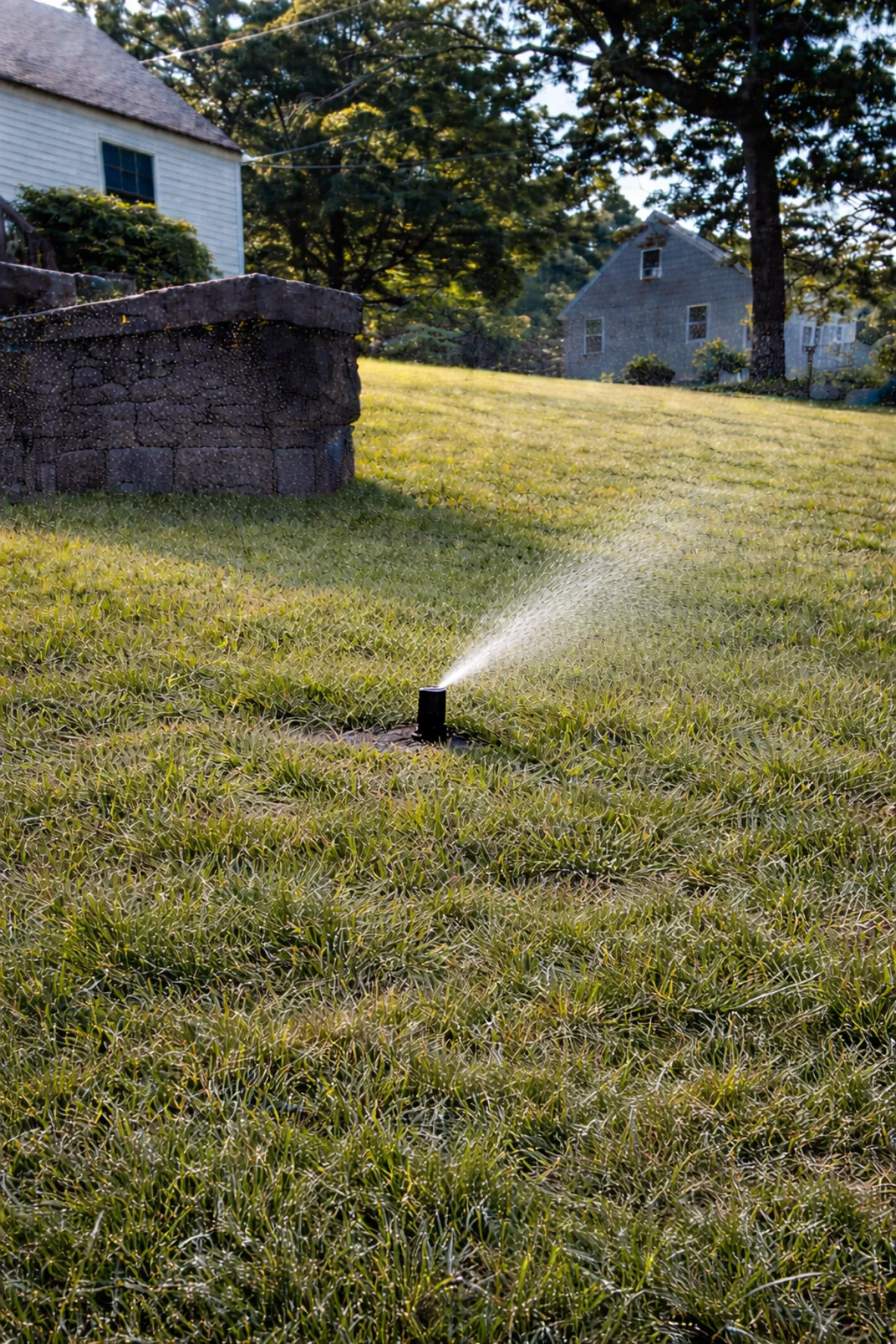
Westford is one of those towns where the soil can't make up its mind. Drive east toward the Chelmsford line and you're trenching through sandy glacial outwash. The shovel goes in easy, the pipe lays clean, and we're done by lunch. Drive fifteen minutes west toward Stony Brook and the Nashua River corridor, and the same shovel hits ledge rock that's been there since the glaciers gave up and went home. (Which, historically, is also how most homeowners feel after the first quote for rocky-till trenching.)
TL;DR: Sprinkler installation in Westford costs $3,000–$8,000 depending on lot size and zone count. Westford has split municipal and well-water properties. Well-fed systems need a flow test before design. Soil ranges from sandy outwash to rocky glacial till depending on which side of town you're on. Most installs take one to two days. A permit is required. We handle the paperwork.
What sprinkler installation actually costs in Westford
National sites will tell you "$2,000 to $10,000" and leave you to figure out which end you're on. That's not useful. Here's what we charge on real Westford properties:
| Lot type | Zones | EMI price range | Typical timeline |
|---|---|---|---|
| Small 1/4-acre / Cape Cod (~12,000 sqft) | 4 zones | $3,000–$4,500 | 1 day |
| Average 1/2-acre (~15,000–20,000 sqft) | 6–8 zones | $4,500–$6,500 | 1–2 days |
| Larger colonial / over 1/2-acre | 8–12 zones | $5,500–$8,000 | 2–3 days |
Those numbers include everything: heads, valves, mainline, lateral lines, controller, backflow preventer, wiring, trenching, and cleanup. We don't do the "base price plus extras" thing where the final bill surprises you.
The national average on DripWorks and LawnLove sits around $4,600 for a half-acre system. That's close to our mid-range. The problem is they're averaging in states where the frost line is 6 inches and there's no backflow testing requirement. Massachusetts adds cost for frost depth, permits, and annual backflow compliance. We explain every line item before we dig.
What makes Westford different from the next town over
Westford sits on the western edge of Middlesex County, and the geology changes fast as you cross town. That matters for installation more than most people realize.
The well-water question. A significant number of Westford properties run on private wells, especially on the western and northern sides of town toward Groton and the Nashua River corridor. Municipal water is straightforward, consistent pressure, known GPM. Well water requires a flow test before we design anything. We check the well pump output, the pressure tank capacity, and the recovery rate. A well producing 8–10 GPM comfortably handles four to six zones. Below 6 GPM, we adjust the zone count, extend cycle times, or discuss a storage tank. We've installed dozens of well-fed systems in Westford. It's not harder. It just needs the numbers first.
If you're on municipal water near the town center or along Route 110, skip this section. Your system installs the same as it would in Chelmsford or Burlington.
The soil is a coin flip. Eastern Westford near the Chelmsford border sits on sandy glacial outwash — the same deposit that runs through Chelmsford's western side. Trenching is fast, pipe goes in clean, and the lawn recovers in two weeks. Head west toward the Stony Brook conservation area and the Nashua River lowlands, and you're in rocky glacial till. Ledge rock at 8–12 inches turns a straight trench into a negotiation. We've broken rock saws on properties off Depot Street and near the Stony Brook corridor. Two neighbors on the same road can have completely different install timelines.
We pull soil samples before designing every Westford system. Not optional. The sprinkler layout that works on sandy outwash floods on till, and the run times that drain properly on till leave sandy soil parched by Tuesday.
The conservation buffers. Westford has significant conservation land: the Stony Brook watershed, the Nabnasset area, the Forge Pond corridor. Properties adjacent to conservation zones often have wetland setbacks that constrain where we can trench and place valve boxes. We check with the Conservation Commission before we dig. It's not a delay. It's a requirement. And it's better than finding out after the install that your valve box is three feet inside a no-disturb zone.
The housing stock. Westford has a mix of older colonials near the town center, 1980s and 1990s subdivisions off Route 110 and Route 225, and newer builds on the eastern side approaching Chelmsford. Each generation has different plumbing, different water supply (municipal vs well), and different lot layouts. A 1980s split-level on a well with a septic system needs a different design than a 2005 colonial on municipal water with a flat quarter-acre.
Why Massachusetts installation costs more than the national average
Massachusetts has three things working against cheap installation:
Frost depth. Our mainline gets buried at 10–12 inches minimum to stay below the frost line. In warmer states, 6 inches does it. Deeper trenching means more labor per foot and heavier equipment on smaller lots. The Irrigation Association publishes installation depth guidelines for frost zones. We follow them because a shallow line that freezes in January is a $500 repair come April.
Backflow preventer. Every residential irrigation system in Massachusetts needs a testable backflow preventer. That's code, not a suggestion. The hardware runs $150–$300, installation adds another $200–$400, and you'll need an annual test ($75–$125) to keep it compliant. Westford requires it. We handle the paperwork and the test coordination.
Permits. Westford requires a plumbing or irrigation permit for new installation. Fees range $50–$100. The permit triggers an inspection, which means the install has to meet code on the first pass. National installers who skip permits leave you with a system that works fine until you sell the house and the buyer's inspector finds it.
What's included in a professional EMI install
Every Westford installation includes:
- Site survey and soil assessment: we walk the property, check water pressure (or test well flow rate), pull soil samples, and map the zone layout before we dig
- Design: head placement, precipitation rate matching, pipe routing, valve box locations, controller placement
- Trenching and pipe installation: mainline at 10–12 inches, lateral lines at 8–10 inches, Schedule 40 PVC
- Heads: Hunter PGP rotors for large areas, Hunter MP Rotator or Rain Bird 1800 series for beds and narrow strips
- Valve manifold: Hunter or Rain Bird valves in accessible valve boxes, wired back to the controller
- Controller: basic Hunter or Rain Bird timer included. Hunter Hydrawise or Rachio smart controller recommended for 5+ zones ($200–$500 upgrade)
- Backflow preventer: testable double-check or RPZ depending on Westford's code requirements
- Wiring: 18-gauge direct-burial wire, properly spliced and waterproofed
- Startup and walkthrough: we run every zone, adjust every head, program the controller, and show you how it all works before we leave
- Cleanup: trench lines filled, sod replaced, gravel raked. We leave the yard cleaner than we found it.
The Westford install timeline
Most Westford installs follow this schedule:
Day 0 (before we arrive): You call us at 781-983-3739. We ask about your lot size, water source (municipal or well), any existing landscaping, pool locations, fence lines, and whether you want a smart controller. We give you a ballpark over the phone and schedule a site visit.
Site visit: We walk the property, check water pressure at the hose bib (or test well flow rate), map the zone layout, and give you a written quote. No pressure. If you want to think about it, think about it.
Install day 1: We mark utilities (Call Dig Safe, it's the law in Massachusetts), trench the mainline and lateral lines, install the valve manifold, and run the wiring. On a quarter-acre lot with sandy soil, we're usually done by mid-afternoon. On rocky till, expect the trenching to take longer.
Install day 2 (if needed): For larger lots, rocky-soil properties, or properties with complex layouts (fences, pools, garden beds), we finish head installation, connect the controller, install the backflow preventer, and run the startup walkthrough.
Total time: One day for most Westford properties on the eastern side. Two days for larger lots or properties west of Stony Brook where the till lives.
When to stop reading this and just call someone
If you're on a quarter-acre lot with municipal water, no pool, no fence complications, and you just want the front and back lawn covered, call us and we'll quote it in fifteen minutes. You don't need to read another article.
If you're on a well and you don't know your flow rate, call us. We'll test it for free during the site visit and design the system around the actual numbers. Don't guess on well capacity. A system designed for municipal pressure on a well that pumps 5 GPM will frustrate you every dry week of summer.
If you're on a half-acre or larger with mixed landscaping, a pool, garden beds, and a septic system, the site visit matters. We'll walk it, design it, and show you exactly where every head goes before we dig. That's the difference between a system that works and a system that makes you call us back in August.
If you have a 15-year-old system that mostly works but has a few tired zones, you probably don't need a full new install. You might just need targeted repairs. We'll tell you honestly.
Honest pricing. No "starting at" nonsense.
| Lot size | Zones | Price range | Includes |
|---|---|---|---|
| 1/4 acre (Cape Cod) | 4 | $3,000–$4,500 | Everything listed above |
| 1/2 acre (colonial) | 6–8 | $4,500–$6,500 | Everything listed above |
| 3/4+ acre | 8–12 | $5,500–$8,000 | Everything listed above |
Smart controller upgrade: add $200–$500 (recommended for 5+ zones)
Permit fee: $50–$100 (we handle the paperwork)
Annual backflow test: $75–$125 (required by Westford code, we coordinate)
Well flow test: included in site visit at no extra charge
We quote the exact number after the site visit. The price we quote is the price you pay. If the job turns out to be more complex than the phone call suggested (ledge rock, surprise clay, a septic tank we didn't know about), we stop, re-quote, and wait for "go ahead" before we continue. That's how it works when the owner is on the truck.
Straight answers.
Do I need to be home during the install? We prefer it for the walkthrough at the end, but the trenching and pipe work can happen while you're at work. We'll coordinate access for the water shutoff.
Will the trenching damage my lawn? We cut sod in strips, stack it aside, backfill, and replace it. The lines heal in two to three weeks during the growing season. On rocky till where we have to work around ledge, recovery takes a bit longer but the result is the same.
What if my water pressure is low? We check pressure at the site visit. Most Westford municipal homes have 45–60 PSI at the hose bib, which is fine. Well-fed homes depend on the pressure tank setting, typically 40–60 PSI. Below 40 PSI and we'll discuss a booster pump or adjusted head selection.
Can you install around my septic system? Yes, but we need to know where it is before we trench. We'll mark it and route around it. If you don't know where your tank and leach field are, we can locate them. Westford has a lot of septic systems — this comes up on nearly every western-side install.
What brands do you install? Hunter and Rain Bird for heads and valves. Hunter Hydrawise, Rachio, and Rain Bird ESP-TM2 for controllers. Watts and Febco for backflow preventers. We carry parts for all of them on the truck.
How do I maintain the system after installation? Annual spring start-up ($75–$175 depending on zones), annual winterization ($100–$150), and a mid-season check if you want one ($95–$125). Or grab the EMI membership at $410/year — it covers all three plus a service call and 10% off parts.
If your Westford lawn has been surviving on a garden hose and the weather app's rain predictions, call us at 781-983-3739. We'll walk the property, test the water, design the system, and give you a number that doesn't change when we're done. Twenty-five years digging trenches in this part of Middlesex County. We probably know your soil better than your geologist does. (We definitely charge less. And our jokes are worse, which somehow makes the bill feel lighter.)
Ready to get your system handled?
EMI Irrigation — family-owned, serving the greater Billerica area and Southern NH.