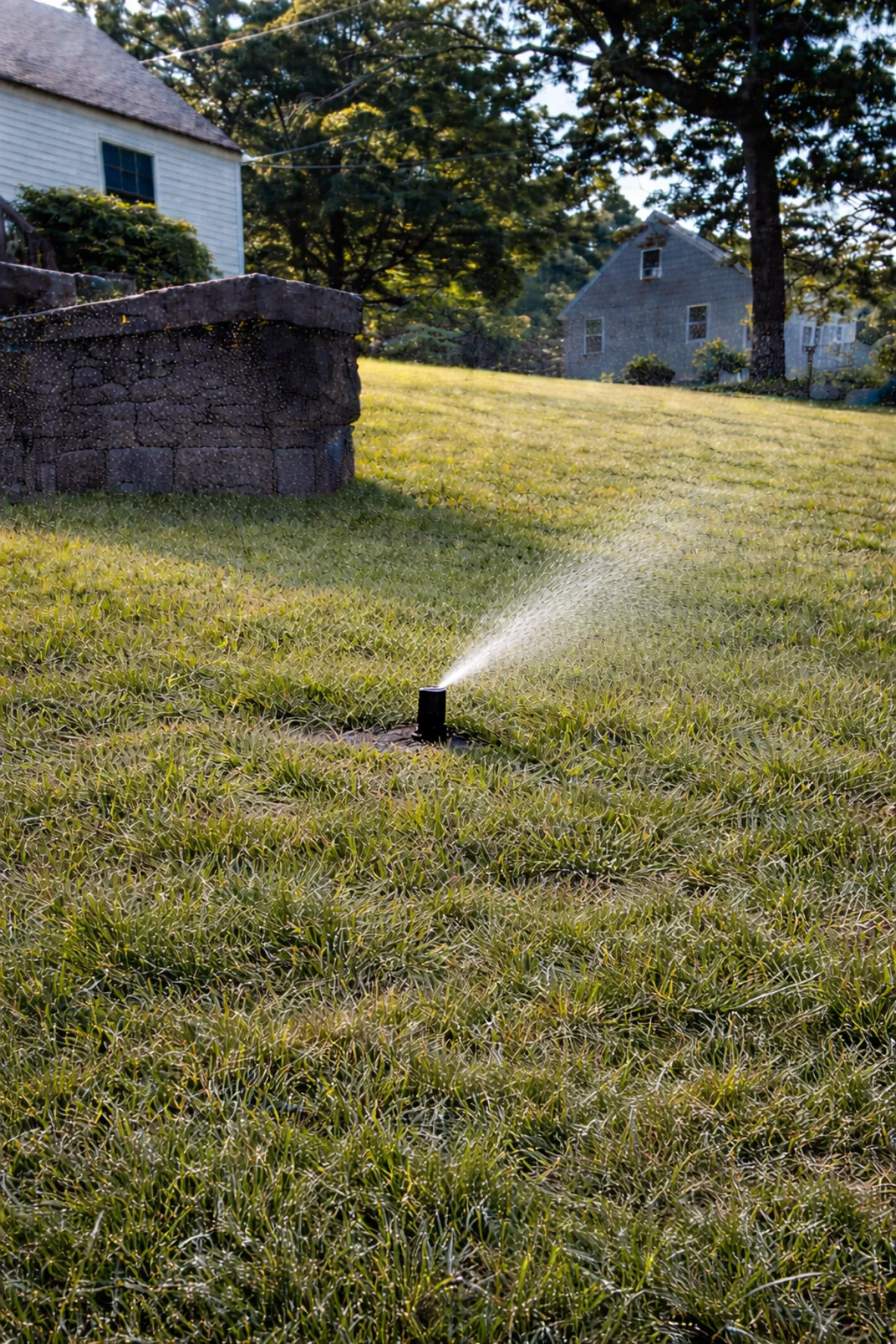
Sprinkler Not Popping Up? Fix It in 10 Minutes (Or Know When to Call)
A sprinkler head that won't pop up is the irrigation equivalent of a teenager who won't get out of bed — the mechanism works fine, it just needs the right motivation. (Usually that motivation is water pressure. For the teenager, I can't help you.)
TL;DR: Nine times out of ten, it's one of three things: debris in the riser, a head that's sunk below grade, or low pressure from a partially closed valve. All three are fixable in under 10 minutes. The tenth time, it's a broken spring or torn wiper seal — that's a head replacement at $75–$150. The national guides skip the Massachusetts stuff (frost heave, sandy soil, iron-rich water). That's what the rest of this covers.
The diagnostic sequence — check these in order
I've been doing this since 2000 and I still walk every stuck head through the same five checks. The order matters because you start with the free stuff and work toward the expensive stuff. Nobody wants to pay $150 for a problem a screwdriver could've fixed.
1. Check the valve (the $0 fix)
Before you touch the head, check the zone valve. Walk to the valve box — usually a green rectangular lid near the street or in the side yard. Make sure the bleed screw and the solenoid are hand-tight, not cranked. Then check the main shutoff valve and the valves on your backflow preventer.
A partially closed valve is the most common cause of heads not popping up across an entire zone. The symptom is obvious: heads close to the valve pop up fine, but the ones at the far end of the zone stay flat or barely rise. That's pressure drop. Open the valve fully and the problem usually disappears.
If you don't know where your backflow preventer is, find it before you need it. It's typically near the meter or where the irrigation line branches off the main. In most Middlesex County homes, it's a brass assembly with two test cocks — looks like a small pipe sculpture that someone installed and then everyone forgot about.
2. Pull the head and flush the riser (the 5-minute fix)
If the valve checks out, pull the stuck head. Grab the top of the pop-up stem, pull it up, and hold it with one hand. With the other hand, unscrew the nozzle counter-clockwise. Look inside.
You're looking for debris — sand, dirt, small gravel, or in Tewksbury and parts of Billerica, iron deposits that look like orange sludge. (Tewksbury town water carries enough iron to stain a driveway, and it builds up inside sprinkler nozzles the same way. We see systems in the Heath Brook area where heads were throwing a 12-foot radius in May and barely reaching 6 feet by August — same hardware, same pressure, just iron sludge.)
Flush the riser by turning the zone on for a few seconds. Water will shoot straight up — stand back. Let it run until the water clears. Then screw the nozzle back on, adjust the arc, and test.
If the head pops up cleanly after flushing, you're done. Put the dirt back, pat it down, and go have a coffee.
3. Check the grade (the Massachusetts-specific problem)
Here's where the national guides stop being useful. Massachusetts is hardiness zone 6a. The ground freezes and thaws every winter. That freeze-thaw cycle does something specific to sprinkler heads: it makes them sink.
In sandy glacial outwash soil — which is what you've got in Tewksbury, most of Billerica, and parts of Chelmsford near the Westford line — the soil settles after each cycle. A head that sat flush with the lawn in October is sitting half an inch low by April. That half inch means the spray pattern hits the grass in front of the head instead of arcing over it. You get brown patches in a ring around the head. You think the system is broken. The head just needs to be raised.
The fix is simple: dig around the head (carefully — the lateral pipe is right underneath), unscrew the head from the riser, add a nipple extender or a taller head body, and re-set it flush with the grade. Parts are under $10. The job takes 15 minutes if you don't hit a rock.
Speaking of rocks — if you're in Bedford uphill toward Hanscom or the Page Road ridge, you'll hit glacial till and ledge rock within eight inches. That turns a 15-minute raise into a 45-minute muttering session. We've broken rock saws on Page Road. Your mileage may vary. Literally.
4. Inspect the head internals
If the head is at grade, the riser is clean, and the valve is open, pull the head out and look at the guts. You're checking three things:
The spring. The retraction spring sits inside the body and pulls the stem back down after watering. If it's broken or corroded, the stem won't pop up under pressure or won't retract after. You can see it when you pull the stem up — if it doesn't snap back when you let go, the spring is done.
The wiper seal. That's the rubber ring at the top of the body where the stem slides through. If it's torn, cracked, or hardened (which happens faster in sandy soil where grit gets into everything), water bleeds out around the stem instead of pushing it up. You'll see water seeping at the base of the head while the zone runs.
The filter screen. Most pop-up heads have a small mesh filter under the nozzle. If it's clogged with sediment — especially iron deposits in Tewksbury water — the head can't get enough flow to pop. Pull it, rinse it, put it back.
Any of these three failures means you need a new head body. The part itself is $5–$25 depending on whether it's a pop-up spray or a gear-driven rotor. A Hunter PGP Ultra rotor — the one we install more than anything — runs $18–$25. A basic Rain Bird 1804 pop-up spray body is $5–$8.
5. Check for a wiring fault
This is the rare one, but it happens. If the zone valve works (you can hear it click when you activate it from the controller), the heads in that zone should have pressure. If they don't, and you've ruled out everything above, there might be a break in the lateral pipe between the valve and the first head.
More often, though, the issue is a wiring fault between the controller and the valve solenoid. We've made the drive to a "dead zone" that turned out to be a chipmunk gnawing through a single direct-burial wire about six inches off the valve box. Both of us walked away unharmed. Mostly.
A wiring locate and splice runs $100–$300 depending on how deep the wire is buried and how much the chipmunk chewed.
What a head replacement actually costs in Middlesex County
No "starting at" nonsense. Just the number.
| Service | EMI Price | What You Get |
|---|---|---|
| Single head replacement (pop-up spray or rotor) | $75–$150 | Parts + labor, one trip, arc adjustment |
| Each additional head, same visit | $75–$120 | Same as above, volume pricing |
| Sunken head raise / re-level | $75–$120 | Dig, extender, re-grade, test |
| Nozzle swap only (no body) | $45–$75 | New nozzle, arc set, flush |
| Wiring fault at head (locate + splice) | $100–$300 | Wire locate, splice, test |
If we get to your property and the fix is just a partially closed valve or a clogged filter screen, we'll tell you that. We don't charge $150 for a problem a screwdriver fixed. That's not generosity — it's just how you keep customers for 25 years.
The Middlesex County soil problem nobody talks about
Two Chelmsford homeowners can have the same system, same brand, same install year, and one is replacing heads every three years while the other gets ten. The difference is soil.
Off Billerica Road in Chelmsford, you hit dense clay within eight inches. Clay holds water, expands when wet, contracts when dry. That constant movement works the threads on the riser fitting. We've pulled heads that were hand-tight when installed and torqued solid by clay pressure two years later.
Drive a mile west toward the Westford line and it's sandy glacial outwash — drains so fast the water's at root level for about 90 seconds before it's gone. Heads settle faster, tilt faster, and sink faster in sandy soil because there's nothing holding them in place.
Then there's the wind corridor off I-93 in Wilmington. Properties near Route 129 get sustained summer gusts of 25–35 mph. That wind walks rotor heads off their arcs, strips wiper seals out of pop-up nozzles, and accelerates gear wear. A rotor that should last 10 years on a sheltered Bedford lot gives out in 6–7 in Wilmington.
The national "sprinkler heads last 10–15 years" number is a fantasy in Middlesex County. Plan on 7–12 depending on soil and microclimate.
When to stop reading and call someone
I'll happily talk you out of a service call if the fix is in your garage. But here's when you should pick up the phone:
Multiple heads in the same zone won't pop up. That's usually a valve diaphragm issue, not a head issue. A manifold rebuild runs $300–$600 — not a DIY job unless you're comfortable working in a valve box that's been sitting in standing water for 15 years.
Water is pooling at the base of a head while the zone runs. That's a cracked lateral pipe, not a stuck head. If you ignore it, you're paying for 600 gallons of water going into the ground instead of onto the lawn. Every cycle.
You've replaced three or more heads in the same season. That's a signal the whole set is aging out. If you're on a 2000s-era builder install — which is most of Burlington, parts of Billerica, and a lot of the Route 38 corridor in Tewksbury — the heads, diaphragms, and probably the controller are all due at the same time.
You can't find the valve box. If the green lid is buried under sod, mulch, or a decade of leaves, the valves underneath are probably in worse shape. We locate and excavate buried valve boxes regularly — it's not glamorous work but it prevents the "zone won't shut off at 2 AM" emergency.
The honest pricing summary
| What's wrong | What it costs | Who can fix it |
|---|---|---|
| Debris in riser | $0 | You (10 minutes, flathead screwdriver) |
| Head sunk below grade | $0–$10 | You (15 minutes, nipple extender, shovel) |
| Clogged filter screen | $0 | You (2 minutes, rinse and replace) |
| Broken spring or torn seal | $75–$150 per head | Us or a handy homeowner |
| Valve diaphragm failure | $95–$250 | Us |
| Cracked lateral pipe | $150–$350 | Us |
| Wiring fault | $100–$300 | Us |
If the fix is free, I'd rather tell you that on the phone than charge you $150 to drive over and turn a valve. Call 781-983-3739 and I'll walk you through the first three checks before we schedule anything.
Straight answers
Why is my sprinkler head not popping up? The most common causes are debris in the riser, a head that's sunk below grade from frost heave, low water pressure from a partially closed valve, or a broken internal spring. Check the simple stuff first — about a third of these calls dissolve in 10 minutes with no truck involved.
Can I fix a stuck sprinkler head myself? If the head is dirty or sunk below grade, yes — pull the head, flush the riser, and raise it flush with the lawn. If the internal spring is broken or the wiper seal is torn, you'll need a new head body. Parts run $5–$25, but getting the old one out without cracking the lateral line takes patience.
How much does it cost to fix a sprinkler head that won't pop up? A single head replacement in Middlesex County runs $75–$150, parts and labor. If the problem is a partially closed valve or debris in the line, the fix is usually $0 — just your time and a flathead screwdriver.
Why do sprinkler heads sink below the lawn in Massachusetts? Frost heave. Massachusetts is hardiness zone 6a — the ground freezes and thaws every winter. Sandy glacial outwash soil (common in Tewksbury, Billerica, and parts of Chelmsford) settles after each cycle. A head that sat flush in October can be half an inch low by April.
Should I replace all my sprinkler heads at once? Usually not. If your system is under 10 years old, replace the failed heads individually. If you're on a 2000s-era builder install and you've replaced three or more heads in the same season, that's a signal the whole set is aging out — but the mainline pipe underneath is fine for another 15+ years.
Why do only some of my sprinkler heads not pop up? If it's one head, it's usually debris or a mechanical failure in that specific head. If it's all heads in one zone, check the zone valve. If it's heads at the far end of a zone but not the close ones, you've got a pressure or nozzle-sizing problem.
Still stuck?
If your sprinkler heads aren't popping up and you've tried the first three checks, call us at 781-983-3739. We'll walk you through the rest over the phone before we schedule a truck. Most of these jobs are one visit, under an hour, and we'll probably tell you a terrible joke about glacial till while we're at it.
We've been fixing sprinkler systems across Middlesex County since 2000 — from Tewksbury's iron-water zones to Chelmsford's clay-versus-sandy blocks to the wind corridor in Wilmington. The system is usually fine. It just needs someone who knows what to look for.
Ready to get your system handled?
EMI Irrigation — family-owned, serving the greater Billerica area and Southern NH.