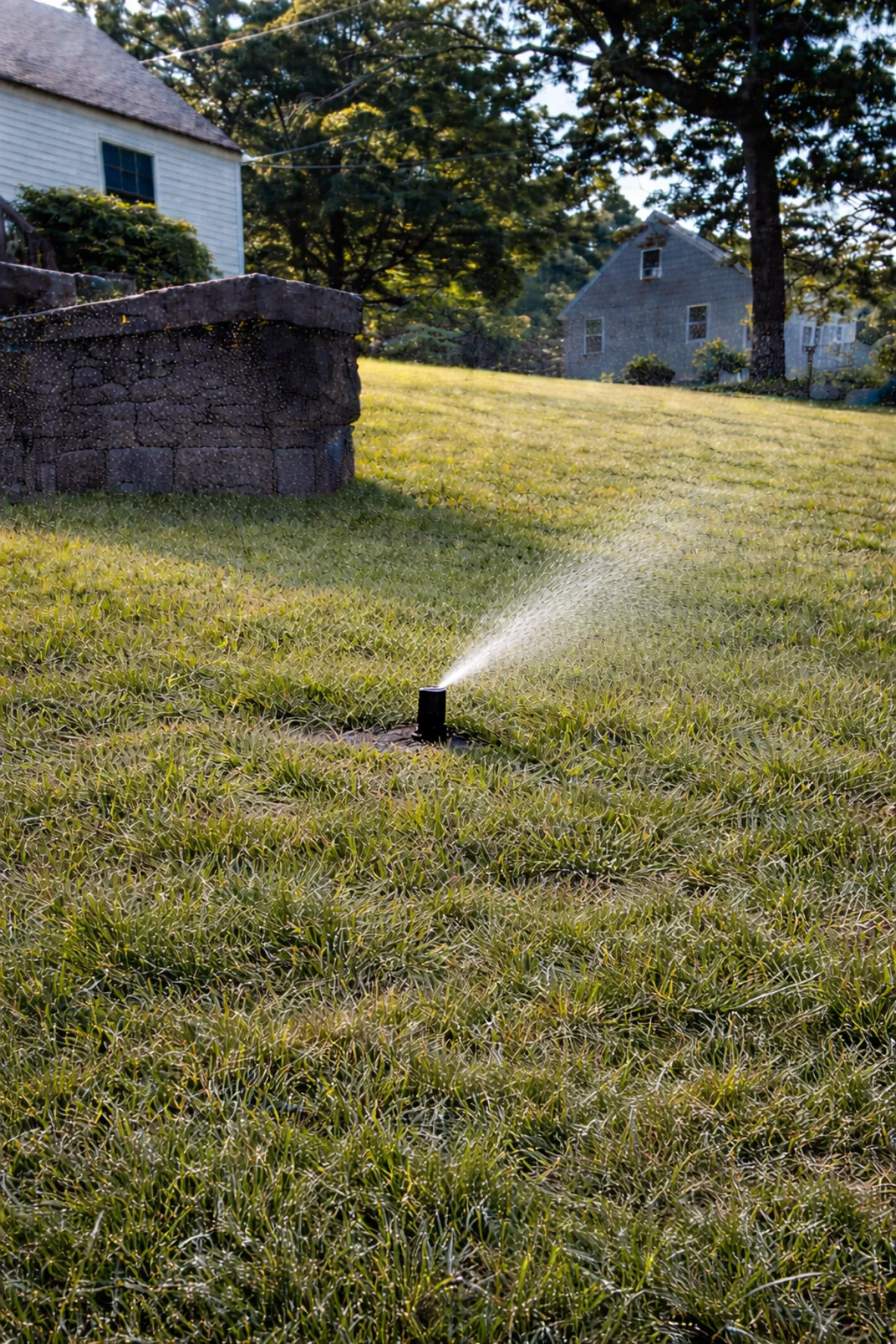
Groton sits at the edge of where Middlesex County gets serious about hills. The town has more conservation land per capita than most of our service area, more private wells than Billerica and Chelmsford combined, and enough ledge rock to make trenching an Olympic sport. Your sprinkler system doesn't care about any of that — it just needs water at the right pressure to the right heads. When that stops happening, that's where we come in.
TL;DR: Groton mixes private wells, municipal water, wetland buffers, and rocky glacial soil. Systems here need different specs depending on which side of town you're on. Repairs land between $75 and $600.
What makes Groton different
Split water supply. Parts of Groton, especially the village center and newer developments, are on municipal water. But large portions of town, particularly the rural properties along Route 111, Chicopee Row, and out toward the Dunstable line, run on private wells. That changes everything about system design, from pressure regulation to nozzle sizing.
Wetland buffers everywhere. The Nashua River, Squannacook River, and dozens of brooks and vernal pools thread through Groton. The Conservation Commission administers the Wetlands Protection Act within 100 feet of any wetland resource. If your system was installed near water, modifications may need a permit. We've worked with the Groton Conservation Commission on enough projects to know the process.
Rocky glacial soil. The western half of Groton sits on glacial till with plenty of ledge rock close to the surface. Trenching that would take a day in Billerica can take two or three in Groton. The eastern half, closer to the Lowell line, has more sandy loam — easier to dig, but drains fast and needs cycle-and-soak scheduling to avoid runoff.
Large lots, longer wire runs. Groton properties average bigger than the towns closer to Route 3. That means longer wire runs from the controller to the valve boxes, and more opportunities for wire faults along the way.
Three things that go wrong, ranked by how often we see them
1. Pressure problems on well systems
Well pressure drops when the pump cycles, when the household is using water, or when the water table dips in late summer. A zone that ran fine in May can barely reach the far heads by August.
Fix: Pressure-regulated heads ($4–$6 per head retrofit). Zone-by-zone adjustment $75–$150. Smart controller with cycle-and-soak to spread demand — $200–$500 installed.
2. Wire faults on long runs
Longer wire runs mean more exposure to rodents, frost heave, and old splices that corrode underground. A zone that won't turn on — or won't turn off — is usually a wire fault, not a valve failure.
Fix: Locate the fault, splice, and waterproof. $100–$300 depending on access.
3. Nozzles clogged by iron and manganese
Groton wells — especially in the western part of town — often carry iron and manganese that builds up inside nozzle orifices over a season. Coverage drops gradually until you notice brown patches in August.
Fix: Pull nozzles, soak or replace. Install inline filter at the backflow — $50–$95 add-on. Same pattern we see in Tewksbury and parts of Carlisle.
The Groton-specific complication: wells plus wetlands
If you're on well water AND within 100 feet of a wetland (and in Groton, that's a lot of properties), you've got two regulatory layers on any system modification. The Board of Health wants well separation distances maintained. The Conservation Commission wants no work in the buffer zone without an order of conditions.
We've navigated this enough times to know which applications need both, which need neither, and which ones the Conservation Commission is going to ask for a field delineation on before they'll issue the order. Saves you a round trip to Town Hall.
What you can check yourself
Run each zone for two minutes. Walk the lawn. Look for:
- Heads that aren't popping up all the way
- Rotors stuck in one position
- Geysering at the base of a head (cracked body)
- Wet spots that weren't there last week (leak)
- Dry patches that should be getting hit (tilted head or worn nozzle)
If the whole system feels weak, check whether you're running it while the house is using water — shower, laundry, dishwasher. Well-pump cycling is the most common cause of "my sprinklers are weak" calls in Groton.
When not to call EMI
- The whole system is weak and the well pump is running constantly. That's a well problem, not an irrigation problem. Call your well contractor.
- Controller display is dead. Check the 9V backup battery and the GFCI outlet in the garage. Both are five-minute fixes.
- Rain sensor light is blinking. It rained recently. The sensor is doing its job. Wait 24 hours.
- Brown spots over a septic leach field. Leach fields change soil moisture patterns. Not an irrigation issue.
- You just moved in and don't know where the system is. Walk the property looking for valve box covers (green rectangles flush with the ground) and heads. Map it before you call — it saves us an hour and saves you money.
What it actually costs
| Repair | Range |
|---|---|
| Single head replacement | $75–$150 |
| Pressure-regulated head retrofit | $75–$150 per zone |
| Valve diaphragm rebuild | $95–$175 |
| Valve replacement | $125–$250 |
| Wire fault locate + splice | $100–$300 |
| Inline filter install | $50–$95 add-on |
| Smart controller upgrade | $200–$500 |
| Full system audit | $95 (credited toward repairs) |
EMI members get 10% off all repairs and parts. One-year membership $410 — includes spring start-up, mid-season check-in, winterization, and a service call with the first hour free. If your system is 10+ years old, the membership pays for itself by the second seasonal service.
We work this town
EMI has been servicing Groton systems since 2000. We're 20 minutes from our Billerica shop — close enough for same-week scheduling, close enough for same-day when something's leaking.
For nearby towns: Carlisle has similar well-water challenges on larger lots, and Westford shares the rocky-soil trenching problem.
Straight answers
Q: How much does sprinkler repair cost in Groton? A: Most repairs $75–$600. Head swap $75–$150. Valve rebuild $95–$175. We quote before work starts — no surprises.
Q: Does Groton require a permit for sprinkler work? A: New installations need a Board of Health permit (well separation) and possibly Conservation Commission approval near wetlands. Repairs on existing systems generally don't. When in doubt, call us and we'll tell you.
Q: I'm on well water in Groton. Do I need special sprinkler heads? A: Pressure-regulated heads, yes. Well pressure fluctuates when the pump cycles, and standard heads give uneven coverage. Retrofit runs $4–$6 per head. We spec them as standard on every well-water system.
Q: How fast can you get to Groton? A: 20 minutes from Billerica. 3–5 business days in peak season. Active leaks and stuck valves get next-business-day priority. Call 781-983-3739.
Q: My system runs near a brook. Do I need Conservation Commission approval to fix it? A: Repairs to existing components within a buffer zone generally don't need a new order of conditions, but any expansion or relocation might. We'll assess and let you know before we start digging.
Q: Should I winterize my Groton sprinkler system? A: Yes. Every year, before the first hard freeze — usually mid-October in Groton. We blow out each zone with 50–80 PSI compressed air. $100–$150 for standard residential. Skipping it risks cracked pipes, cracked heads, and a spring start-up bill that dwarfs the winterization cost.
External resources:
- Groton Conservation Commission
- MassDEP private well guidelines
- Massachusetts Wetlands Protection Act overview
If your Groton system needs someone who knows the difference between a well-pressure problem and a broken zone — and who won't charge you for the distinction — call 781-983-3739 or book online.
Ready to get your system handled?
EMI Irrigation — family-owned, serving the greater Billerica area and Southern NH.