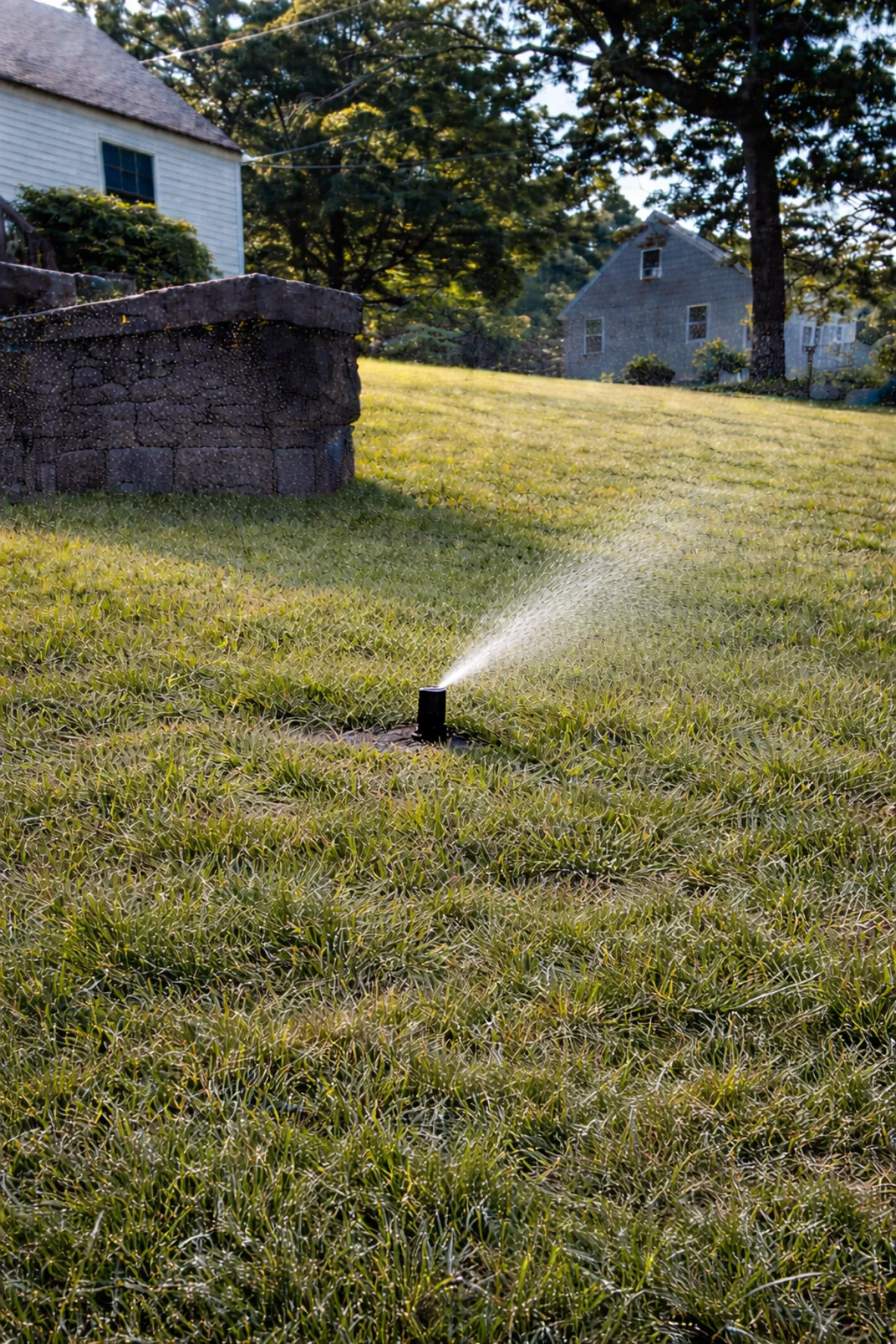
Lexington has a watering restriction problem that most homeowners don't discover until July. The timer in the garage was set in 2014, zone six starts at 9:01 AM every dry day, and that's a violation every morning all summer. The timer doesn't know. The MWRA does. (Your lawn is indifferent, which at this point is the least of your concerns.)
I've been repairing sprinkler systems in Lexington since 2000. The town runs on MWRA water from the Wachusett Reservoir, and that comes with rules: odd/even watering days, no irrigation between 9 AM and 5 PM from May through September, mandatory rain-skip after measurable rainfall. A smart controller handles all of this. A 12-year-old timer handles none of it.
TL;DR: Sprinkler repair in Lexington runs $75–$600 depending on the problem. The most common call is a dead rain sensor — a $35 part. The second most common is a timer that's been running zones into the MWRA blackout window since the Obama administration.
What makes Lexington different from the towns next door
MWRA water, MWRA rules. Lexington is one of roughly 40 communities fed by the Massachusetts Water Resources Authority. That means the strictest residential watering rules in Middlesex County. Odd/even days. No irrigation 9 AM–5 PM. Mandatory rain-skip after rainfall. The rules aren't suggestions. The town enforces them, and the fines start at $50 for a first violation.
Older colonial housing stock with aging systems. Lexington built out heavily in the 1970s through 1990s. Those homes have irrigation systems that are now 20–40 years old. The mainline PVC is fine. It lasts 30+ years buried at depth. What's failing is the surface hardware: tilted pop-up heads, hardened valve diaphragms, controllers with dead backup batteries and calendars stuck on 2011.
Variable soil, block by block. The area near Lexington Center and toward Arlington sits on heavier clay. Head toward the Bedford line or out past Route 128 and you hit sandy glacial outwash. The same sprinkler layout that works on the sandy side floods the clay side. We've seen identical systems on the same street behave completely differently because one lot has six inches of topsoil over ledge and the next has loam to the water table.
Three things that go wrong in Lexington, ranked by how often we see them
1. Dead rain sensor
The most common Lexington call, spring or fall. The system "won't turn on" because the rain sensor — a small plastic box mounted at the eave — is blocking the cycle. If it rained overnight and the sensor is working, that's correct behavior. Wait 24 hours. If the sensor is 10+ years old and the light isn't responding, it's dead.
Fix: Replace the sensor. $35 part, 10 minutes on a ladder. Massachusetts has required rain sensors on new installs since 2009, and the ones from that era are mostly clogged, corroded, or defeated by UV exposure. We carry replacements on every truck.
This is also the single cheapest way to stop your system from running through a thunderstorm. A $4,000 irrigation system running during a downpour isn't just wasteful. In Lexington, it's a violation if it's happening on the wrong day.
2. Timer running into the MWRA blackout window
The second most common call, and the one homeowners never figure out on their own. The system runs fine. It just runs at the wrong time. A 7:00 AM start across 10 zones at 12 minutes per zone means zone 6 starts at 9:00 AM exactly. That's the MWRA blackout. Every dry day. All summer.
Fix: If the timer is a basic mechanical or early-digital model (Hunter ICC, Rain Bird ESP from the 2000s), replace it with a smart controller. The Hunter Hydrawise or Rachio handles odd/even days, the 9 AM–5 PM blackout, and rain-skip automatically. Install runs $200–$500 including the controller, and it takes about 90 minutes onsite. On a six-zone Lexington system, the water savings alone pay for the upgrade in two to three seasons.
If you're not ready to replace the timer, at least reprogram the start times so every zone finishes before 9 AM. That means earlier start times as the zone count goes up. 6:00 AM for a 10-zone system, maybe 5:30 AM for 12 zones. Not glamorous, but legal.
3. Valve diaphragm failure
The valve manifold sits in a green box in the yard, sometimes in standing water, and never gets serviced until it fails. The rubber diaphragms inside harden with age, especially in Lexington's clay-heavy areas where the box stays damp. A failed diaphragm means a zone either won't open (dry patch) or won't close (constant running, flooded section).
Fix: A full manifold rebuild runs $300–$600 depending on the number of valves and accessibility. We replace the diaphragm kit, solenoid, and bonnet on each valve. Most Lexington systems have 4–8 valves in one or two manifold boxes. The mainline stays. We're only swapping the rubber and electrical parts.
This is the repair that makes people think they need a whole new system. They don't. The buried PVC is fine. The heads are probably fine. The valve guts aged out on schedule.
What it actually costs (no "starting at" nonsense)
| Repair | EMI price range | Typical visit time |
|---|---|---|
| Rain sensor replacement | $35–$75 | 15 minutes |
| Single head replacement | $75–$150 | 20–30 minutes |
| Sunken head raise / re-level | $75–$120 | 15–20 minutes |
| Valve rebuild (diaphragm kit) | $95–$175 | 45–60 minutes |
| Valve replacement | $125–$250 | 60–90 minutes |
| Mainline / lateral pipe repair | $150–$350 | 60–120 minutes |
| Wiring fault (locate + splice) | $100–$300 | 45–90 minutes |
| Smart controller upgrade | $200–$500 | 60–90 minutes |
| Full manifold rebuild | $300–$600 | 2–3 hours |
| Mid-season system check | $95–$125 | 45 minutes |
| Full diagnostic / audit | $95 (credited toward repair) | 45–60 minutes |
We quote before we start. If the job turns out to be more complex than the phone call suggested — which happens when you're diagnosing a buried system through a green box in the mud — we stop, quote the new number, and wait for you to say go ahead.
When to stop reading this and just call someone
A zone won't shut off. Turn off the mainline supply before the backflow preventer. That stops the water. Then call. A stuck valve dumping 600 gallons an hour into your basement well is not a "wait and see" situation.
Water bubbling up from the lawn. That's a mainline or lateral break. The system is pressurized. It won't fix itself. Shut off the supply and call.
Multiple zones are dry. If more than one zone isn't firing, the problem is usually upstream: the controller, the common wire, or the master valve. That's a diagnostic call, not a head replacement.
Your timer is older than your youngest kid. If the controller in the garage has a dead backup battery, a calendar that hasn't been updated since the install, and no Wi-Fi, it's time. A $200–$500 smart controller is the single highest-ROI upgrade on an aging Lexington system. Especially with MWRA rules.
When NOT to call us
One brown spot in an otherwise green lawn. Walk the system while it runs. If every head is popping up and throwing evenly, the brown spot is probably a soil issue, a thatch issue, or a shade/sun transition, not a sprinkler problem. Aeration and overseeding fix this for a lot less than a service call.
The system runs fine but your water bill spiked. Check the timer first. Did someone change the schedule? Is a zone running twice? Is the rain sensor dead so it ran through last week's storms? Three minutes in the garage saves you a $95 diagnostic.
You're selling the house and want the system "checked." We'll do it, but honestly, if the system runs, the heads pop up, and nothing's leaking, it's fine for the home inspection. Save the $95.
A Lexington-specific note on the MWRA and your timer
Every summer I get the same call from a Lexington homeowner: "I got a watering restriction notice and I don't understand what I'm supposed to do." Here's the short version.
Lexington gets its water from the MWRA — the Massachusetts Water Resources Authority — which draws from the Wachusett Reservoir. The MWRA imposes mandatory outdoor watering restrictions from May 1 through September 30:
- Odd-numbered addresses water on odd-numbered calendar days
- Even-numbered addresses water on even-numbered calendar days
- No irrigation between 9 AM and 5 PM on any day
- Mandatory rain-skip after measurable rainfall (typically 24–48 hours)
The rules are real and the town enforces them. A smart controller handles all of this automatically. It knows your address, tracks rainfall via the sensor, and adjusts the schedule. A 12-year-old timer in your garage handles none of it. That's the single biggest reason to upgrade the controller before anything else on an aging Lexington system.
If you're curious whether your current timer is compliant: look at the start times. If any zone starts after 8:45 AM, it's probably running into the blackout. If the schedule doesn't alternate odd/even days, it's non-compliant on half the calendar.
Straight answers
How much does sprinkler repair cost in Lexington? Most repairs run $75–$600. The most common fix, a dead rain sensor, is $35–$75. A valve rebuild is $95–$175. A smart controller upgrade is $200–$500. We quote before we start.
Why does my system violate MWRA rules? Because the timer was programmed once and never touched again. The MWRA requires odd/even watering and a 9 AM–5 PM blackout. If your timer doesn't know about either, it's running non-compliant zones every day. A smart controller fixes this automatically.
My system won't turn on in spring. What's wrong? Check the rain sensor light. If it's active, the sensor blocked the cycle after overnight rain. Wait 24 hours. If the sensor is dead (10+ years old), replace it. $35 part, 10 minutes. That's the fix nine times out of ten.
Should I repair or replace my 15-year-old system? Probably repair. The mainline PVC lasts 30+ years. What fails at 15 years is the heads, the valve diaphragms, and the controller. A $300–$600 manifold rebuild plus a $200–$500 controller upgrade usually buys another decade for a fraction of a full replacement cost.
How fast can EMI get to Lexington? Three to five business days in peak season. For urgent issues (stuck valve, mainline break, continuous running), we can usually get there within 24 hours. Call 781-983-3739.
Do I need a permit for sprinkler repair in Lexington? No. Permits are required for new installation, not for repair or replacement of existing components. If we're swapping heads, rebuilding valves, or replacing a controller, no permit needed. If you're adding new zones or extending the system, then yes, we handle the paperwork.
What's the difference between a sprinkler repair and a system audit? A repair fixes a specific problem. An audit is a full walkthrough. We run every zone, check every head, test the pressure, inspect the valve manifold, and give you a written punch list of what needs attention. The audit costs $95, and that $95 is credited toward any repair you approve. Most Lexington homeowners with systems older than 10 years benefit from an audit once, then targeted repairs after that.
About EMI Irrigation
EMI Irrigation has been installing, repairing, and winterizing sprinkler systems across Middlesex County since 2000. Nick — the owner — still answers the phone (781-983-3739) and is on most jobs. We service 50+ towns from our Billerica base, including Lexington, Concord, Burlington, Bedford, Arlington, Waltham, and into the Laconia lakes region of New Hampshire.
If your Lexington system is running zones into the MWRA blackout, has a dead rain sensor, or just needs someone to look at it and tell you honestly whether it's a $35 fix or a $3,000 problem, give us a call. We'll tell you which one it is before we touch anything.
Ready to get your system handled?
EMI Irrigation — family-owned, serving the greater Billerica area and Southern NH.