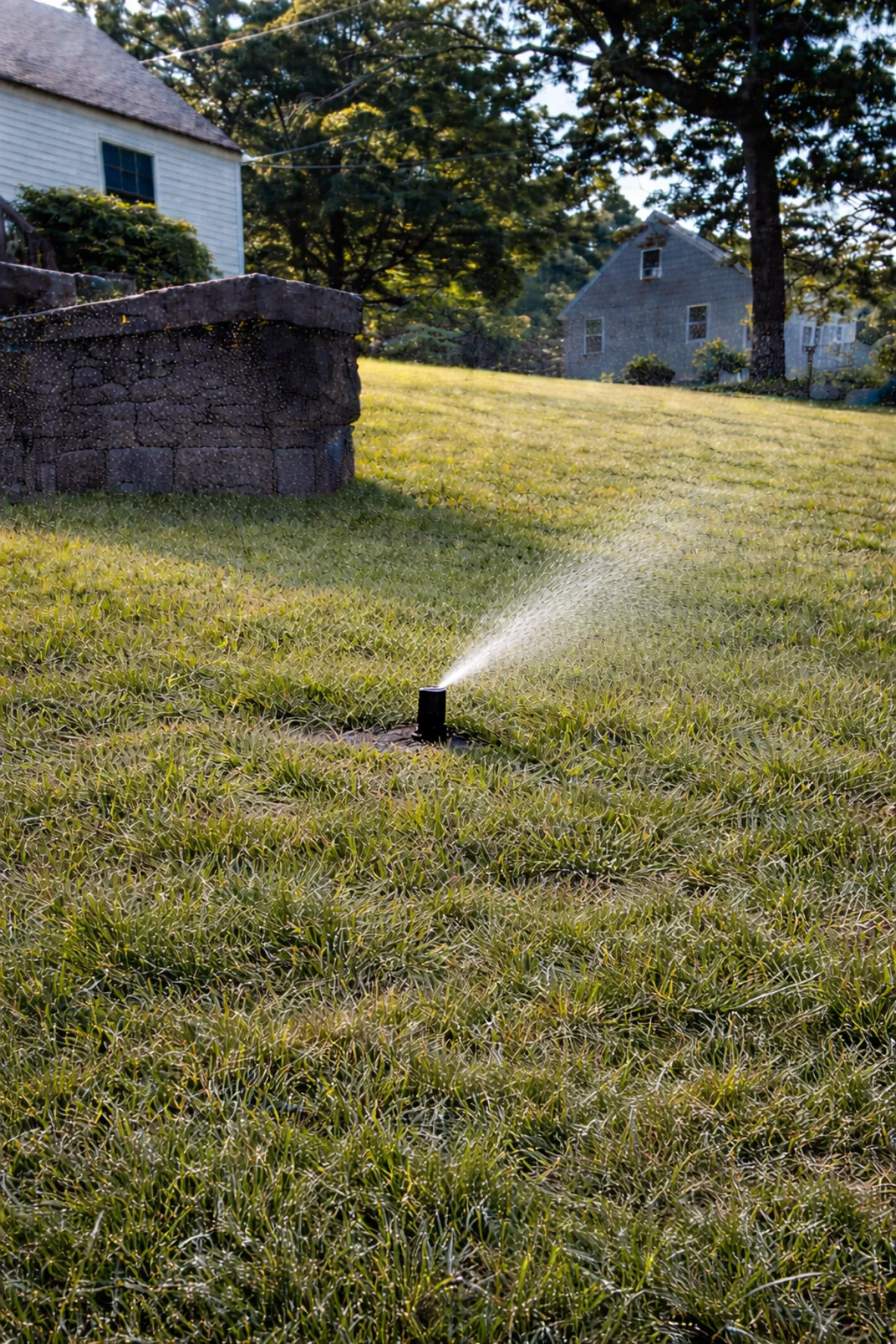
Sprinkler System Upgrades: What Actually Saves Water
Your sprinkler system was installed sometime between 2003 and 2015. It runs. The lawn is mostly green. But you've heard about smart controllers and water-saving heads and you're wondering whether any of it is worth the money, or whether it's just the irrigation industry's version of buying a new phone when your current one works fine.
Honest answer: most 15-year-old systems in Middlesex County have $300-$800 in upgrades that would pay for themselves in two to three seasons. Some of those upgrades are genuinely useful. Some are marketing dressed up as innovation. Here's which is which.
What's actually failing on your 2000s-era system
I've been installing and repairing sprinkler systems across Middlesex County since 2000. The residential boom of the early 2000s put thousands of systems in the ground. Burlington alone had a massive build wave along the Route 62 corridor and off Winn Street. Those systems were installed by framers chasing schedules, not irrigation specialists designing for longevity.
Fifteen to twenty years later, here's what's showing its age:
- The controller in your garage is a Hunter ICC or Rain Bird ESP programmed in 2009 and not meaningfully updated since. Backup battery dead. Calendar out of date. No internet. It runs the same schedule in July as it does in April, which is like wearing a winter coat in summer because you forgot to check the weather.
- The spray heads are throwing water at whatever pressure the valve sends. The ones closest to the valve get 50 PSI. The ones at the end of the zone get 30. Coverage is uneven by design.
- The valve diaphragms are rubber that's been sitting in a green box, sometimes in standing water, for 15 years. They're turning into Triscuits. (That's a technical term. Mostly.)
- The rain sensor, if there even is one, is clogged, dead, or defeated. Massachusetts has required rain sensors on new installs since 2009. The ones from that era have mostly given up.
The mainline PVC is usually fine. Schedule 40 PVC buried at proper depth lasts 30+ years. Don't replace the buried infrastructure when only the surface components are tired.
The three upgrades that actually matter
1. Smart controller ($200-$500 installed)
This is the single highest-ROI upgrade on any system with 6 or more zones. A smart controller connects to WiFi, pulls local weather data, and automatically adjusts your watering schedule. Rain forecast? It skips the cycle. Heatwave? It adds water. You control everything from a phone app.
The numbers: 20-35% reduction in outdoor water use in the first season. On a Middlesex County home watering 6-8 zones, that's $100-$200 per year off the water bill. The install runs $200-$500 all-in, including the unit, wiring to your existing 24V AC system, WiFi setup, and programming. Most installs take 60-90 minutes. No rewiring needed. They work on the same 24V AC wiring your old timer uses.
The brands I carry on the truck: Hunter Hydrawise (most reliable long-term), Rachio 3 (best app), Rain Bird ESP-TM2 (budget option that still does the job). All three work on existing wiring. Pick based on which trade-off you care about, not whichever YouTube ad you saw last.
One thing that's worth the upgrade alone: automatic compliance with watering restrictions. Lexington, Burlington, and other MWRA-fed towns issue restriction notices every summer. No watering 9 AM to 5 PM, odd/even days, mandatory rain-skip after rainfall. A 7:00 AM start across 10 zones at 12 minutes per zone means zone 6 starts at 9:00 AM exactly. That's a violation, every dry day, all summer. A smart controller handles this automatically.
2. Pressure-regulated spray heads ($4-$6 per head)
This one surprises people. Your existing pop-up spray heads throw water at whatever pressure the valve sends. On most 2000s-era systems without pressure regulation, the heads closest to the valve are throwing 50 PSI and the ones at the end of the zone are throwing 30. That's a 40% pressure differential across a single zone. Coverage is uneven by design.
Pressure-regulated heads maintain a consistent 30-40 PSI regardless of incoming pressure. The result: uniform coverage, less misting (which evaporates before it hits the ground), and 10-15% water savings from reduced waste alone.
The retrofit is straightforward. Swap the existing head bodies for pressure-regulated ones. Same footprint, same connections, same pop-up height. A 6-zone system might have 30-40 heads, so you're looking at $120-$240 in parts plus labor. Most systems can be done in a half-day visit.
This is the upgrade I recommend most often on Burlington and Chelmsford systems from the 2000s build wave. The heads are tired, the nozzles are worn, and the pressure variation was never addressed at install. A head-and-nozzle overhaul runs $500-$1,500 depending on system size, but the difference in coverage is immediate. You can see it from the back step.
3. Wired rain sensor ($35)
The cheapest upgrade with the biggest "why didn't I do this sooner" factor. A wired rain sensor mounts at the eave, detects rainfall, and tells the controller to skip the cycle. It's required by Massachusetts code on all new installs, but the ones from 2009 are mostly dead.
If you have a 15-year-old system and the rain sensor hasn't been replaced, it's probably not working. A $35 sensor replacement keeps a $4,000 system from running through a thunderstorm. I've seen systems in Billerica running at full blast during a July downpour because the sensor was clogged with pollen and leaf debris. Six hundred gallons into a saturated lawn while it's raining. The grass didn't need it. The water bill didn't need it. The neighbor who watched it happen definitely didn't need it.
A "smart" rain sensor that's a Wi-Fi weather lookup is not a substitute for a wired rain sensor at the eave. It's a supplement. Massachusetts code wants a physical sensor on the structure. The Wi-Fi one helps; it doesn't replace.
Upgrades that are worth it on aging systems
Valve manifold rebuild ($300-$600)
The valve manifold is the most-overlooked failure point on any 2000s-era system. It's sitting in a green box, sometimes in standing water, never serviced. Rubber diaphragms harden. Solenoids corrode. A full manifold rebuild replaces the diaphragms, solenoids, and bonnets on all valves. Parts are $10-$15 per valve; the rest is labor.
If your system has zones that don't fully shut off (you see seepage from heads after the zone cycles), or zones that take a long time to start, the valve diaphragms are probably the issue. A rebuild is usually cheaper than replacing the whole manifold.
Nozzle replacement ($2-$5 per nozzle)
Sprinkler nozzles wear out. The orifice enlarges slightly over 15 years of use, which changes the precipitation rate and throw distance. On systems in Tewksbury where the town water carries enough iron to stain driveways orange, the nozzles clog with iron sludge and coverage falls off by half by August. A $15-$25 stainless mesh inline filter at the backflow cuts that maintenance load by roughly 70%.
Nozzle replacement is cheap and makes a visible difference in coverage uniformity. It's often done as part of a head-and-nozzle overhaul.
Upgrades that are mostly marketing
Full system replacement when 30% of heads need swapping
If someone walks your property for free and the deliverable is a quote with the word "replacement" five times, they came to sell you a new install. A real inspection produces a punch list of $50-$300 fixes, not a $9,000 PDF. If the mainline is intact and the valve bodies are solid, upgrade the surface components. Don't rip out buried infrastructure that has another 15 years of life.
"Smart" everything
A smart controller is worth it. Pressure-regulated heads are worth it. But not every component needs to be "smart." Smart valve boxes, smart flow sensors, smart zone-by-zone monitoring, these are features that sound impressive on a quote and get used for about two weeks before the homeowner stops checking the app. The core upgrades (controller, heads, rain sensor) deliver 90% of the benefit at 20% of the cost.
When to stop upgrading and start replacing
There's a line. If your system needs $2,000-$3,000 in upgrades across heads, valves, controller, and sensors, and the mainline is 20+ years old with evidence of previous repairs, full replacement might be the better investment. A new 6-zone system in Middlesex County runs $4,500-$6,500 with modern components, smart controller, and pressure-regulated heads from day one.
The rule of thumb: if the upgrade cost exceeds 50% of a full replacement, and the system is over 15 years old, replace it. If the upgrade cost is under 30% of replacement, and the mainline is sound, upgrade it. The middle zone is where the judgment call lives, and that's what a diagnostic visit is for.
We charge $95 for a full system audit, and that $95 gets credited toward whatever work you decide to do. We'll tell you honestly whether your system needs $300 in upgrades or $5,000 in replacement. Repeat customers are worth more to us than one big invoice.
What it actually costs (no "starting at" nonsense)
| Upgrade | Cost range | ROI timeline |
|---|---|---|
| Smart controller (installed) | $200–$500 | 2–3 seasons |
| Pressure-regulated head retrofit (30–40 heads) | $300–$600 | 2–3 seasons |
| Wired rain sensor | $35–$50 | Immediate |
| Valve manifold rebuild | $300–$600 | Immediate (stops seepage) |
| Nozzle replacement (full system) | $100–$250 | Immediate (visible coverage improvement) |
| Head + nozzle overhaul (full system) | $500–$1,500 | 2–3 seasons |
| Full system replacement (6–8 zones) | $4,500–$6,500 | 10+ years |
When to stop reading this and just call someone
If your system is over 10 years old and you haven't had a professional look at it in the last three years, schedule a diagnostic. Not a "free inspection" sales call. A real diagnostic that produces a punch list of specific fixes with prices. We'll walk the system with you, zone by zone, and show you exactly what's worn, what's failing, and what's fine for another five years.
Call EMI Irrigation at (781) 983-3739. I'll come out, look at the system, and give you an honest answer about what's worth upgrading and what's not. We serve 50+ towns across Middlesex County, including Billerica, Burlington, Chelmsford, Tewksbury, Lowell, Lexington, Bedford, Westford, Wilmington, Acton, Concord, Carlisle, Dracut, and beyond.
Straight answers
What are the best sprinkler system upgrades to save water? The three upgrades with the highest ROI are a smart controller ($200-$500 installed), pressure-regulated spray heads ($4-$6 per head), and a wired rain sensor ($35). On a 6-zone system in Middlesex County, these three together cut outdoor water use by 25-40% in the first season.
How much does it cost to upgrade a sprinkler system? It depends on what you're upgrading. A smart controller swap runs $200-$500. Pressure-regulated head retrofits are $4-$6 per head (a 6-zone system might have 30-40 heads, so $120-$240 in parts plus labor). A full head-and-nozzle overhaul on an aging system runs $500-$1,500. Most Middlesex County homeowners spend $300-$800 on upgrades that pay for themselves in 2-3 seasons.
When should I upgrade my sprinkler system instead of replacing it? If the mainline PVC is intact and the valve bodies are solid, upgrade. The mainline on most 2000s-era systems lasts 30+ years. What fails is the surface components: heads, nozzles, diaphragms, controllers, and sensors. A $500-$1,000 upgrade on a system with good bones beats a $5,000-$8,000 full replacement every time.
Is a smart sprinkler controller worth the upgrade? On any system with 6 or more zones, yes. The water savings (20-35% off your outdoor bill) pay for the controller in 2-3 seasons. Below 5 zones, the ROI is real but slower. The bigger benefit for Massachusetts homeowners is automatic compliance with watering restrictions.
Do I need to upgrade my sprinkler heads? If your system was installed in the 2000s and still has the original heads, probably. Standard pop-up spray heads throw water at whatever pressure the valve sends, which means the heads closest to the valve get 50 PSI and the ones at the end get 30. Pressure-regulated heads fix that for $4-$6 per head. The difference in coverage uniformity is immediate.
Can I upgrade my sprinkler system myself? A smart controller swap is a legitimate DIY if you're comfortable with basic wiring. Most work on existing 24V AC and mount on the same wall bracket. Head replacements are straightforward too. But valve work, pipe repairs, and anything involving the backflow preventer should be done by a licensed contractor. Massachusetts plumbing code requires it.
Ready to get your system handled?
EMI Irrigation — family-owned, serving the greater Billerica area and Southern NH.