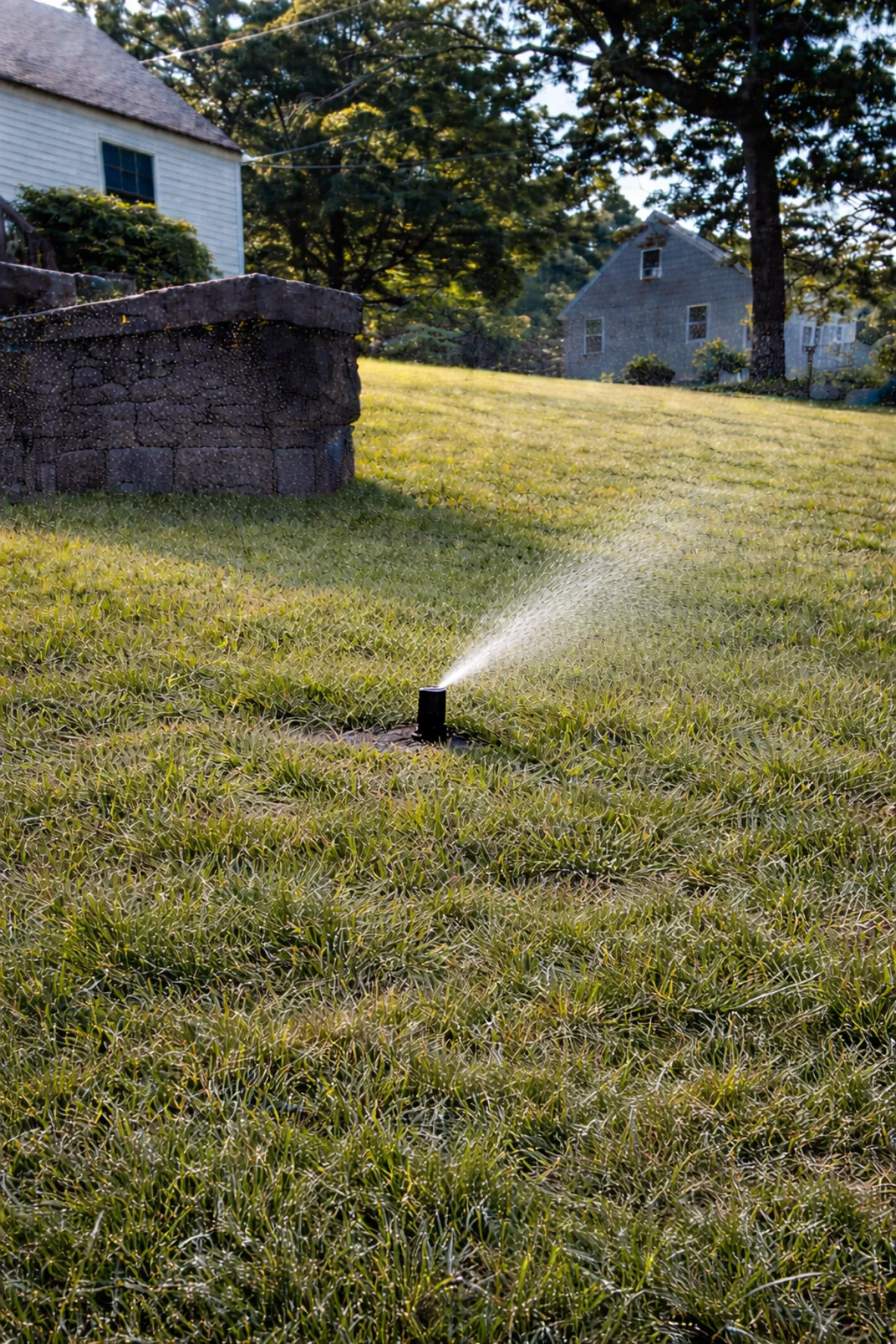
Sprinkler Zone Not Working? Diagnose It in 15 Minutes (Or Save the Service Call)
One dead sprinkler zone is the irrigation equivalent of one burner not working on your stove — the rest of the system is fine, but that corner of the lawn is quietly dying while you assume everything's OK. (I've seen lawns with a perfect green rectangle and one brown stripe down the middle. The homeowner thought it was a disease. It was a $15 solenoid.)
TL;DR: If one zone won't turn on but the others work, the problem is almost always the zone valve — specifically the solenoid, the diaphragm, or the wiring to that valve. Not the controller. Not the water supply. Not the whole system. The fix ranges from a $4 wire connector to a $250 valve replacement. Here's how to figure out which one you need.
The diagnostic sequence — start with the free stuff
I've been doing this since 2000 and I walk every dead zone through the same four checks. The order matters because you start with the $0 fixes and work toward the $200 fixes. Nobody wants to pay for a valve replacement when a wire nut was loose.
1. Check the controller (the $0 check)
Before you dig anything up, stand at the controller. Run the dead zone manually — most controllers have a "manual" or "test" button. If the controller display shows the zone running but nothing happens outside, the controller is doing its job. Move on.
If the controller doesn't show the zone running at all — no display change, no countdown timer — the problem might be the controller's zone output, not the valve. Swap the dead zone's wire with a known-working zone's wire at the controller terminal. If the dead zone now works on the working terminal, your controller has a bad output. If it still doesn't work, the problem is downstream (wire or valve).
This test takes two minutes and a flathead screwdriver. It's the first thing we do on every service call.
2. Check the valve (the most common failure)
Walk to the valve box. It's a green rectangular lid, usually buried at ground level near the street or in the side yard. Most Middlesex County homes have one box per 2–3 zones — the boxes are labeled or the wires are tagged, but not always helpfully.
Open the lid. You're looking for three things:
The solenoid — it's the small cylindrical thing with two wires coming out of the top of the valve. It's what the controller sends power to in order to open the valve. Solenoids fail. They corrode, the internal coil burns out, or the plunger gets stuck. A failed solenoid is the single most common cause of a dead zone in my experience.
Test it: turn the zone on at the controller, then manually turn the solenoid a quarter-turn counterclockwise. If the zone fires up, the solenoid is getting power but not actuating — replace it ($15–$25 part, five minutes). If the zone still doesn't fire, the problem is either the diaphragm or the water supply to that valve.
The diaphragm — it's the rubber membrane inside the valve body that opens and closes to let water through. Diaphragms tear, warp, and harden — especially on systems installed in the 2000s that have never been serviced. A torn diaphragm means the valve can't open, even with a working solenoid.
This is a valve rebuild: $95–$175 at our shop, parts run $10–$15 for the diaphragm kit. The labor is getting the valve body apart without cracking the fittings — which is why most homeowners call us for this one.
The wiring — follow the wires from the solenoid back toward the controller. Look for wire nuts (the little plastic caps connecting the solenoid wires to the field wires). In Middlesex County, these connections sit in the valve box, sometimes in standing water. They corrode. The wire nut fills with green oxidation. The connection fails.
If the wire nut is corroded, cut it off, strip the wires fresh, and re-splice with a new waterproof wire nut ($4 for a pack of five). This is the cheapest fix in irrigation and it solves maybe 15% of dead-zone calls.
3. Check for a wiring fault (the tricky one)
If the valve checks out — solenoid clicks, diaphragm is intact, manual open works — but the zone still won't run from the controller, you've got a wiring problem between the controller and the valve.
The most common wiring fault in Middlesex County is a broken or corroded common wire. Every valve shares one common wire (usually white) that runs from valve to valve back to the controller. If that common wire breaks at any splice point, every valve downstream of the break goes dead.
The test: if multiple zones stopped working at once, check the common wire connections in every valve box. One corroded common splice can take out three zones at once. I've seen this in Tewksbury and Billerica more than anywhere else — the iron-rich water accelerates corrosion on every wire connection in the box.
A wire locate-and-splice runs $100–$300 depending on how deep the fault is and whether we need to trace the wire path. Most are found and fixed in one visit.
4. Check the backflow preventer (the spring start-up surprise)
If ALL zones stopped working — not just one — the problem isn't the zone valve. It's upstream. Check the backflow preventer.
The backflow preventer is that brass assembly near your water meter with two test cocks and a couple of handle valves. In spring, if the handles weren't opened after winterization, the system is physically blocked from getting water. Open both handles (they should be parallel to the pipe, not perpendicular). If they're perpendicular, they're closed. That's your problem.
I've made the drive to a "dead system" that turned out to be closed backflow handles more times than I'd like to admit. It's a $0 fix and it takes 10 seconds. Check this before you call anyone.
When one zone is weak, not dead
Sometimes the zone runs, but badly — heads pop up with no force, the spray barely reaches the next head, or the zone takes twice as long to cover the area. That's not a dead zone. That's a pressure problem.
The most common cause in Middlesex County is a partially clogged valve. Debris — sand, iron deposits, small gravel — gets past the filter screen and lodges in the valve body, restricting flow. The zone still runs, but at half pressure.
The fix: turn off the water, open the valve body, clean the filter screen and the seat, reassemble. If the diaphragm is warped from the debris, replace it while you're in there. Parts are $10–$15. Labor is the same visit.
In Tewksbury specifically, iron buildup inside the valve is so common we carry extra filter screens on every Tewksbury truck. The iron in the water coats everything — heads, nozzles, valve internals. A $15 inline filter at the backflow cuts that maintenance load by roughly 70%.
The Massachusetts winter factor
Every spring, we get a wave of dead-zone calls from homeowners who turned the system on for the first time since October. The pattern is predictable:
- Cracked valve bodies from water that wasn't fully blown out during winterization. The ice expanded, the PVC or brass cracked, and now the valve leaks or won't hold pressure.
- Corroded wire splices from sitting in standing water in the valve box all winter. The wire nuts fill with green oxidation over the cold months.
- Blown-back backflow preventers — the freeze cracked the internal components. The backflow still passes water but it's leaking from the test cocks.
This is why spring start-up includes a zone-by-zone walk. We run every zone, watch every head, check every valve box. Catching a cracked diaphragm in April is a $125 fix. Catching it in July when the lawn is already brown is a $125 fix plus the cost of re-sodding.
When to stop troubleshooting and call someone
Here's the honest answer: about a third of dead-zone calls dissolve in 10 minutes with no truck involved. Check the controller, check the backflow handles, check the valve box for a loose wire nut. If those three checks don't solve it, you're into valve internals or wire tracing — and that's where a service call saves you time and the risk of cracking a fitting.
If your system is under 10 years old and one zone died, it's almost certainly a $95–$175 fix. If your system is 15–20 years old (the 2000s builder-installed wave that's hitting Middlesex County right now), multiple zones failing in the same season is a signal that the valve manifold is aging out — not just one valve, but the whole set. A full manifold rebuild is $300–$600, and it's usually cheaper than replacing three valves individually over three service calls.
Don't call us for a loose wire nut. Do call us when the solenoid clicks but the zone doesn't run, or when you open the valve box and see something that looks like a science experiment. We'll show up, we'll fix it, and we'll probably tell you a terrible joke about glacial till while we're at it. Consider that a bonus, not a warning.
What it costs (no "starting at" nonsense)
| Problem | Fix | Cost range |
|---|---|---|
| Loose wire nut | Re-splice | $0 (DIY) or $100–$150 (service call) |
| Failed solenoid | Replace solenoid | $75–$150 (parts + labor) |
| Torn diaphragm | Valve rebuild | $95–$175 |
| Cracked valve body | Full valve replacement | $125–$250 |
| Wiring fault (common wire) | Locate + splice | $100–$300 |
| Multiple valves aging out | Manifold rebuild | $300–$600 |
| Backflow preventer damage | Backflow replacement | $400–$800 |
Every price above is flat, all-in, approved before we start. No hourly. No surprises. If the job turns out to be more complex than the phone call suggested, we stop, quote the new number, and wait for "go ahead."
Still stuck?
If your sprinkler zone won't turn on and you've checked the controller, the backflow handles, and the valve box — or if you opened the valve box and decided you'd rather not — call us at 781-983-3739. We've been fixing dead zones across Middlesex County since 2000. Most zone repairs are one visit, same week.
Honest pricing, decent jokes, and a truck that probably gets to your driveway before the second cup of coffee.
Ready to get your system handled?
EMI Irrigation — family-owned, serving the greater Billerica area and Southern NH.