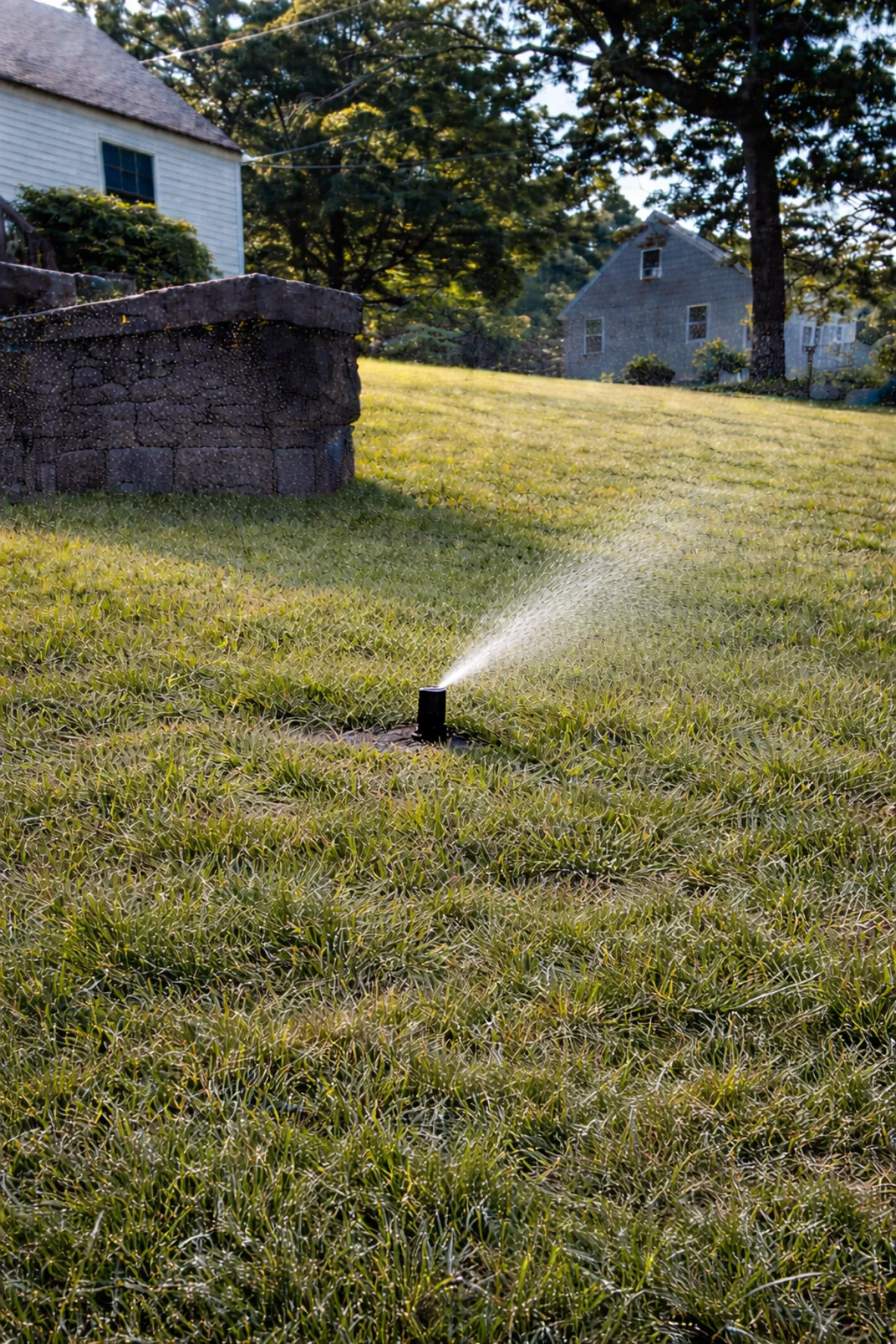
How Much Does an Irrigation System Cost in Massachusetts? Real Numbers, No Games
A guy calls me last week and asks, "How much does an irrigation system cost?" I told him it depends — do you want the one that waters your lawn, or the one that waters your driveway too? (We do both. The driveway one is cheaper because it requires zero skill.)
That question — "how much does an irrigation system cost" — is the number-one thing homeowners ask. And most of what you'll find online is either a vague range that means nothing or a sales page dressed up as a blog post. So here's the honest version.
TL;DR
Most residential irrigation system installations in Middlesex County cost between $3,000 and $8,000. A small quarter-acre lot runs $3,000–$4,500. An average half-acre property lands at $4,500–$6,500. Larger colonials with 8–12 zones hit $5,500–$8,000. Smart controller adds $200–$500. Permits run $50–$100. That's the real range — no "starting at" nonsense.
The honest price bands (no games)
I've been installing systems since 2000. Here's what residential irrigation actually costs in our service area — 50-plus towns across Middlesex County and into the New Hampshire Lakes Region.
Small quarter-acre lot (Cape Cod, ranch, ~12,000 sq ft):
- 4 zones
- $3,000–$4,500
Average half-acre property (15,000–20,000 sq ft):
- 6–8 zones
- $4,500–$6,500
Larger colonial (over half-acre):
- 8–12 zones
- $5,500–$8,000
Those are real numbers from real jobs. Not rounded, not cherry-picked, not designed to get you on the phone so someone can "assess your property" and come back with a quote that has more zeroes than a scoreboard.
What actually drives the price up or down
Every property is different. But the cost of an irrigation system isn't random — it follows a few predictable variables.
Number of zones
This is the biggest lever. Each zone needs its own valve, wiring, and head layout. A 4-zone Cape and a 12-zone colonial on the same street can be $3,000 apart for good reason. More zones means more pipe, more labor, more materials.
Lot size and layout
A flat, open half-acre is a straightforward dig. A half-acre with a pool, a patio, a retaining wall, and a shed in the back corner is a different conversation. Obstacles mean longer trench routes, more fittings, and more time. We price for the actual layout, not the tax card square footage.
Soil and terrain
This one surprises people. In Chelmsford, I can dig a trench off Billerica Road and hit dense clay eight inches down. Drive a mile toward the Westford line and it's sandy glacial outwash — the trench practically digs itself. Bedford near Hanscom? Glacial till and ledge rock that turns a one-day job into a three-day job. (We've broken rock saws on Page Road. More than one.)
Sandy soil drains fast, clay holds water, and rocky soil costs more to trench. We design around what's actually under your lawn, not what's convenient to assume.
Municipal water pressure
Some towns run higher pressure than others. Higher pressure means you can cover more area per zone, which means fewer zones, which means a lower total. Lower pressure means the opposite — smaller throws, more zones needed, higher install cost. We test pressure before we design, not after.
What's included in a standard installation
When we quote an irrigation system install, here's what the price covers:
- Design and layout — zone mapping based on your actual property, soil, and water pressure
- Trenching and pipe — Schedule 40 PVC mainline and lateral lines, buried at proper depth (below frost line in our area)
- Heads — Hunter PGP rotors, MP Rotators, or Rain Bird 5000/1800 series pop-ups depending on the zone
- Valves — Hunter or Rain Bird valve manifold in a valve box, one valve per zone
- Controller — typically a Hunter Hydrawise or Rachio smart controller (more on that below)
- Backflow preventer — required by Massachusetts code, testable double-check or RPZ depending on your town
- Rain sensor — required by Massachusetts law on all new residential installs since 2009
- Permit — we handle it; fee is $50–$100 in most Middlesex County towns
- Startup and walk-through — we program the controller, walk every zone with you, and make adjustments before we leave
What's not included: landscaping repair beyond the trench line, electrical work if your controller location doesn't have power, and any irrigation outside the residential scope (we don't do commercial).
The smart controller question — worth it or not
Short answer: yes, on any system over 5 zones.
Longer answer: a smart controller replaces the old-school timer in your garage with one that connects to Wi-Fi and adjusts watering based on actual weather data. The Hunter Hydrawise is what we prefer to install. Rachio is the one with the better app. Rain Bird ESP-TM2 is the budget-friendly option that still gets the job done.
Here's the math. A smart controller installed runs $200–$500. Install takes 60–90 minutes — works on existing 24V AC wiring, no rewiring needed. It saves 20–40% on outdoor water use starting in the first season. Payback on most Middlesex County properties is 2–3 seasons.
That's not marketing. That's what the water bill shows.
If your system is under 5 zones, the ROI is real but slower. If you're at 6–8 zones, the cycle-and-soak feature alone pays for the difference. And if you're in an MWRA-fed town like Lexington with odd/even restrictions and 9 AM–5 PM blackout windows, a smart controller keeps you compliant without you having to think about it. (Your 12-year-old timer in the garage doesn't know it's a restricted day. It also doesn't know what day it is.)
Permits, backflow, and the Massachusetts rain sensor law
Every new irrigation system install in Massachusetts requires a permit. Fee runs $50–$100 in most towns. We handle the paperwork.
You also need a backflow preventer — a device that keeps irrigation water from flowing back into your drinking supply. It's not optional, and it needs an annual test. That test runs $75–$125 depending on your town. We coordinate it or handle it in-house.
And since 2009, Massachusetts has required a rain sensor on all new residential irrigation systems. It's the thing on your eave that tells the controller to skip watering when it's rained. Sounds obvious. Is obvious. Still required by law because apparently someone needed it to be. (I'm not judging. I'm just saying the sensor exists for a reason.)
For more on Massachusetts plumbing and cross-connection requirements, the state's Board of State Examiners of Plumbers and Gas Fitters has the full regulatory breakdown.
When NOT to install a new system
This is the part where most contractors go quiet. I won't.
If your system is 15–20 years old and the mainline is still good (Schedule 40 PVC lasts 30-plus years), you probably don't need a full replacement. You might need heads, a valve rebuild, and a new controller. That's a $400–$1,200 conversation, not a $6,000 one.
I've seen it a hundred times — literally. Burlington had a residential construction boom in the 2000s off Route 62 and Winn Street. Those systems were installed by framers chasing schedules, not irrigation specialists. Fifteen to twenty years later, the heads are tired, the diaphragms are hardened, and the controllers are calendar-blind. But the mainline? Still fine.
Here's the opinion I'll stand behind: the cheapest install is rarely the cheapest five-year outcome. A customer gets quoted $2,800 for a 6-zone system using off-brand heads and no smart controller. We quote $4,200 with Hunter heads, a Hunter Hydrawise controller, and proper pressure regulation. That $2,800 system uses roughly 25% more water for the next decade. The gap pays for the install difference twice over.
If someone quotes you a full system replacement and your mainline is intact, get a second opinion. If someone quotes you under $3,000 for a 6-zone system with no brand-name parts, ask what you're actually getting. (And if they say "premium quality" without naming a brand, that's your answer.)
The real cost over five years
Installation is a one-time expense. But the system runs for decades, so the five-year picture matters more than the day-one price.
Typical five-year cost for a 6-zone system installed at $5,000:
- Installation: $5,000 (one-time)
- Annual backflow test: $75–$125/year × 5 = $375–$625
- Spring start-up: $100–$150/year × 5 = $500–$750
- Winterization: $100–$150/year × 5 = $500–$750
- Occasional repairs (heads, nozzles, minor fixes): $150–$400 total over 5 years
Five-year total: roughly $6,500–$7,500
Now compare that to a membership. Our 1-Year Membership is $410 (regular $600) and covers spring start-up, mid-season check-in, winterization, a service call with the first hour free, and 10% off parts and repairs. Over five years at membership pricing, you're looking at about $2,050 in seasonal maintenance — and your system gets professional attention twice a year, which catches small problems before they become $500 ones.
For more on winterization specifically (which protects that $5,000 investment every fall), see our guide on professional winterization services.
What if your system already has brown spots
If you're reading this because your lawn has brown patches and you're wondering whether to repair or replace, start with diagnosis, not a quote. Most brown spots on an irrigated lawn are coverage problems, not volume problems. A tilted head, a worn nozzle, or a partial valve failure — not "not enough water."
We've written about this in detail: brown spots and broken sprinkler repair. Nine times out of ten, the fix is mechanical, not a full system overhaul.
And if you want us to look at it, our diagnostic is $95 — and we credit that toward any repair if you proceed. We're not going to show up, hand you a $9,000 replacement quote, and call it a free inspection.
For details on our irrigation installation services, that page has the full breakdown.
Straight answers
How much does a sprinkler system cost for a quarter-acre lot? Between $3,000 and $4,500 for a 4-zone system. That covers design, trenching, pipe, heads, valves, controller, backflow, rain sensor, permit, and startup.
How much does an irrigation system cost for a half-acre property? $4,500 to $6,500 for a 6–8 zone system. Larger lots with obstacles (pools, patios, sheds) land toward the higher end.
Is it cheaper to repair an old system or install a new one? If your mainline is intact — and on most 2000s-era systems, it is — repair is almost always cheaper. A valve rebuild runs $95–$175. A controller swap is $200–$500. Head replacements are $75–$150 each. You can refresh a tired system for $400–$1,200 instead of $5,000–$8,000 for a full install.
Do I need a permit for a new irrigation system in Massachusetts? Yes. Nearly every Middlesex County town requires one. Fee is typically $50–$100. We handle the paperwork as part of the install.
How much does a smart controller save on the water bill? 20–40% on outdoor water use. On a 6-zone system, that's $150–$300 a year in most towns. The controller pays for itself in 2–3 seasons.
Do I need a rain sensor on my irrigation system? If it's a new install, Massachusetts law has required one since 2009. If you have an older system without one, it's worth adding — it's a $35 part that keeps your system from running through a thunderstorm.
How much is annual backflow testing? $75–$125 depending on your town. It's required annually in most Middlesex County municipalities. We coordinate it or handle it directly.
What's the cheapest irrigation system I can get? You can find someone to install a 6-zone system for $2,800 using off-brand parts and no smart controller. I wouldn't recommend it. That system will use 25% more water for the next decade. The $4,200 Hunter system pays for the difference in water savings alone — usually within 3–4 years. The cheapest install is rarely the cheapest five-year outcome.
The bottom line
An irrigation system is an investment in your lawn, your water bill, and your Saturday mornings. (Because mowing a brown lawn at 8 AM in July is nobody's idea of a good time.) The real cost isn't just the install — it's what happens over the next five, ten, fifteen years.
We've been doing this since 2000. We know which towns run what pressure, which streets sit on what soil, and which systems from the 2000s build wave are reaching end of life on a predictable schedule. If you want an honest number for your property, call us at 781-983-3739. We'll give you a real quote, with real parts, and we'll probably tell you a terrible joke about glacial till while we're there. Consider that a bonus, not a warning.
Ready to get your system handled?
EMI Irrigation — family-owned, serving the greater Billerica area and Southern NH.