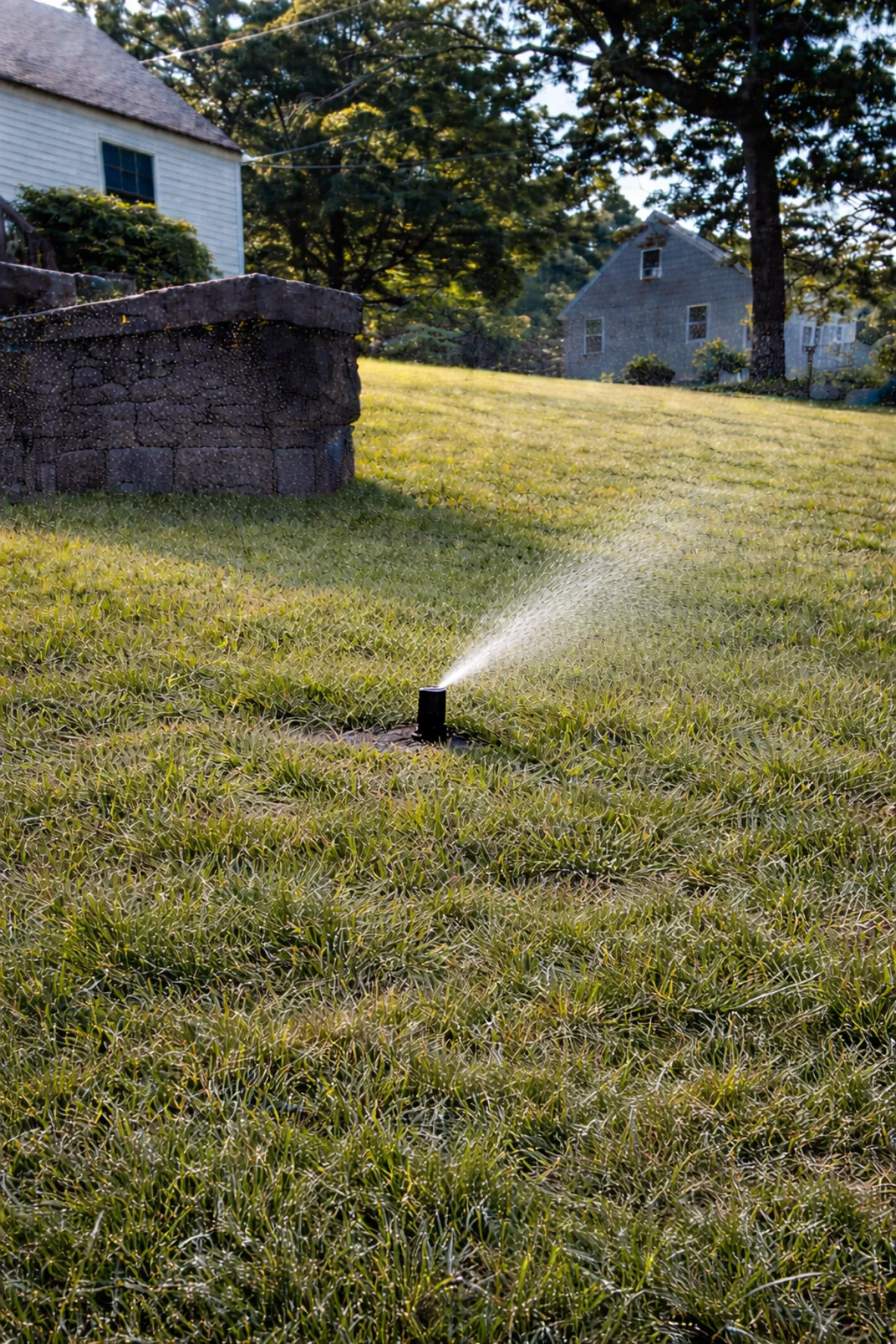
Mid-Season Sprinkler Audit: The 20-Minute Walk That Catches Trouble Before August Does
Mid-Season Sprinkler Audit: The 20-Minute Walk That Catches Trouble Before August Does
Nobody audits their sprinkler system in July. Everybody audits their sprinkler system in August, right after the brown stripe shows up next to the one head that's been misting the fence for six weeks. By then it's not an audit — it's a diagnosis, and diagnoses in August cost more than check-ins in July, mostly because the lawn's already dead in that spot and now you're talking about reseeding too.
TL;DR: A mid-season audit is a 20-minute walk (or a $95-$125 professional visit, about 45 minutes) done partway through the season to catch what spring start-up can't. Heads drift, valves stiffen, and schedules go stale after three months of running — not because anything broke, just because things wear the way things wear. Catch it in July and it's a five-minute fix. Catch it in August and it's a brown patch, a bigger bill, and a conversation about reseeding.
Why spring start-up doesn't cover this
Your spring start-up visit — the one where we walk every zone, check the winter didn't crack anything, and reprogram the controller — tells you the system survived the off-season. It does not tell you what three months of daily cycling is going to do to it.
Heads pop up and retract thousands of times over a season. Every cycle is a tiny mechanical event: a spring compresses, a wiper seal drags, a gear train turns. None of it matters on cycle one. By cycle four hundred, in early July, a head that started dead-on has usually drifted a few degrees off its original arc. Multiply that across every head on every zone and you get a system that's technically "working" and actually a little bit wrong everywhere at once.
Valves do something similar. The diaphragm inside a valve is rubber sitting in a plastic box that's frequently half-full of water. It doesn't fail dramatically in month one. It gets a little less responsive every month it's wet, until one day in August it either doesn't open all the way (weak zone) or doesn't close all the way (the zone that runs at 2 AM and again at 6 AM because the mainline never fully depressurized — yes, that's a real service call we get, and no, "my sprinklers won't stop" is never a fun voicemail to get at 6:15 in the morning).
A mid-season audit exists to catch drift while it's still drift, not once it's a diagnosis.
What we're actually looking for (and what you can check yourself)
Run every zone manually, two or three minutes each, and walk it while it's running. Here's the punch list, ranked roughly by how often we actually find something:
Head arc and alignment. Is the spray landing on grass, or is it landing on the driveway, the fence, or the side of your house? An inch of drift at the head becomes six feet of misdirected water at the edge of the pattern. This is the single most common finding on a mid-season audit, full stop.
Pop-up height. Heads that used to fully extend and now rise halfway usually have grass or dirt encroaching on the housing, or a wiper seal that's starting to drag. Either way, half a pop-up means half the intended coverage radius.
Puddling or geysering at the base of a head. That's a seal failure or a cracked riser, and it's losing water the whole time the zone runs, not just at the one head — it's dropping pressure to every other head on that zone too.
Zones that run noticeably longer or shorter than the schedule says. If the controller says four minutes and the zone runs closer to seven, or shuts off early, something upstream — usually the valve — isn't responding the way the timer expects.
The rain sensor bypass. Flip it, confirm the zone still runs, flip it back. Takes ten seconds and it's the cheapest insurance check on the whole list.
Whether the schedule still matches the season. A schedule set for cool, wet early May is often wrong for hot, dry late July. This isn't a mechanical check, it's a "does the number still make sense" check, and it's the one homeowners skip because nothing about it looks broken.
What you can't easily check yourself: valve response time under load, and whether pressure at the far end of a long zone has dropped compared to spring. That's where the professional visit earns the $95-$125 — we've got the gauge and the baseline numbers from your start-up visit to compare against. (My apprentice calls this "the part where Nick stares at a pressure gauge like it owes him money." He's not wrong.)
Why the valve manifold is the thing nobody looks at
Here's my one strong opinion on this, and I'll back it with a number: the valve manifold is the single most overlooked failure point on a residential system, and it's usually sitting in a green box in the yard that hasn't been opened since spring start-up, if that.
Rubber diaphragms harden. Solenoids corrode, especially in a box that holds standing water after every rain. None of that shows up as "the system is broken" — it shows up as one zone running a little weak, or a little long, or not quite shutting off clean. Homeowners chase the symptom (a soggy patch, a weak zone) for weeks before anyone opens the manifold box and finds the actual cause. A full manifold rebuild runs $95-$175 for a single valve, more if multiple valves need diaphragms. That's a lot cheaper than the water you waste running a stuck-open zone for three weeks while you troubleshoot everything except the one box actually causing it.
The three findings that actually matter, ranked by urgency
Not every audit finding deserves the same reaction. Here's how I sort them when I'm standing in your yard with a clipboard.
Head drift or tilt is the least urgent of the three. It wastes some water and looks a little sloppy, but it's not going to get meaningfully worse in the next few weeks, and it's a $75-$120 fix whenever you get around to it. Fine to fold into your next scheduled visit instead of treating as an emergency.
A weak or slow-responding valve is worth acting on within a few weeks, not months. A valve that hesitates now is a valve that's headed toward fully sticking — open or closed — by August, and a stuck-open valve is exactly the kind of thing that shows up as an ugly jump on your water bill before anyone notices the puddle causing it.
A dead rain sensor is the one I'd move on the same week you find it. It's the cheapest fix on this whole list — about $35 for the part — and it's the one most likely to turn into either wasted water during a storm or an actual compliance problem if your town happens to be under a watering restriction that summer. Cheap fix, outsized consequence if you let it sit.
A story from the wind corridor
I've got properties off the I-93/Route 129 interchange in Wilmington, up around the Wildwood area and Middlesex Avenue near the highway, where summer wind regularly runs 25-35 mph. That wind doesn't just bend a spray pattern for a minute — it walks rotor heads off their programmed arc, permanently, a degree or two at a time, every time the wind's up during a cycle. A head that started throwing water dead-center on the lawn in May is aimed at the neighbor's driveway by late July, and nobody adjusted anything. The wind did it, mechanically, cycle by cycle.
Same hardware two miles away on a sheltered Bedford lot barely drifts at all in a season. Different microclimate, completely different audit findings. It's why "just check it once at start-up" doesn't hold up — the thing that knocks your system out of alignment by August is different depending on which side of the highway you live on, and none of it announces itself until the drift is big enough to see from the back step.
When not to call us
If you just did your spring start-up and it's only been six weeks, you probably don't need a professional visit yet — do the 20-minute DIY walk instead and save the $95 for when it's actually earned its keep.
If you've already found the problem yourself — a head that's obviously cracked, a zone that's obviously not popping up — you don't need a diagnostic audit, you need the repair. Skip straight to booking that instead of paying for us to confirm what you already know.
And if your system is under two years old and installed correctly, a mid-season audit is mostly a formality. New hardware hasn't had time to drift much. Save the visit for systems five-plus years old, where the drift has actually had time to accumulate.
What it costs
| Service | Typical cost | Notes |
|---|---|---|
| DIY walk-audit | $0 | 20 minutes, catches most alignment and pop-up issues |
| Professional mid-season check | $95-$125 | ~45 minutes onsite, includes pressure comparison against start-up baseline |
| Full diagnostic (if something's already wrong) | $95 | Credited toward the repair if you move forward |
| Valve manifold rebuild | $95-$175 | Per valve, diaphragm kit |
| Head replacement (found during audit) | $75-$150 | Parts and labor, one trip |
| Included free with 1-Year Membership ($410) | mid-season check included | Also covers spring start-up + winterization + 1 service call |
If your system is more than a couple of years old, the membership math is worth doing — the mid-season check is already baked into the $410 1-year plan alongside start-up and winterization, so you're not paying for the visit separately.
Straight answers
What is a mid-season sprinkler audit? A walk-through of every zone partway through the season, checking for head drift, valve response, and schedule accuracy — the stuff spring start-up can't predict because it hasn't happened yet.
How often should I do this? Twice a year: spring start-up, then a mid-season check around mid-July.
What does it cost? Free if you do it yourself. $95-$125 for a professional visit, or included in the $410 1-Year Membership.
Can I skip it if nothing seems wrong? You can, but "nothing seems wrong" and "nothing is wrong" aren't the same claim in July. That's exactly the gap this audit is built to close.
A mid-season audit is the cheapest thing you'll do for your system all summer, and the only one that pays you back by not happening in August. Give the system a 20-minute walk before it gives you a brown stripe and a bigger bill instead. If you want the professional version, or you already found something during your own walk, call 781-983-3739 or book online. For the mechanical basics this audit is checking, see our guides on sprinkler zone not working and sprinkler low pressure. If the audit turns up a dead rain sensor, we've got the fix for that too, and if you're tired of manually checking any of this, a smart controller will flag some of these problems on its own. For water-conservation guidance behind the "why bother" of all this, see MWRA's conservation page and the UMass Extension turf program.
Ready to get your system handled?
EMI Irrigation — family-owned, serving the greater Billerica area and Southern NH.