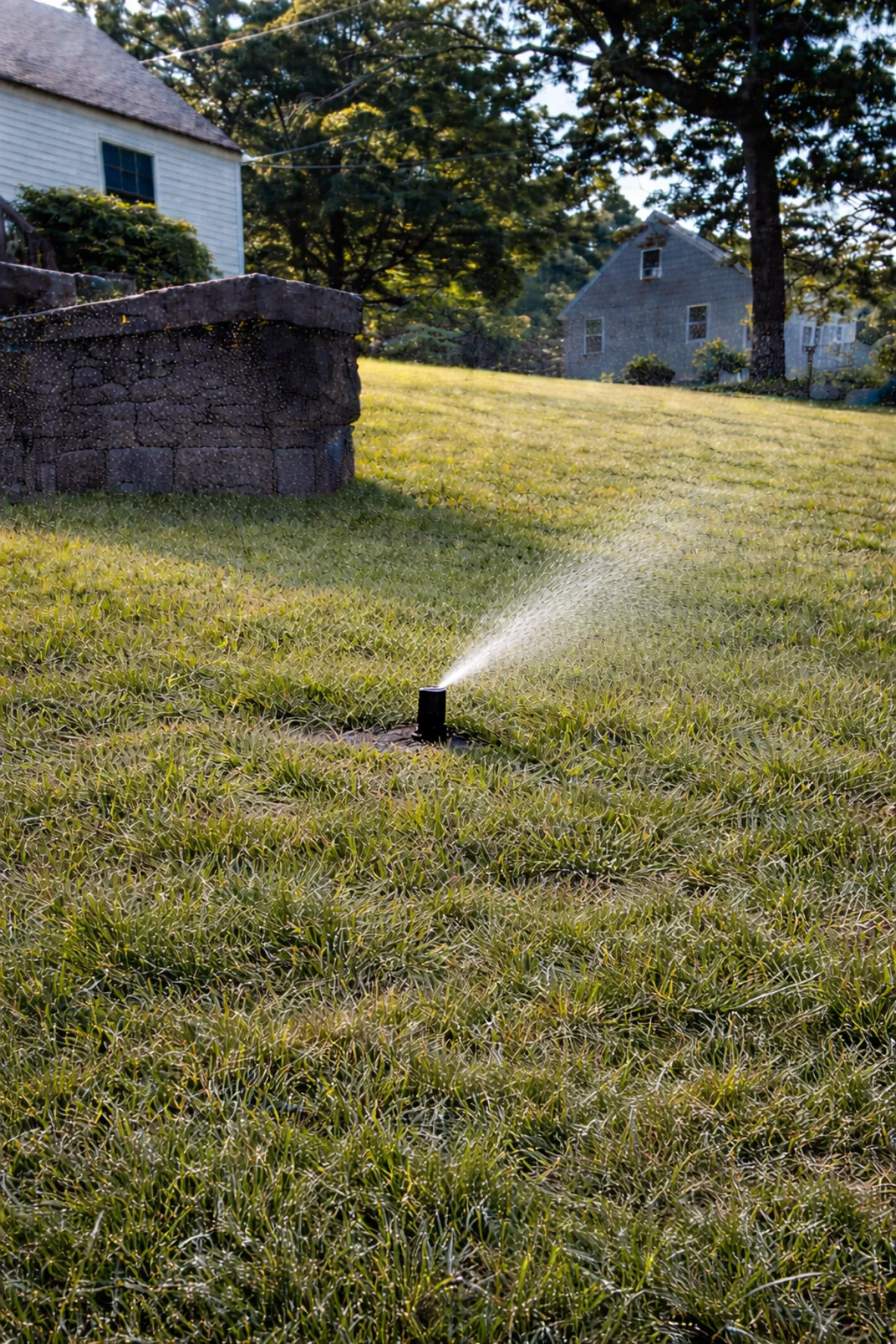
Brown patches in a Tewksbury lawn are the irrigation equivalent of a haircut your kid gave themselves with the kitchen scissors. The damage is uneven, the cause is obvious to everyone except the person responsible, and watering more does not, in fact, help.
I get a version of this call about nine times out of ten between mid-June and August. "The system is on, the schedule didn't change, and the back half of the lawn looks like a parking lot." Almost every time, the answer for sprinkler repair in Tewksbury has nothing to do with how long the system runs. It has to do with the system itself — heads, valves, nozzles, the iron sludge you can't see — and a couple of Tewksbury-specific conditions that quietly age these things faster than you'd expect.
TL;DR: Most Tewksbury brown spots are coverage problems, not watering-volume problems. Iron-rich town water and sandy glacial soil make small failures show up faster here than in the next town over. Repairs land between $75 and $600, single visit, parts on the truck.
What you're actually working with in Tewksbury
Tewksbury has two conditions that quietly punish irrigation hardware on a schedule most homeowners don't notice until the damage shows up topside:
Sandy glacial outwash. A lot of the residential stock — those 1970s ranches and split-levels along Route 38, the Whipple Road neighborhoods, the postwar builds near Trull Brook — sits on fast-draining sandy soil. Water moves straight past the root zone before turf can absorb it. Heads have to compensate with cycle-and-soak scheduling (three short cycles, not one long one), and a single misaligned head leaves a much more visible dry patch than the same misalignment would on clay.
Iron-rich town water. Tewksbury's municipal supply carries enough iron that it stains driveways orange, builds up inside nozzle orifices, and slowly chokes off pop-up spray patterns. We have systems in the Heath Brook area where a head was throwing a 12-foot radius in May and barely reaching 6 feet by August — same hardware, same line pressure, just iron sludge accumulating where you can't see it. That's not the system "failing." That's the system doing exactly what untreated iron water makes it do.
If your contractor in 2008 didn't put a stainless mesh filter on the supply, the system has been eating iron for 18 years. (Which sounds like the title of a folk album, but is in fact what's happening behind that valve box.)
Three things that go wrong, ranked by how often we see them
1. Heads tilted by frost heave
Tewksbury winters move sandy soil more than people realize. Freeze, expand, settle, repeat — and over 15 winters, a head that was installed perfectly vertical in 2009 is now tilted 10 or 15 degrees off plumb. Doesn't sound like much. Except a rotor that should be covering 30 feet in a 90° arc is now throwing 40% of its water sideways into the driveway (where it does roughly nothing for the lawn and slowly stains the apron orange).
Telltale sign: the brown patch is shaped like a wedge, with the narrow end pointing at a head.
Fix: Pull the head, reset on a compacted gravel collar, re-level. About $75–$120 per head. Five or six tilted heads in one zone gets discounted by the visit; we'd rather do them all than come back next month.
2. Iron-clogged nozzles
The orifice on a pop-up spray nozzle is roughly the diameter of a coffee stir stick. The orifice on a drip emitter is a quarter of that. Tewksbury iron content closes both, slowly, from the inside. By August of year three with no filter, the nozzles closest to the manifold are still throwing water and the ones at the end of the zone are misting like a half-asleep humidifier.
Telltale sign: even coverage near the valve, weak coverage at the far end of the same zone.
Fix: Pull the nozzles, soak in a mineral-dissolving solution, replace any that are too far gone (about $5–$8 in parts each, $75–$120 labor for the zone). Install a 150-mesh stainless inline filter at the backflow — $15–$25 in parts, cuts re-clog rate by roughly 70%. The single highest-ROI add-on we install in this town.
3. Valve diaphragms past their service life
The valve diaphragm is a piece of rubber inside each zone valve that opens and closes when the controller sends 24 volts to the solenoid. After 12–15 years of cycling, the rubber hardens, develops micro-tears, or accumulates enough mineral scale (see: Tewksbury iron) that it doesn't seal anymore. Two failure modes:
- Won't fully close → zone leaks continuously, lawn over that valve is suspiciously green, water bill climbs about $40–$60 a month.
- Won't fully open → zone runs at 60% of normal pressure, far heads underperform, brown patches develop.
Fix: Diaphragm kit is $10–$15 in parts, rebuild is $95–$175 depending on how badly the valve box flooded over the winter. Full valve body replacement runs $125–$250 if the body itself is shot. We can usually tell which one you need with the lid off and a flashlight.
The thing that makes Tewksbury brown spots worse every single time
Here's the part nobody wants to hear: watering more makes coverage problems worse.
If a head is tilted, broken, clogged, or fighting a sluggish valve, the area inside its intended pattern is dry no matter how long you run the zone. Extending run time floods the areas that are getting covered — which is great for fungal disease (dollar spot, brown patch, the lawn ailments that look exactly like drought damage but are actually overwatering damage). Now you have a dry spot and a fungus spot, both turning brown, both looking like the same problem.
The fix is always the same sequence: diagnose the mechanical failure → fix it → then re-evaluate the schedule. Never reverse the order. (I have made this speech, by my count, somewhere north of two thousand times in the last 25 years. My apprentice mouths along now.)
What you can check yourself before calling anyone
Most diagnostic information is visible from your back step with a coffee. Run each zone manually from the controller for two minutes and walk it:
- Is every head popping up fully? Half-risen heads are failing.
- Is every rotor completing a full arc, or does any one stop or reverse prematurely?
- Are any heads geysering from the base? (That's a cracked casing — frost did it.)
- Do the last two or three heads in a zone look noticeably weaker than the first two? That's iron or pressure drop.
If you see one specific head behaving badly, mark it (a popsicle stick, a piece of flagging tape, a phone photo with a landmark). If a whole zone looks underpowered, the valve or the lateral line is the suspect, not the heads.
About a third of the "broken system" calls I get dissolve in 10 minutes with the homeowner doing exactly this walk. Which is fine — I'd rather you save a service call than feel like we drove out for nothing.
When not to call EMI
I'll talk you out of a service call if I can. A short list:
- A single head misting sideways and you have a Phillips screwdriver. Pull the cap, clean the filter screen, reset the arc. 90 seconds, zero dollars.
- The controller display is dark. Check the 9V backup battery in the back of the unit and the GFCI in the garage. Free fix in ~40% of these calls.
- The rain sensor light is solid red. It rained last night. The system is doing exactly what the sensor is paid to do. Wait a day.
- A zone won't turn on and the controller LED says "fault." It might just be a tripped solenoid breaker on the controller itself. Power cycle once before calling.
If any of those don't resolve it — fair enough, call us. But check them first. The truck doesn't need the trip and you don't need the bill.
What it actually costs (no "starting at" nonsense)
Honest numbers for Tewksbury repairs in 2026:
| Repair | Range |
|---|---|
| Single head replacement | $75–$150 |
| Head raise / re-level (frost heave) | $75–$120 |
| Nozzle cleaning + zone walk | $75–$120 |
| Stainless inline filter install (iron defense) | $50–$95 add-on |
| Valve diaphragm rebuild | $95–$175 |
| Valve replacement | $125–$250 |
| Lateral pipe repair (6–12") | $150–$350 |
| Wiring fault locate + splice | $100–$300 |
| Full system audit | $95 (credited toward repairs) |
EMI members get 10% off parts and repairs, plus priority scheduling when the phone backs up in late July (which it will). One-year membership is $410 and covers spring start-up, mid-season check, winterization, and a service call — for any system over 10 years old, that math is already in your favor.
A practical Tewksbury walk-through
If your lawn has brown patches and you want to think about it like Nick would before picking up the phone:
- Run each zone for 2 minutes from the controller while you walk it. Note any head behaving badly.
- Match the brown patches to the suspect heads. If a brown patch sits inside a zone where one head is tilted or one rotor stops short, you've found your problem.
- Check whether the brown patch is shaped like a wedge (pointing at a head — usually tilt or partial blockage) or a circle (pointing at the soil itself — usually a buried lateral leak putting too much water below grade).
- If the entire zone looks weaker than its neighbors, the valve or a lateral break is the suspect, not the heads.
- Don't add run time. It doesn't fix mechanical failures, and it makes the green areas susceptible to brown patch fungus (which, ironically, looks just like drought damage). Sequence matters: fix → re-evaluate → adjust.
We work this town a lot
EMI Irrigation has been servicing Tewksbury systems for 25 years. We know the Route 38 ranches with the builder-grade Hunter ICC controllers from 2009. We know which Heath Brook and Long Pond properties sit on iron-heavy supply lines and need a filter on every install. We know the Whipple Road colonials with mature oaks and the lateral lines that need root-tolerant repairs every five or six years.
If you're in Tewksbury and the lawn is browning at the same time the water bill is climbing, that's the problem to look at first. If you're seeing the same thing in Chelmsford, where the brown-spot story is mostly soil-driven, the diagnosis is different — same symptom, different cause. And for the Burlington 2000s-build systems aging into their second decade, the diagnostic pattern overlaps but the water authority's different.
For Tewksbury specifically, the most common service path is: 30-minute system audit, head-and-nozzle pass, optional iron filter install, done in one visit. Most of those land in the $150–$400 total range. We bring the parts on the truck.
Ready to get your system handled? Call EMI Irrigation at 781-983-3739 or book online. Honest numbers, decent jokes, and a truck that's usually in your driveway before the second cup of coffee.
You can also check the Tewksbury DPW water page before calling — sometimes the answer to "why does my lawn look like this" is "the town declared a Stage 2 restriction last Tuesday and your timer doesn't know yet." (Which is its own conversation. We can have it on the driveway.)
Straight answers
Q: How much does sprinkler repair cost in Tewksbury? A: Most repairs land between $75 and $600. A single head swap is $75–$150. A valve rebuild is $95–$175. A mainline repair runs $150–$350. We quote the exact number before any work starts, so there's no surprise on the invoice.
Q: Why do my sprinkler heads keep clogging in Tewksbury? A: Iron in the town water supply. The supply carries enough iron to slowly choke the inside of nozzle orifices over a couple of seasons. A 150-mesh stainless inline filter at the backflow ($50–$95 installed) cuts the re-clog rate by about 70%. We install one on every Tewksbury system that doesn't already have one.
Q: My system was installed in the early 2000s. Is it still worth repairing or should I replace it? A: Almost always still worth repairing. The mainline PVC and the buried zone manifold are usually fine for 30+ years. What ages out at 15–20 years is the surface stuff — heads, nozzles, valve diaphragms, the controller in the garage. Targeted repairs typically land between $200 and $800. A full replacement is $4,500–$8,000 and rarely necessary for systems that age normally.
Q: How quickly can EMI get to a Tewksbury repair call? A: 3–5 business days in peak season (June through August). Active leaks or zones that won't shut off get priority and usually next-business-day. Call 781-983-3739 and describe what's happening — that way we bring the right parts on the first trip.
Q: One zone in my Tewksbury system won't shut off. What do I do right now? A: Shut off the mainline supply at the backflow preventer. (The valve handle right before the device, usually on the outside of the foundation.) That stops water flow while you wait for service. Then call us. A stuck-open diaphragm valve is almost always rebuildable, $95–$175.
Q: Why does the lawn near my driveway have orange stains? A: That's iron from the town water, deposited every time a head sprays toward concrete. We move heads 6–8 inches back from hardscape and install iron-resistant nozzles on every Tewksbury job. If you've already got the stains, the system itself is the source — not the lawn, not the soil, not the contractor who installed it. Just chemistry.
If your Tewksbury system is doing things it didn't do last summer and you'd rather not spend July diagnosing it from the back step, give us a call at 781-983-3739. We'll show up, we'll figure out what's actually wrong, and we'll probably tell you a terrible joke about glacial till on the way out. Consider that a bonus, not a warning.
Ready to get your system handled?
EMI Irrigation — family-owned, serving the greater Billerica area and Southern NH.