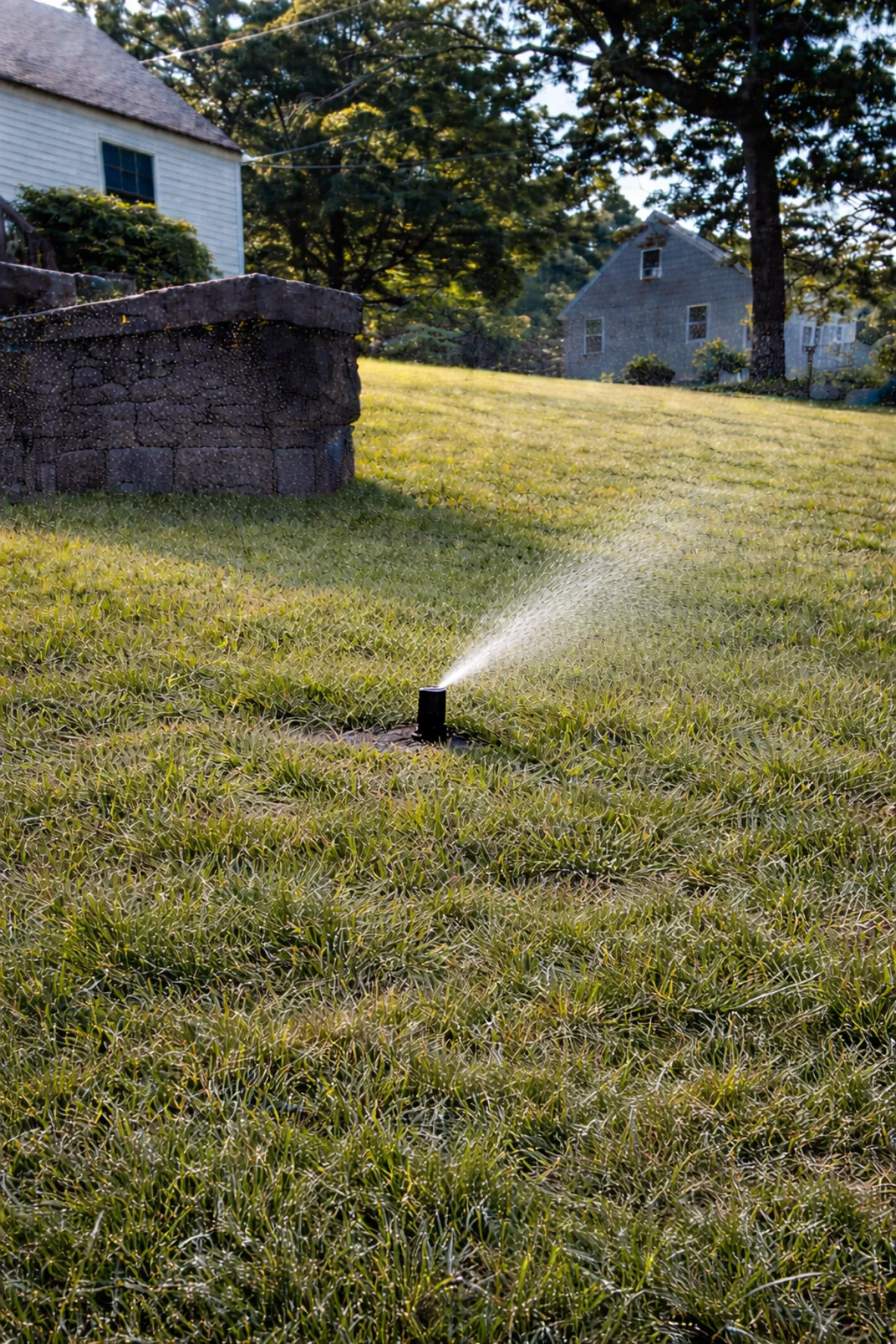
Your Lexington Water Bill Spiked. Your Timer Is Probably Also the Reason You're Violating Watering Restrictions
Your Lexington Water Bill Spiked. Your Timer Is Probably Also the Reason You're Violating Watering Restrictions
Somewhere in Lexington right now, a homeowner is staring at a water bill that looks like a typo and mentally rehearsing the call to report a leak. Before you make that call, I want you to do some third-grade math instead. It'll take four minutes and it might save you the diagnostic fee (and possibly a violation notice you didn't know you'd earned).
TL;DR: In Lexington, a spiked water bill and a watering-restriction violation are very often the same problem wearing two hats. The usual cause is a fixed-schedule controller — set once, years ago — running long enough that it both burns extra water and rolls past the 9 AM cutoff without anyone noticing. Fix the schedule, fix both problems. Here's how to check it yourself before you call anyone.
Why Lexington feels a bill spike harder than the next town over
Lexington doesn't pull water from a well in someone's backyard or a small local reservoir the DPW manages on its own terms. Lexington is MWRA-fed — water comes down through the Cosgrove Tunnel from the Wachusett Reservoir, same as Boston and dozens of other communities on that system. That's genuinely good news for supply reliability. It is less good news for your quarterly bill.
MWRA-supplied towns tend to run some of the higher water and sewer rates in the state, because you're paying into a large shared system, not a small local one with lower overhead. That's not a criticism of the DPW. It's just math. And it means the exact same irrigation habits that would barely register on a well-water town's bill land differently in Lexington. Run a zone ten extra minutes a day in a town on a flat-rate well and nobody notices. Do the same thing here and it shows up in a number that makes you sit down.
So when the bill spikes, the instinct is "there's a leak somewhere." Sometimes there is — that's a real thing, and if you want the full walkthrough on finding one, I wrote up sprinkler system leak detection for exactly that scenario. But more often, in Lexington specifically, the answer isn't underground. It's in the little grey box in your garage.
The math your controller is quietly failing
Here's the thing about old timers: they're not broken. They're doing exactly what they were told to do, back when someone told them to do it. The problem is nobody's gone back and checked the math since.
Lexington's restrictions include a mandatory no-watering window from 9 AM to 5 PM, on top of odd/even day rules. Most original installation schedules were programmed for an early morning start — 6, 6:30, 7 AM — which sounds compliant on its face. Early start, no problem, right?
Except a start time isn't the whole story. It's the start time plus every zone's run time stacked on top of it. Say you've got 10 zones at 12 minutes each. A 7:00 AM start means zone 1 finishes at 7:12, zone 2 starts then and finishes at 7:24, and so on down the line. By the time you get to zone 6, you're starting at 9:00 AM on the nose. Zone 7 through 10 are running well into the blackout window — every restricted day, all summer, while the homeowner is confident they're compliant because they "start early."
I looked at a system in Lexington this spring that was doing exactly this. Nice property, mature landscaping, 11 zones, controller original to the install. Owner was positive they were fine because the system "starts before I leave for work." It started at 6:45. It finished at 9:20. Every zone after number 7 was a violation, every single restricted morning, for years, and the only reason anyone caught it was a neighbor mentioning a DPW notice at a block party. Nobody was cutting corners. The schedule was just never rebuilt after the zones got added.
This is the part that actually connects to your bill: a controller that doesn't know it's overrunning the compliance window usually doesn't know much else either — like whether it rained last night, or whether June was unusually cool and the lawn needed less, not more. It's not adjusting for anything. It's just running the same total minutes it was told to run in whatever year someone last stood in the garage with a manual.
Do the same math on your own system
Before you call anyone, or blame a leak, do this:
- Write down your controller's start time and every zone's run time, in order. Not from memory — actually open the program menu.
- Add them up, zone by zone, like you're building a timeline. Start time, plus zone 1's minutes, plus zone 2's minutes, and so on.
- Check where that timeline crosses 9:00 AM. If any zone is still running after that point, you have a restriction violation baked into your everyday schedule — not a one-time mistake, a standing one.
- Check your watering days against the current odd/even rule. A fixed weekday schedule (Mondays, Wednesdays, Fridays, say) doesn't track a date-based rule at all. It's coincidence when it lines up.
If your system clears both checks, good — genuinely, that's not nothing, and if the bill is still high, a leak or a valve issue is a more likely next suspect (see the leak detection guide above). If it doesn't clear, you've found at least part of your bill spike, and you've found your restriction problem, in the same four minutes.
Why "just run it longer" makes the bill worse, not better
There's a common instinct once people realize the compliant window is tighter than they thought: compress the schedule to fit inside 6 to 9 AM, but keep the same total watering time by cranking up the minutes per zone. It feels like a fair trade. It isn't.
Extending run times doesn't push water deeper once the soil's taken what it can hold — it runs off toward the driveway, or it sits and invites fungus, or it just evaporates off the surface in the last few minutes anyway. You're not getting more water into the root zone. You're paying MWRA rates for water that's doing nothing but making your bill worse and your lawn no happier. (Your lawn, for the record, does not care how much you spent. It only cares whether the water got where it needed to go.)
The better move is smarter distribution, not more volume — matching the schedule to what the zone and the weather actually call for, inside the legal window, instead of trying to out-brute-force a shrinking one.
My one gripe with the "smart sensor" pitch
Here's my opinion, and it costs you nothing to hear it: a Wi-Fi weather lookup on a smart controller is not a substitute for a wired rain sensor mounted at the eave. It's a supplement. A good one. But not a replacement.
Massachusetts has required a physical rain sensor on all new residential irrigation systems since 2009. That's code, not a suggestion, and it exists because a weather API pulling data from the nearest station can miss a localized downpour that dumped an inch on your specific roof and none on the station six miles away. The wired sensor catches what actually fell on your house. The app is guessing, intelligently, from a distance.
Run both together and you've got the real Lexington combination: a controller that respects your restriction schedule and adjusts for regional weather trends, plus a sensor that catches the rain that actually landed on your lawn. That's the setup that keeps you both compliant and off the "why is my bill so high" list. Either piece alone leaves a gap.
When you don't need to call us
If your math above came back clean — compliant window, correct days, and the bill spike showed up in a single billing cycle with no gradual buildup — don't call us yet. Check for the obvious first: a hose left cracked open, a leaking outdoor spigot, a pool that got topped off that quarter. None of that is an irrigation problem, and I'd rather you save the $95 diagnostic for something that's actually ours to fix.
If the math came back messy — zones running past 9 AM, days that don't match the current restriction, or a bill that's been climbing steadily over a season with no obvious explanation — that's when it's worth a look. We'll run a system audit for $95, credited toward any repair, and tell you honestly whether you're looking at a schedule fix or something actually broken underground.
What it typically costs to fix
| Fix | Typical cost | Notes |
|---|---|---|
| Rebuild your own schedule (DIY) | $0 | Just needs the math above and 15 minutes with the manual |
| Full diagnostic / system audit | $95 | Credited toward repairs if you proceed |
| Mid-season system check | $95–$125 | ~45 minute visit, catches schedule and hardware issues |
| Rain sensor test/replace | Included in check | Wired sensor, mounted at the eave |
| Smart controller upgrade, installed | $200–$500 | 60–90 min, existing wiring, Hydrawise/Rachio/ESP-TM2 |
| 1-Year Membership | $410 member / $600 regular | Start-up, mid-season check, winterization, 1 free-hour service call, 10% off parts |
Straight answers
Why is my water bill so high in Lexington compared to other towns? Because Lexington is MWRA-fed, not on a well or small local system, and MWRA-supplied towns tend to carry higher water and sewer rates. The same waste that's minor elsewhere shows up bigger here.
How do I know if my system runs past the 9 AM cutoff? Add your start time to every zone's run time, in order. If the running total crosses 9 AM before your last zone, you're in violation on every restricted day, even with an early start.
Will longer run times fix my lawn and justify the extra cost? No. Once soil is saturated, extra minutes run off or evaporate instead of soaking deeper. You pay more and the lawn sees no benefit.
Is a Wi-Fi rain lookup the same as a rain sensor? No. Massachusetts has required a physical rain sensor since 2009. The Wi-Fi lookup is a smart supplement, not a substitute for the wired sensor at your eave.
Does a smart controller solve both the bill and the compliance problem? Yes, when it's programmed with your restriction schedule and paired with a working rain sensor. That combination is what actually closes both gaps at once.
For more on how Lexington's restrictions work day to day, I covered the rules themselves in Lexington's watering restrictions in full — this post is about what happens when the old equipment quietly breaks both the rules and your budget at the same time. And if you want the statewide version of the restriction picture, Massachusetts watering restrictions has that. For general background on how these controllers work across our whole service area, see smart sprinkler controller. You can also check MWRA water conservation and MassDEP water conservation directly, or the Town of Lexington site for the current restriction status.
Do the four-minute math on your own controller before you assume the worst. If it checks out, good, you saved yourself a truck visit. If it doesn't, book online or call 781-983-3739 — we'll get your schedule and your bill talking to each other again.
Ready to get your system handled?
EMI Irrigation — family-owned, serving the greater Billerica area and Southern NH.