Drip Irrigation vs. Sprinkler System: When Each One Actually Earns Its Keep
Drip Irrigation vs. Sprinkler System: When Each One Actually Earns Its Keep
People ask me which is better, drip or spray, like they're picking a truck. Wrong question. It's not "which is better" — it's "which job is this for." A spray head watering your lawn and a drip line watering your hostas are doing completely different jobs, and asking one to do the other's work is how you end up with a soggy foundation bed and a lawn that's somehow still thirsty.
TL;DR: Spray heads are the right call for turf — you can't practically drip-irrigate a whole lawn. Drip is the right call for garden beds, foundation plantings, and anything that isn't grass, because it puts water at the root with almost no evaporation loss. Most Middlesex County yards do best with both running as a hybrid system, not one replacing the other. Converting beds to drip typically runs $500-$1,500 per garden zone and cuts water use in those beds by 30-50% on sandy soil.
What each one is actually built to do
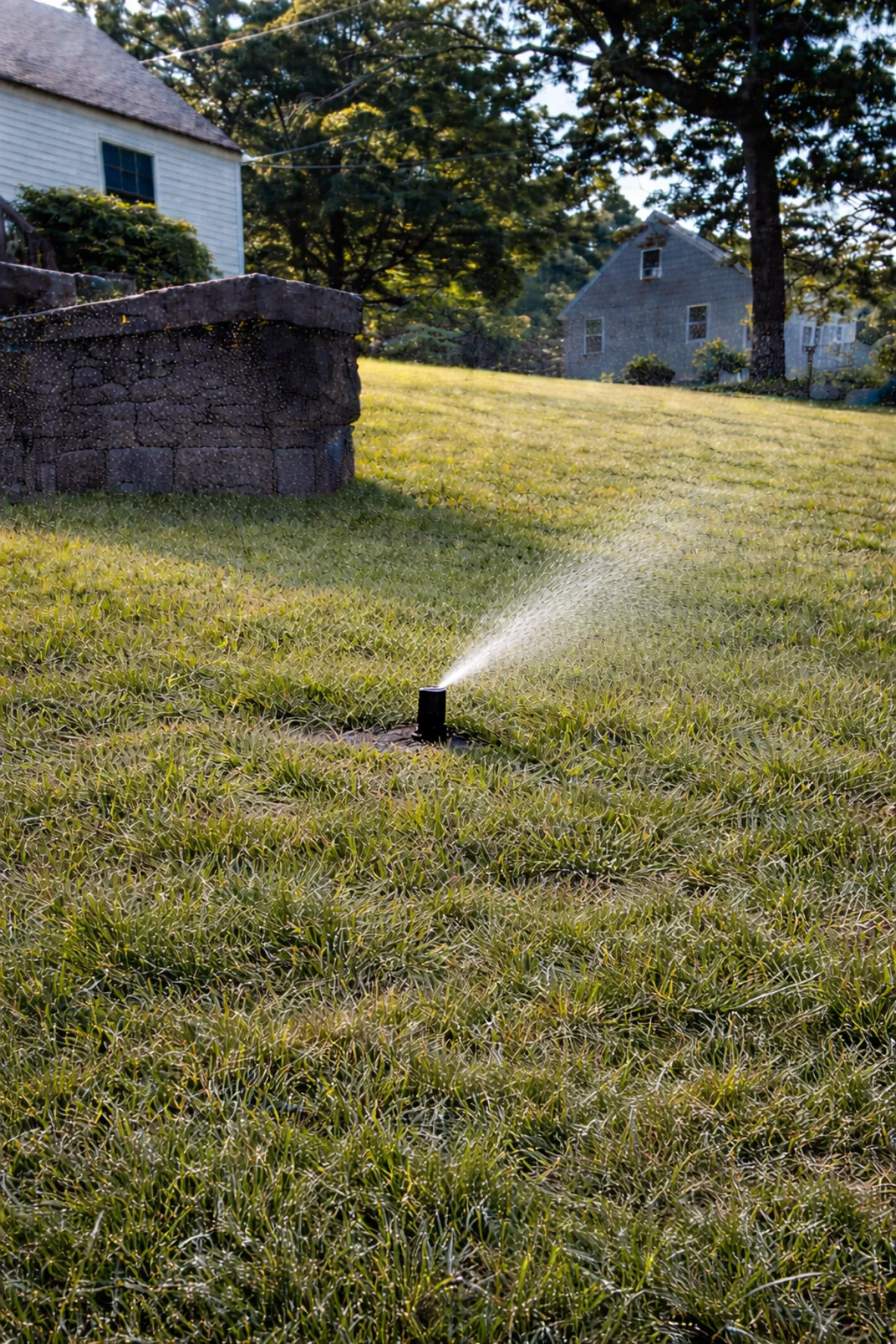
A spray or rotor head is built to cover area. It's throwing water across a defined radius — a lawn, mostly — and it's good at that job specifically because grass has roots spread evenly across the whole surface. Overspray isn't ideal, but grass is forgiving of a little imprecision, and there's no practical way to hand-place water to every blade individually. Spray heads are the right tool because the target (a big flat area of uniform plant) matches what a spray head is good at (covering a big flat area).
Drip is built for precision, not coverage. It's a network of tubing with small emitters that put water exactly at a plant's root zone, drop by drop, at low pressure, with almost no evaporation and almost no runoff. That's exactly wrong for a lawn — you'd need thousands of emitter points and it would take forever to install and maintain. It's exactly right for garden beds, foundation plantings, and anything arranged as individual plants rather than a continuous mat of turf.
Comparing them head to head, as if one wins, misses that they're not competing. They're a socket wrench and a hammer. Ask me which one's better and I'll ask what you're trying to fix (my apprentice has heard this speech enough times he mouths along now).
Where spray heads lose the argument (and why it's not their fault)
Spray heads waste water in three specific, predictable ways: evaporation (water thrown in the air on a hot day loses a real percentage before it hits the ground), wind drift (a 10 mph breeze walks a spray pattern sideways, often onto driveway, mulch, or siding instead of soil), and overspray (a zone designed to cover a lawn edge inevitably throws some water past that edge, onto beds that didn't need a lawn-volume soak).
None of that is a design flaw. It's the tradeoff you accept for being able to water a few thousand square feet of turf in ten minutes instead of hand-watering it. But when that same spray zone is also covering the garden bed along the foundation, the bed gets the same volume and timing as the lawn, whether or not that's what the plants in it actually need. Most beds end up overwatered on the schedule and underwatered at the root, because surface water from a spray head doesn't reliably reach four to six inches down where the actual root mass is.
Where drip earns its keep
Convert that same bed to drip and two things change immediately. First, the water goes where the plant needs it — at the root, slowly, over a longer run time, so it actually soaks in instead of running off. Second, you stop paying for water that lands on mulch, driveway, or bare soil between plants, which on a spray zone is often a third or more of what that zone throws.
On sandy Middlesex County soil specifically, that adds up to a 30-50% cut in water use for the converted beds. Sandy soil drains fast, so surface water from a spray head barely has time to reach the root zone before it's gone — drip's slow, direct delivery is a much better match for how quickly sandy ground moves water through it.
Why builder-grade systems get this wrong by default
Here's my one strong opinion on this, and it's not really about drip — it's about how builder-installed systems from the 2000s handled beds in the first place. Framers running irrigation on a construction schedule, not irrigation specialists designing for the long term, typically ran one spray zone to cover both the lawn edge and the adjacent foundation bed, because running a separate drip line was slower and the schedule didn't have slower in it. Fast to install. Wrong for fifteen years running.
We find this constantly on 2000s-era Middlesex County systems: the foundation bed along the front of the house has been getting lawn-volume spray for a decade and a half, and it shows — either the bed's chronically soggy near the foundation (not great for the foundation, for what it's worth, and definitely not something your hostas signed up for) or the plants are stressed at the root despite looking wet on the surface after every cycle. Converting just that one zone to drip is one of the highest-value retrofits you can do on an aging system, and it's usually a $500-$1,500 job, not a full system overhaul.
The Tewksbury wrinkle — why drip needs a filter some places and not others
Not every drip conversion is identical. Tewksbury and other iron-heavy towns need a 150-mesh filter and pressure regulator on every drip line, no exceptions, because the iron in the town water will clog drip emitters — which have much smaller openings than a spray nozzle — far faster than it fouls a spray head. We install that filter as standard on every drip system in those towns, not as an upsell. Skip it on iron water and you're looking at clogged emitters within a season instead of several years.
Maintenance on any drip system is flushing the end caps every 4-6 weeks during the season and an acid flush twice a year. It's a different maintenance list than a spray system's nozzle cleaning and arc checks — not necessarily a longer one, just a different one.
How to decide, zone by zone
Walk the property and sort what you're looking at into three buckets before you call anyone.
Straightforward drip candidates: foundation beds, mulched borders, anything planted as individual shrubs or perennials rather than a continuous mat of turf. If a zone is currently on spray and it's watering a bed like this, converting is almost always worth it.
Straightforward spray candidates: actual lawn, full stop. There's no practical way to hand-run drip lines across a few thousand square feet of turf, and grass doesn't need drip's precision anyway — its roots are spread evenly enough that broad coverage does the job.
The judgment calls: small beds under 100 square feet, mixed zones where a bed and a lawn edge share one valve, and anything where the conversion labor might cost more than several seasons of water savings would return. These are worth a real look instead of a guess — we'll tell you honestly if a zone's too small to bother converting.
What spray zones do to the stuff around the beds, not just the beds
There's a side effect of lawn-volume spray hitting a garden bed that doesn't show up in a water-savings percentage: overspray lands on mulch, driveway, and siding just as often as it lands on the plant it's meant for. That's water you're paying for that never touched a root, plus it's the reason mulch near a spray zone breaks down and washes toward the lawn faster than mulch fed by drip, and it's a chunk of why foundation beds on old spray zones look scraggly no matter how often you water them. Converting doesn't just save water — it stops feeding the driveway and the mulch bed's edge instead of the plant.
When drip isn't worth it
If your beds are small — a few foundation shrubs, not a real garden — the labor to run dedicated drip lines can cost more than the water you'd save over several seasons. For a bed under 100 square feet, sometimes the honest answer is: leave it on spray, or hand-water it, and put the drip budget toward a bed that's actually big enough to earn back the conversion cost.
And if you're chasing drip purely for the water-bill number without actually having non-turf beds to convert, you're solving the wrong problem — you can't meaningfully drip-irrigate a lawn, so if your water bill issue is coming from turf, look at pressure and coverage first, not a drip conversion.
What it costs
| Situation | Typical cost | Notes |
|---|---|---|
| Drip conversion, per garden zone | $500-$1,500 | Depends on bed size and layout |
| Pressure regulator + 150-mesh filter | included | Mandatory in iron-heavy towns like Tewksbury |
| Ongoing maintenance | flush every 4-6 weeks + acid flush 2x/season | Different chore list than spray, not necessarily longer |
| Water savings on converted beds, sandy soil | 30-50% | Bed-specific, not whole-system |
| Full diagnostic if unsure which zones make sense | $95 | Credited toward the conversion if you move forward |
Straight answers
Is drip irrigation better than a sprinkler system? Neither wins outright — drip is better for beds, spray is better for turf. Most yards need both.
How much can I actually save? 30-50% on the beds you convert, on typical sandy Middlesex County soil. That's a bed-specific number, not a whole-system number.
What does a conversion cost? $500-$1,500 per garden zone, filter and pressure regulator included where the town's water requires it.
Should I convert my whole yard to drip? No — turf still needs spray heads. The right move for most properties is a hybrid: spray for lawn, drip for beds.
If a foundation bed's been getting lawn-volume spray since your system went in, that's usually the easiest conversion on the property to justify — your hostas will stop looking personally offended by August. Call 781-983-3739 or book online and we'll tell you honestly which zones are actually worth converting and which aren't. For the cost side of a full drip retrofit, see our drip irrigation cost guide, and for the spray-side maintenance this comparison assumes, our guides on sprinkler low pressure and sprinkler zone not working cover the usual culprits. If you haven't had a mid-season look at the rest of the system, here's what that catches. For water-use guidance behind the numbers here, see the EPA WaterSense program and UMass Extension's guidance on drip irrigation.
Ready to get your system handled?
EMI Irrigation — family-owned, serving the greater Billerica area and Southern NH.